Google
Web Dreamtime
SiteSearch Google
Showing posts with label Chronicles. Show all posts

Monday, March 15, 2010

A Wink Or a Nod from an Unexpected Place

A reblast from the past in honor of the Gorgeous One's induction into the 2010 Wrestling Hall of Fame.


Direct link to mp3.

Subscribe to the Dreamtime podcast


Use the Dreamtime Player


"... all it takes is a wink or a nod from some unexpected place to vary the tedium of a baffling existence.

That happened to me when Gorgeous George the great wrestler came to my hometown. In the mid-50s, I was performing in the lobby of the National Guard Armory, the Veterans Memorial Building, the site where all the big shows happened - the livestock shows and hockey games, circuses and boxing shows, traveling preacher revivals, country-and-western jamborees.


Once a year or so, Gorgeous George would bring his whole troupe of performers to town: Goliath, The Vampire, The Twister, The Strangler, The Bone Crusher, The Holy Terror, midget wrestlers, a couple of lady wrestlers, and a whole lot more.

I was playing on a makeshift platform in the lobby of the building with the usual wild activity of people milling about, and no one was paying much attention. Suddenly the doors burst open and in came Gorgeous George himself. He roared in like the storm, didn't go through the backstage area, he came right through the lobby of the building and he seemed like forty men. It was Gorgeous George, in all his magnificent glory with all the lightning and vitality you'd expect. He had valets and was surrounded by women carrying roses, wore a majestic fur-lined gold cape and his long blond curls were flowing. He brushed by the makeshift stage and glanced towards the sound of the music. He didn't break stride, but he looked at me, eyes flashing with moonshine. He winked and seemed to mouth the phrase 'You're making it come alive.'"
"I am the Greatest Wrestler in the World!"

During the peak of his career, Gorgeous George's fame was comparable to that of Muhammad Ali's - whose public persona had more than a little of Gorgeous George in it. During the early part of his career, when he was still known as Cassius Clay, Ali was promoting his latest fight on a Las Vegas radio show. Also appearing was Gorgeous George, who was talking up his own fight and who worked himself into a frenzy describing the hurt he planned for opponent,
"If this bum beats me, I’ll crawl down Las Vegas Boulevard on my hands and knees. But it won’t happen. I’ll tear his arm off. For I am the greatest wrestler in the world!"
Like the young Dylan, the young Ali was entranced by George's rhetoric, and became even more enthusiastic when he discovered that George regularly sold out wherever he appeared. Taking up George's invitation, Ali went to see his match and, as he later remembered, "I saw 15,000 people coming to see this man get beat, and his talking did it. I said, 'This is a g-o-o-o-d idea!'"

Gorgeous George's influence can also be seen in Little Richard, James Brown, and Liberace, as well as nearly every other sports or entertainment figure - such as Elton John - who ever adopted a flamboyant, outrageous style.

Gorgeous George was born George Wagner in Seward, Nebraska on March 15, 1915. He began his wrestling career during his teens - often competing at local carnivals, where the prize purse averaged 35 cents. By age 17, George was getting bookings through the area's top promoter. At 5'9' and 215 pounds, Wagner was not all that an imposing a figure, but he developed a reputation as a solid wrestler, and by the late `30s he had legitimately captured two regional titles.

He also met his first wife, Betty Hanson, who George subsequently married in an in-ring ceremony. That turned out to be so popular that the couple incorporated the wedding into their tour and would re-enact it in arenas throughout the U.S. Seeing how show biz elements helped draw crowds may have started George thinking about developing a more memorable shtick than simply straight wrestling. At least one report has it that he got the idea for an effeminate, dandy villain wrestler after reading an article about a now-forgotten contemporary who wrestled under the name Lord Patrick Lansdowne, and who would appear at bouts as a British Lord attended by a valet.

The Human Orchid

Also known as "The Human Orchid," George debuted his new persona in 19 and 41 in Eugene, Oregon, and was instantly slapped with the title "Gorgeous George" by a bemused ring announcer. George rapidly became the villain crowds loved to hate. One of the first wrestlers to use the type of flamboyant entrance now common in pro wrestling matches, George would arrive to the strains of Pomp and Circumstance, escorted down a personal red carpet by his ring valet “Jeffries,” who would carry a silver mirror for George to gaze upon as rose petals were strewn at his feet.

These entrances often took longer than the actual bout, as George still had to exchange taunts with the crowd, have Jeffries spray the ring and unwilling opponent with disinfectant which George claimed was "Chanel #10." The show would culminate in George's refusal to let the referee inspect him for foreign objects unless he was also doused by Jeffries while George shrieked in horror, "Keep your filthy hands off me!"

Eventually the match would begin, and George would brazenly ignore the rules while chanting his motto to the audience: "Win if you can, lose if you must, but always cheat!"

It was an outrageous, larger-than-life act, tailor-made for the new medium, television. Gorgeous George would become the biggest drawing card of the wrestling industry, as well as one of its first genuine stars. It's been claimed that Gorgeous George was responsible for selling as many TV sets as Milton Berle, Mr. Television, himself.

By the '50s, Gorgeous George was earning over $100,000 a year, making him that decade's highest paid athlete. His most famous match would take place in 1959 before 14,000 fans and millions of television viewers where he would be defeated by longtime rival "Whipper" Billy Watson and would lose his treasured platinum locks to the Whipper's razor.

Although he would wrestle for three more years, and in fact, knowing a good crowd-pleaser when he saw one, would lose his hair to an opponent's razor twice more in those three years, age and a tough lifestyle eventually caught up with the Gorgeous One. George retired in 1962, bought into a turkey ranch and opened a cocktail lounge in Van Nuys, California, "Gorgeous George's Ringside Restaurant," where he would entertain customers with card tricks.

Our Daddy, Gorgeous George

Gorgeous George passed away on December 26, 1963 at age 48. Although he had made millions during his wrestling career and for a time was probably the most recognizable entertainer on the planet, Gorgeous George would die broke. He was buried at Valhalla Memorial Park in North Hollywood, California, the final resting place for several other celebrities including Oliver Hardy; Curly Joe from The Three Stooges; and in a coincidental Dreamtime connection, Cliff ("Ukulele Ike") Edwards, the voice of Jiminy Cricket, who also died penniless.

Gorgeous George's grave can be found in plot 6657, near the northeast side of the fountain. A plaque reads "Love to Our Daddy Gorgeous George."

Audio excerpt from Chronicles: Volume One, read by Sean Penn.

***

You've been listening to the Dreamtime podcast – occasional commentary on Bob Dylan's Theme Time Radio Hour.

Dreamtime is researched and written by Fred Bals and is a Not Associated With production. As the name says, we're not associated with XM Radio, Bob Dylan, or much of anything else.

Some of the music on Dreamtime is provided via the Podsafe Music Network. Check it out at music.podshow.com.

Remember that the Dreamtime team loves to get email. You can write us at dreamtimepodcast@gmail.com

The Dreamtime top cats are Curly Lasagna and Shaggy Bear. Our announcers are the notorious honky-tonkin' sisters, Jailbait and Joyride.

Until next time, dream well.

Wednesday, August 05, 2009

"The last time I saw Donald Armstrong" - The Bob Dylan/James Dickey Connection

I've been dipping into Chronicles: Volume One again while talking with Scott Warmuth over various discoveries we've made in the text. Scott, as you already know if you follow Dreamtime, found evidence that a 1961 issue of TIME magazine was the reference source for at least one section in Chronicles. During our correspondence Scott mentioned another discovery he had made, which I'll let him reveal publicly himself when he's ready. But his remark had me opening Chronicles again, and as I was skimming through the text, I stopped on what I always thought was one of the stranger passages in the book..

I gazed around the room, got up and nervously paced around a few times, watching the clock on the wall--it seemed to be running backwards.  I sat back down feeling lines plowing into my face and the whites of my eyes turning yellow. Al Kooper was clowning around, telling shaggy dog stories. I was listening to Daniels practicing scales on the fiddle, thumbing through some magazines that were left on the table, Collier's, Billboard, and Look magazine. Running across an article in Male magazine about a guy, James Lally, a radio man in World War II who had crashed with his pilot in the Philippines.  I got sidetracked for a second.  It was a gut crunching article, unfiltered.  Armstrong, the pilot, was killed in the crash, but Lally was taken prisoner by the Japanese, who took him to a camp and beheaded him with a samurai sword and then used his head for bayonet practice.  I pushed the magazine away.  Russ Kunkel, the drummer on the sessions, was siting on the couch was his eyes halfway shut, tapping two sticks together-- gazing through the glass darkly. I couldn't stop thinking about Lally and felt like moaning in the wind.~ Chronicles: Volume One, Pages 139-140
There's something weird - weird in the full Shakespearian sense - about this paragraph.  There's a thread of unspoken dread running throughout the passage that doesn't seem warranted. Dylan has "lines plowing into my face" and relates that the whites of his eyes are turning yellow.  The wall clock is running backwards. He feels like "moaning in the wind" and paraphrases 1 Corinthians 13:12, noting that drummer Russ Kunkel is "gazing through the glass darkly." All these allusions seem to make even less sense when read in context. Before and after the passage, Dylan is thinking about what was constantly on his mind; trying to figure out how to "freeze-frame" his image and "suggest only shadows of my possible self."  On a separate note, he's also deciding what to call the album which he would eventually title New Morning.

So what to make of the story of Lally and Armstrong that is the foundation of the passage? Are we to believe the article impressed Bob Dylan so much in 1970 that he introduced it as a strange non sequitur into Chronicles thirty years later?

You'd be unlikely to find a copy of Collier's in a 1970 recording studio, unless Bob Dylan brought it in himself.  The magazine stopped publishing in 19 and 57.  Leaving that aside, the other three magazines could have been on the table, including Male, a he-man "men's adventure" magazine specializing in lurid war tales and still being published into the `70s. It's also possible that there was an article about James Lally in some edition of Male, as his actual death at the hands of the Japaneses fit all the requirements for one of their patented stories, especially given the grisly details. According to one report Lally's body, as well as the body of the already deceased Armstrong, had been buried to their shoulders and their heads used for bayonet practice, as Dylan tells us the article relates. The war-crimes trial of Lally's executioners was also one of the first of its kind, making it even better fodder for a Male article.

Without an index of Male, we'll never know whether Dylan read the story in that magazine or not.  Perhaps the overall gruesomeness of Lally's death or some specific imagery caught his attention. Maybe it ended up in his commonplace book to be unearthed and used some three decades later when he was looking for some background material about the making of New Morning.

That's possible.  It's also possible that Dylan was well aware of another source reporting the death of Donald Armstrong, James Dickey's poem, "The Performance."
The last time I saw Donald Armstrong
He was staggering oddly off into the sun,
Going down, off the Philippine Islands.
I let my shovel fall, and put that hand
Above my eyes, and moved some way to one side
That his body might pass through the sun,

And I saw how well he was not
Standing there on his hands,
On his spindle-shanked forearms balanced,
Unbalanced, with his big feet looming and waving
In the great, untrustworthy air
He flew in each night, when it darkened. from "The Performance," 1959
 In March 1945, James Dickey had volunteered to become the historian for the 418th Air Squadron, and recorded the following on March 15th:
A most unexpected and tragic occurrence befell the Squadron when 2nd Lt. DONALD H. ARMSTRONG ... and his observer F/O JAMES J. LALLY ...high-speed-stalled close to the ground over the Jap strip at St. Jose,Panay, and crashed northwest of the field. ... [The plane] was found to be almost completely demolished except for a small portion of the crew nacelle. The entire Squadron awaited apprehensively the guerrilla radio operating near San Jose, for the plane had gone down between Japanese and Filipino-held positions. Finally the guerrillas informed us that Armstrong had been killed and Lally, badly injured, was in the hands of the enemy. There has been no further news to date.
The event resonated with Dickey for the rest of his life, becoming the basis for essays, short stories, and eventually two poems about Armstrong and Lally, "Between Two Prisoners" and "The Performance." One of James Dickey's most-anthologized poems, "The Performance" was not without its share of  Dylanesque controversy. Dickey changed many of the facts, ignoring Lally altogether and making Armstrong, who had died in the plane crash, "a mythical hero executed by sadistic enemies," as Henry Hart wrote in The Southern Review.  Dickey, a man who liked to mythologize his own life, claimed "almost every word of `The Performance' is literally true," and at various other times said he had been close friends with Donald Armstrong, wrote that Armstrong was a daredevil hero who had taken it upon himself to bomb an enemy field, and that he had seen Armstrong practicing showy handstands as reported in "The Performace."

In fact, none of it was true, but more grist for the re-invention that James Dickey created for his own life. "Dickey revises Armstrong's life by re-envisioning it," Hart writes, and goes on to theorize that "Armstrong provided Dickey with a mirror in which he could see himself in larger-than-life proportions."

James Dickey famously growled in a 1969 symposium about the "debased kind of music Bob Dylan and these people play."  If you read the line in context, Dickey was more complaining about the decline of traditional southern country and folk music, an opinion that Dylan would likely have agreed with then and now.  But whether James Dickey was a fan of Bob Dylan or not, it's probable that Dylan was a fan of his.

The inherent danger in exploring anything Bob Dylan writes or says is that sometimes the cigar is probably just a cigar, and maybe this anecdote of his idly thumbing through an issue of Male is just what it is. On the other hand, we're dealing with a man whose 1991 Grammy Acceptance Speech sounded, on first listen, to be embarrassed, semi-coherent rambling...
"Well, my daddy, he didn't leave me much, you know he was a very simple man, but what he did tell me was this, he did say, son, he said..." (pause) "He said, you know it's possible to become so defiled in this world that your own father and mother will abandon you and if that happens, God will always believe in your ability to mend your ways."
... which turned out to be a allusion to Psalms 27:10.and a near-direct quote from the commentary of Rabbi Shimshon Rafael Hirsch...
"Even if I were so depraved that my own mother and father would abandon me to my own devices, God would still gather me up and believe in my ability to mend my ways."


Saturday, August 01, 2009

This TIME It Is For Reference

Even Dreamtime isn't immune from using the occasional obligatory headline.

Our internet pal and correspondent Scott Warmuth was the man who first broke the news that several lines in the songs of Modern Times were based - sometimes borrowed from - the poet laureate of the Confederacy, Henry Timrod. Scott went on to discover fragments from Ovid, Chaucer and James Joyce in the lyrics of the Together Through Life songs, and has recently looked into Chronicles to see what he could find.

Scott noticed that a phrase in Chronicles referring to Hanoi as the, "brothel-studded Paris of the orient" appeared in quotation marks and wondered where it had been sourced. A little digging uncovered the Friday, March 31, 1961 edition of TIME magazine:

Chronicles, page 87:
"They had turned Hanoi, the capital city, into the 'brothel-studded Paris of the orient.'...The press reported Hanoi was grubby and cheerless, that the people dressed in Chinese shapeless jackets"

TIME, Friday, Mar. 31, 1961
North Viet Nam: Poor Neighbor
"Hanoi, long the brothel-studded 'Paris of the Orient,' is now grubby and cheerless..."

Interesting, but as Scott started to go through that issue of TIME (which can be found on-line here), it got even more interesting. He discovered that Dylan had apparently used that specific issue of the magazine as a reference source for a complete section of Chronicles. Among other things he mentions a glossary of phobias in that issue, "..."There'd be articles about things like new modern-day phobias, all with fancy Latin names...", paraphrases an article titled The Anatomy of Angst, and refers to people and events all covered in that edition of TIME, including Jackie Kennedy and the Cuban Revolutionary Council meeting at the Biltmore Hotel.

You can find a complete list of Scott's discoveries over at Expecting Rain, although I should warn you that as is usual with these cases, there's a turgid and occasionally nasty ongoing battle between those who feel Bob Dylan should be drawn-and-quartered for plagiarism, those who feel that way about Scott for reporting his discovery, and those with a more pragmatic view. I'm on the third side, if it matters. Any careful reading of the section in question shows that either Dylan or his editor very carefully mentions "articles" and "reported in the press," and the line about Hanoi as "brothel-studded" is enclosed in quotes, indeed the very clue that sent Scott off on his research. And I know Scott. His motivations are neither evil nor mercenary. He's simply interested in Dylan's sources, who, God knows, obliges with providing them.

There are many other lines in Chronicles that are better ammo for the "Dylan as magpie" crowd, including phrases that appear borrowed from such sources as Really the Blues by Mezz Mezzrow and Bernard Wolfe, Raised on Radio by Gerald Nachman, Daily Life in Civil War America by Dorothy and James Volo, as well as works by Jack London, and even potboilers by Sax Rohmer. Ed Cook, over in Washington, D.C., recently noted the parallels between the story Chronicles tells about Sonny Boy Williamson and the story Blues with a Feeling: the Little Walter Story relates about the first Sonny Boy.

Take any random descriptive phrase in Chronicles, run it through Google Books, and the chances are pretty good you'll get a match.

Some might find this awful, some might find it disappointing. Me, I find it interesting, just as I find it interesting that one of the weirder elements of Modern Times, Dylan's shout-out to Alicia Keyes in Thunder on the Mountain, is based on a 19 and 40 Memphis Minnie song found on Queen of the Delta Blues, Vol. 2, Ma Rainey.
I was thinking about Ma Rainey
Wonderin' where Ma Rainey could be


I was thinking about Ma Rainey
Wonderin' where Ma Rainey could be

I've been looking for her
Even been to Tennessee
There are numerous stories of Bob Dylan's "box of words," his apparent equivalent of a commonplace book, a storage bin for lines, phrases, stories, anecdotes that have caught his eye and ear. Thanks to the work of people like Scott, we get a peek inside that box occasionally, and are the richer for it, I think.

Friday, June 06, 2008

Theme Time Radio Hour Makes Bob Dylan Smile

An interesting interview conducted by the Times (UK) Online here. Some nuggets:

When I ask if he finds the art establishment preferable to the one he is more used to, Dylan grins and pulls a face of mock disgust. “The music world's a made-up bunch of hypocritical rubbish. I know from publishing a memoir [2004's Chronicles Volume One] that the book people are a whole lot saner. And the art world? From the small steps I've taken in it, I'd say, yeah, the people are honest, upfront and deliver what they say. Basically, they are who they say they are. They don't pretend. And having been in the music world most of my life [he laughs again], I can tell you it's not that way. Let's just say it's less...dignified.”
He's had two proposals for a new series of paintings, both of which he sounds interested in doing. The first is Dylan portraits of celebrities: "inventors, mathematicians, scientists, business people, actors..." The other Dylan's interpretation of "historically romantic figures. Napoleon and Josephine, Dante and Beatrice, Captain John Smith and Pocahontas, Brad and Angelina [here he laughs]..."

As already reported, he's at work on Volume II of Chronicles. On Volume I he notes:
“It took me maybe two years in total. I was touring so much in the beginning, on days off or on a bus, I'd write my thoughts out in longhand or on a typewriter. It was the transcribing of the stuff, the rereading and retelling of it, that was time-consuming and I came to figure that there had to be a better way. I know what that is now. You need a full-time secretary so that you can get the ideas down immediately, then deal with them later.”
He is, unsurprisingly, hopeful about Barack Obama:

“Well, you know right now America is in a state of upheaval,” he says. “Poverty is demoralising. You can't expect people to have the virtue of purity when they are poor. But we've got this guy out there now who is redefining the nature of politics from the ground up...Barack Obama. He's redefining what a politician is, so we'll have to see how things play out. Am I hopeful? Yes, I'm hopeful that things might change. Some things are going to have to.” He offers a parting handshake. “You should always take the best from the past, leave the worst back there and go forward into the future,” he notes as the door closes between us.

And when Theme Time Radio Hour is mentioned, Dylan smiles.

.

Friday, March 28, 2008

More on the unedited version of Chronicles: Volume One


The saga of the unedited version of Chronicles: Volume One continues with Mike Hobo posting a video interview with Zainab McCoy, the lady offering what is apparently an early uncorrected galleys/authors proof copy of the book.

As our friends over at RightWingBob correctly point out, referring to it as a "manuscript" isn't entirely accurate, but if the one page that Ms. McCoy has released is any indication, it could be a fascinating document. In an email to RightWingBob, Ms. McCoy (who also sent a note to Dreamtime on our posting about that excerpt) noted,

"...If you think that page had a spectacular error you’d die laughing at the rest. I’ve come to believe that the rest of the deleted text could be source material for writing a psychoanalytical novel about the man himself..."
The video doesn't add any extra information, although it's always nice to have a face to go with the name. As I said before, I hope Ms. McCoy's copy ends up with someone - or at someplace - where the material can be made available to researchers.

Based on my experience, that also won't be the only copy of the uncorrected galleys - I suspect there are several more out there.

Monday, March 17, 2008

The First Chronicles Manuscript


Interesting story here, via Positively Bob Dylan. Hans Marius Stormoen was commissioned to translate Dylan’s Chronicles: Volume One into Norwegian, and was given what appears (from the page reproduced to your left) to be an author's proof copy of the manuscript for the job.

Prior to the book's publication, Dylan delivered a new - edited - version of the manuscript, which is the version that was eventually published. Stormoen's widow, Zainab McCoy, who is now offering the original manuscript for sale, notes:

"...in the first manuscript you can hear Dylan’s voice, his casual unedited way of speaking and writing. It even includes Bob’s personal note to the editor 'type written on the PC'".
The sample page, marked as "167" in the author's proof, parallels pages 165-166 in the published U.S. hardcover edition of Chronicles with some significant changes. In the published version, Dylan simply refers to a "heated presidential race underway and you couldn't avoid hearing about it" while writing about the genesis of his song Political World. In the original manuscript, Dylan writes:
"...I'd seen that the Governor of Massachusetts was running for President and his advisors had selected a woman running mate for him to ensure his defeat. Some advisors! I reasoned that this was a man who didn't like power to begin with and had agreed to run only if he could lose and something about this struck me funny..."
Outside of making you wonder what Dylan thinks of the current presidential race, I'd speculate that a fact checker - maybe from Simon and Schuster, maybe from Dylan's team - went through the proof copy and recommended some edits, including deleting Dylan's erroneous claim that a "Governor of Massachusetts'" had a female running mate selected to "ensure his defeat." Dylan seems to have conflated the 1984 elections - when Walter Mondale and Geraldine Ferraro were running mates - with the elections of 1988, which featured Massachusetts Governor Michael Dukakis and Texan Lloyd Bentsen as the Democratic candidates.

I'd love to get my hands on a copy of that original manuscript, but being a poor but honest writer, that's unlikely. Maybe some Dylan collector will purchase it and make it available to researchers.

Wednesday, January 09, 2008

Episode 48 - That Fateful Day: The Lost Songs of Hank Williams


Direct link to mp3.

Subscribe to the Dreamtime podcast

Podcast feed: Subscribe


Listen now with the Dreamtime Player


Sometime in 2008, we should see a CD collection of new Hank Williams songs - or at least songs started by Williams before his death on that fateful New Years' Day in 1953 - a compilation produced by Bob Dylan and possibly including at least one Dylan contribution. The still not officially announced project is using as its lodestone a portfolio of 35 unrecorded songs that were found in Williams' briefcase after his death, many with complete lyrics, but all without music. According to reports, back in 2004 Sony/BMG and the administrators of the Hank Williams estate approved "the idea of Bob Dylan taking a run at putting music" to those lyrics, as one of the lawyers put it, and the songs were sent off to Dylan.

The project apparently went on a back-burner for the next few years, or Dylan was unhappy with whatever results came from his doing the work solo, because nothing more was heard about the Briefcase Songs* until 2007 when Paste Magazine published an interview with Dominic Suchyta, a bassist with the band Steppin' In It, and a friend of Jack White. Suchyta noted that he had recently backed White, the man who seemed to be Dylan's new best friend in 2007, on a Williams song called You Know That I Know for the Dylan project.


You know that I know that you ain't no good
You wouldn't tell the truth if you could

Lying is a habit you practice wherever you go
You may fool the rest of the world, but you know that I know

"... it was a Hank Williams lyric sheet that Jack put to music and edited a bit,” says Suchyta. “[Dylan] sent most of or all of the unfinished tunes and [Jack] picked this one to finish."

According to Suchtya, other participants recording the Hank Williams songs include Willie Nelson and Norah Jones, and later reports have added Lucinda Williams and Alan Jackson to the group. Suchtya also speculated in the interview that Dylan himself had recorded at least one tune for the project during the 2006 Modern Times sessions, a guess that was later reported as fact in follow-up articles. But whether Dylan actually has recorded any of the Briefcase Songs - or will be recording any of them during the recording sessions he's rumored to have planned for 2008 - still remains to be seen, or to be heard.

There's a nice parallel between the Briefcase Songs and the two Mermaid Avenue collections, the 1998 and 2000 albums showcasing a group of till-then unheard lyrics of Woody Guthrie, with music provided by Billy Bragg and Wilco. As readers of Dylan's Chronicles: Volume One remember him writing,

"On one of my visits, Woody had told me about some boxes of songs and poems that he had written that had never been seen or set to melodies - that they were stored in the basement of his house in Coney Island and that I was welcome to them...

I found the house...One of Woody's kids, Arlo...told the babysitter to let me in. Arlo was probably about ten or twelve years old and didn't know anything about any manuscripts locked in the basement....

Forty years later, these lyrics would fall into the hands of Billy Bragg and the group Wilco and they would put melodies to them, bring them to full life and record them. It was all done under the direction of Woody's daughter Nora. These performers probably weren't even born when I had made that trip out to Brooklyn".

Dylan - as well as Bruce Springsteen and even Guthrie's son, Arlo - all reportedly later campaigned to get their hands on Woody's lyrics. But Nora Guthrie ultimately made the decision to turn the songs over Bragg, who she contacted on her own. Although one published report has it that there was a falling out between Nora Guthrie and Dylan that influenced her decision, it's more likely that her comment in the liner notes of Mermaid Avenue that she wanted to bring Woody's music to a younger generation of listeners is closer to the truth. Certainly if Dylan, Springsteen, or even Arlo had taken on the job, it would have been a much different project, and would have had a vastly different audience.

When I first heard about the Dylan project in 2007, I thought the Hank Williams songs were from the rediscovered "Lost Songbook," that came to light in 2006, after two collectors - and the proprietors of the Honky Tonk Hall of Fame - revealed in the Chicago Sun-Times that they had purchased it. But that tattered, brown notebook is something different - containing twenty handwritten, unpublished Hank Williams lyrics and song fragments from 1947 through 1949, seventeen of which were never recorded.

While nobody disputes its legitimacy, the provenance of that notebook is much murkier than the songs from Hank's briefcase. A woman claiming to have various country music-related items, including "some Hank Williams things," offered the notebook up for sale, although she mistakenly believed it had belonged to Roy Orbison. However, the two collectors recognized the songbook as the same one photographed for the book Hank Williams: Snapshots From the Lost Highway, and purchased it for a reported $1500.


How the notebook - which collectors have valued for as much as a quarter-million dollars - disappeared from the Acuff-Rose archives, where it was photographed in 1998, is unknown. One theory has it that it was thrown out or misplaced after Sony/BMG bought Acuff-Rose in 2002. Sony/BMG claims that it was stolen, and in fact prosecuted the woman - who turned out to be a janitor at the Sony building and stated in court that she found the notebook in a dumpster - and one of the collectors for theft. The criminal case was dismissed in March 2007 for lack of evidence, although Sony is now pursuing a civil lawsuit to recover what it still claims is its property.

Hank Williams' notebook currently is being kept under lock-and-key at the Sumner County, Tennessee courthouse.

*Briefcase Songs is a placeholder title I created for the purposes of this article and is not the title of the still-announced Dylan project.

Sources: Chronicles: Volume One, pages 99-100. The clip is from the audio version of the book, read by Sean Penn.

The Chicago Sun-Times, September 3, 2006 - Lost and Found: Hank Williams Lost Notebook.

Various news reports on the ongoing saga of the lost notebook.

The Hank Williams radio show excerpts are from the second episode of Williams' first syndicated series - The Health and Happiness show - recorded in October 19 and 49. Several of the shows can be downloaded from the Internet archive, and all eight shows are available in CD and MP3 format at Amazon.


***

You've been listening to the Dreamtime podcast – occasional commentary on Bob Dylan's Theme Time Radio Hour. Dreamtime is researched and written by Fred Bals and is a Not Associated With production. As the name says, we're not associated with XM Radio, Bob Dylan, or much of anything else.

Some of the music on Dreamtime is provided via the Podsafe Music Network. Check it out at music.podshow.com.

Remember that the Dreamtime team loves to get email. You can write us at dreamtimepodcast@gmail.com

The Dreamtime top cats are Curly Lasagna and Shaggy Bear. Our announcers are the notorious honky-tonkin' sisters, Jailbait and Joyride.

Until next time, dream well.

Visit the Dreamtime Store

Monday, August 06, 2007

Episode 38 - A Wink or a Nod From Some Unexpected Place


Direct link to mp3.

Subscribe to the Dreamtime podcast


Use the Dreamtime Player


"... all it takes is a wink or a nod from some unexpected place to vary the tedium of a baffling existence.

That happened to me when Gorgeous George the great wrestler came to my hometown. In the mid-50s, I was performing in the lobby of the National Guard Armory, the Veterans Memorial Building, the site where all the big shows happened - the livestock shows and hockey games, circuses and boxing shows, traveling preacher revivals, country-and-western jamborees.


Once a year or so, Gorgeous George would bring his whole troupe of performers to town: Goliath, The Vampire, The Twister, The Strangler, The Bone Crusher, The Holy Terror, midget wrestlers, a couple of lady wrestlers, and a whole lot more.

I was playing on a makeshift platform in the lobby of the building with the usual wild activity of people milling about, and no one was paying much attention. Suddenly the doors burst open and in came Gorgeous George himself. He roared in like the storm, didn't go through the backstage area, he came right through the lobby of the building and he seemed like forty men. It was Gorgeous George, in all his magnificent glory with all the lightning and vitality you'd expect. He had valets and was surrounded by women carrying roses, wore a majestic fur-lined gold cape and his long blond curls were flowing. He brushed by the makeshift stage and glanced towards the sound of the music. He didn't break stride, but he looked at me, eyes flashing with moonshine. He winked and seemed to mouth the phrase 'You're making it come alive.'"
- Bob Dylan, Chronicles: Volume One
"I am the Greatest Wrestler in the World!"

During the peak of his career, Gorgeous George's fame was comparable to that of Muhammad Ali's - whose public persona had more than a little of Gorgeous George in it. During the early part of his career, when he was still known as Cassius Clay, Ali was promoting his latest fight on a Las Vegas radio show. Also appearing was Gorgeous George, who was talking up his own fight and who worked himself into a frenzy describing the hurt he planned for opponent,
"If this bum beats me, I’ll crawl down Las Vegas Boulevard on my hands and knees. But it won’t happen. I’ll tear his arm off. For I am the greatest wrestler in the world!"
Like the young Dylan, the young Ali was entranced by George's rhetoric, and became even more enthusiastic when he discovered that George regularly sold out wherever he appeared. Taking up George's invitation, Ali went to see his match and, as he later remembered, "I saw 15,000 people coming to see this man get beat, and his talking did it. I said, 'This is a g-o-o-o-d idea!'"

Gorgeous George's influence can also be seen in Little Richard, James Brown, and Liberace, as well as nearly every other sports or entertainment figure - such as Elton John - who ever adopted a flamboyant, outrageous style.

Gorgeous George was born George Wagner in Seward, Nebraska on March 15, 1915. He began his wrestling career during his teens - often competing at local carnivals, where the prize purse averaged 35 cents. By age 17, George was getting bookings through the area's top promoter. At 5'9' and 215 pounds, Wagner was not all that an imposing a figure, but he developed a reputation as a solid wrestler, and by the late `30s he had legitimately captured two regional titles.

He also met his first wife, Betty Hanson, who George subsequently married in an in-ring ceremony. That turned out to be so popular that the couple incorporated the wedding into their tour and would re-enact it in arenas throughout the U.S. Seeing how show biz elements helped draw crowds may have started George thinking about developing a more memorable shtick than simply straight wrestling. At least one report has it that he got the idea for an effeminate, dandy villain wrestler after reading an article about a now-forgotten contemporary who wrestled under the name Lord Patrick Lansdowne, and who would appear at bouts as a British Lord attended by a valet.

The Human Orchid

Also known as "The Human Orchid," George debuted his new persona in 19 and 41 in Eugene, Oregon, and was instantly slapped with the title "Gorgeous George" by a bemused ring announcer. George rapidly became the villain crowds loved to hate. One of the first wrestlers to use the type of flamboyant entrance now common in pro wrestling matches, George would arrive to the strains of Pomp and Circumstance, escorted down a personal red carpet by his ring valet “Jeffries,” who would carry a silver mirror for George to gaze upon as rose petals were strewn at his feet.

These entrances often took longer than the actual bout, as George still had to exchange taunts with the crowd, have Jeffries spray the ring and unwilling opponent with disinfectant which George claimed was "Chanel #10." The show would culminate in George's refusal to let the referee inspect him for foreign objects unless he was also doused by Jeffries while George shrieked in horror, "Keep your filthy hands off me!"

Eventually the match would begin, and George would brazenly ignore the rules while chanting his motto to the audience: "Win if you can, lose if you must, but always cheat!"

It was an outrageous, larger-than-life act, tailor-made for the new medium, television. Gorgeous George would become the biggest drawing card of the wrestling industry, as well as one of its first genuine stars. It's been claimed that Gorgeous George was responsible for selling as many TV sets as Milton Berle, Mr. Television, himself.

By the '50s, Gorgeous George was earning over $100,000 a year, making him that decade's highest paid athlete. His most famous match would take place in 1959 before 14,000 fans and millions of television viewers where he would be defeated by longtime rival "Whipper" Billy Watson and would lose his treasured platinum locks to the Whipper's razor.

Although he would wrestle for three more years, and in fact, knowing a good crowd-pleaser when he saw one, would lose his hair to an opponent's razor twice more in those three years, age and a tough lifestyle eventually caught up with the Gorgeous One. George retired in 1962, bought into a turkey ranch and opened a cocktail lounge in Van Nuys, California, "Gorgeous George's Ringside Restaurant," where he would entertain customers with card tricks. Although filmed before his retirement, you can see a different side of Gorgeous George in this clip from You Asked For It, as he demonstrates some sleight-of-hand for the audience and host Art Baker.

Our Daddy, Gorgeous George

Gorgeous George passed away on December 26, 1963 at age 48. Although he had made millions during his wrestling career and for a time was probably the most recognizable entertainer on the planet, Gorgeous George would die broke. He was buried at Valhalla Memorial Park in North Hollywood, California, the final resting place for several other celebrities including Oliver Hardy; Curly Joe from The Three Stooges; and in a coincidental Dreamtime connection, Cliff ("Ukulele Ike") Edwards, the voice of Jiminy Cricket, who also died penniless.

Gorgeous George's grave can be found in plot 6657, near the northeast side of the fountain. A plaque reads "Love to Our Daddy Gorgeous George."

Audio excerpt from Chronicles: Volume One, read by Sean Penn.

***

You've been listening to the Dreamtime podcast – occasional commentary on Bob Dylan's Theme Time Radio Hour.

Dreamtime is researched and written by Fred Bals and is a Not Associated With production. As the name says, we're not associated with XM Radio, Bob Dylan, or much of anything else.

Some of the music on Dreamtime is provided via the Podsafe Music Network. Check it out at music.podshow.com.

Remember that the Dreamtime team loves to get email. You can write us at dreamtimepodcast@gmail.com

The Dreamtime top cats are Curly Lasagna and Shaggy Bear. Our announcers are the notorious honky-tonkin' sisters, Jailbait and Joyride.

Until next time, dream well.

Thursday, September 14, 2006

Episode 13 - Stay away from planes and automobiles

[Intro]

Episode 13 - Stay away from planes and automobiles


Direct link to mp3


Subscribe to Dreamtime


[Dylan Email reading - from "Devil"]

"…I don't know what they're teaching in school nowadays, but here's a list for ya: Two princesses - Princess Grace of Monaco and Britain's Princess Diana; the famous 20th century dance innovator Isadora Duncan; Albert Camus, the author of "The Stranger;" James Dean, who died in his Porsche Spyder; action-painter Jackson Pollock; beautiful blonde actress Jayne Mansfield; and old blood'n'guts himself, General George Patton, Jr., all died in car accidents.

So be careful when you get behind the wheel. You never know when the checkered flag comes down and you find yourself in a race with the Devil."

[Dead Man's Curve excerpt]

Notably missing from Dylan's list in the "Theme Time" episode, "Devil," are any musicians. But, if you're a regular listener to "Theme Time," you'll know that Dylan has provided an ongoing roll call of musicians who have died in plane and automobile crashes since the first show, "Weather," and his introduction of "The Spaniels" version of "Stormy Weather."

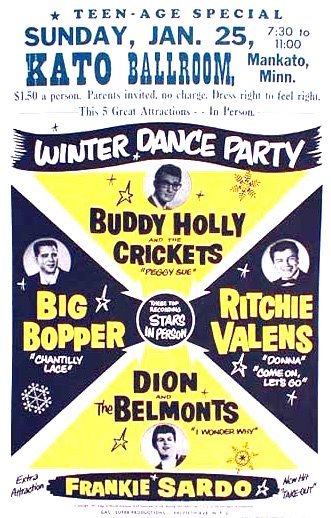
The Spaniels were on the Winter Dance Party Tour with Buddy Holly, Ritchie Valens and the Big Bopper in February of 1959, the day the music supposedly died, as Dylan relates with noticeable disgust in his voice, because the music can't die, of course. It's probably one of the few things in the world that's definitely indestructible, unkillable, invincible. But musicians are only human, and Buddy Holly, Ritchie Valens and the Big Bopper all did die that day in the infamous plane crash.

It's not easy being a DJ, Dylan mentions in the recent "Radio" episode, and it's not easy being a professional musician either. Bad food, a bad lifestyle where bottles, pills and needles are all too available. And there's too much travel, and nights staring out at a sea of faces that you can barely see through the lights. And the next day is the next town, and you have to get there somehow.

You wonder whether Dylan thinks about that on the Never-ending Tour, looking out the window as the bus takes him to another town.

Patsy Cline was another star claimed in a plane crash, on March 5th, 19 and 63, along with her manager, Randy Hughes, who was flying the yellow Piper Comanche, and Cline's fellow musicians, Cowboy Copas and Hawkshaw Hawkins. Dylan played Hawkin's Dog House Boogie on the 16th episode of "Theme Time." and Cowboy Copas' "Three Strikes and You're Out" on "Baseball."

As I mentioned in my last episode, Jack Anglin, of Johnnie & Jack, also died in 1963, driving alone to attend a memorial service for Patsy Cline not far from his home. Jack rounded a bend at high speed, crashed and was killed at age 46. Dylan hasn't played Johnnie & Jack yet on "Theme Time," but I bet he will.

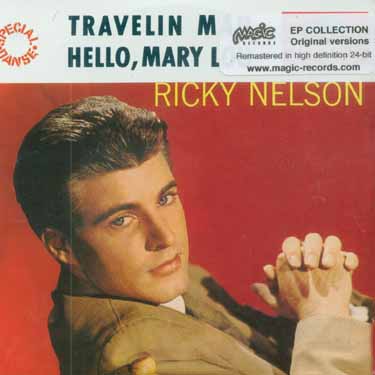
Another artist who I'm betting will make a "Theme Time" appearance is Rick Nelson, who Dylan has high praise for in "Chronicles." Born Eric Hilliard Nelson in 1940, Rickie Nelson had the million-selling hit, "Travelin' Man" in 19 and 61. Shortly after the single topped the US charts, Nelson celebrated his 21st birthday and announced that he was changing his performing name from Ricky to Rick.

Ten years later, Nelson composed "Garden Party," an open letter to fans that he was determined not to become a living museum of `60s replays, like it or not. Ironically, "Garden Party" also became a million-seller and was Nelson's last hit record. On the 31st of December 19 and 85, a chartered plane carrying him to a concert date in Dallas crashed near De Kalb, Texas.

[Travelin' Man excerpt]

Planes are dangerous enough for musicians, as are helicopters, as Bill Graham among others would tell you, but for sheer body count, four-wheeled vehicles are the musician's major nemesis.

Eddie Cochran - Dylan played his "Summertime Blues" - was killed in England when his taxi suffered a burst tire and veered off the road and crashed. Gene Vincent was a badly injured passenger.

Keith Godchaux of the Grateful Dead - Dylan played their "Friend of the Devil," in the "Devil" show, although Pig Pen was still their keyboardist back then - was leaving a toll plaza and drove straight into the back of a flatbed truck, killing him instantly.

Speaking of the "Devil" episode, and as I mentioned in my own take on the Louvins, Ira Louvin died at age 40 in a head-on collision with a drunk driver as he drove home from a performance. Of course country music has a rich history of songs about car crashes, such as Porter Wagoner's "Carroll County Accident," which I think pretty much fits Dylan's recent exposition on what country music is all about.

[Carroll County Accident]

Tommy Perkins, the drummer for Bob Wills and his Texas Playboys died in 2003 driving home from a festival celebrating the "King of Western Swing."

J.B. Lenoir from the "Mother" episode of "Theme Time" died in 19 and 67 from a heart attack following a car crash.

Bessie Smith - lost at age 43 when her car was struck head-on by a truck. She survived the accident, but legend has it that she was denied treatment from several "whites only" hospitals in Mississippi before arriving at a "colored's only" hospital in Clarksdale. But by then it was too late for Bessie.

And I could go on but I think that's enough. It's a jungle out there, as Randy Newman sings, and many of the beasts have steel skins. So take care of yourself, and if you think of it, say a prayer for all the musicians on the road.

This has been Fred Bals with the Dreamtime podcast - occasional commentary on Bob Dylan's Theme Time Radio Hour weekly show. Dreamtime is not associated with XM Radio or Bob Dylan, and is obviously not associated with either the airline or automobile industries. Until next time, stay safe, and sweet dreams.

Links to music excerpted on the show:

Jan & Dean - Dead Man's Curve (Amazon link)


Rick Nelson - Travelin' Man
Ricky Nelson - Rick Nelson: The Best of, Vol. 2 - Travelin' Man


Porter Wagoner - The Carroll County Accident
Porter Wagoner - RCA Country Legends: Porter Wagoner - The Carroll County Accident


The Nitty Gritty Dirt Band - Will the Circle Be Unbroken - Wreck On the Highway


Visit the Dreamtime Store for music from "Mothers"

Tuesday, July 25, 2006

Episode 5 - Two voices from Chronicles

[From Theme Time - "Cars"] - "A delivery boy makes a wrong turn."

Subscribe to Dreamtime


Direct link to mp3

This is the Dreamtime podcast - occasional commentary on Bob Dylan's Theme Time Radio Hour weekly show.

Episode 5 - "Two voices from Chronicles."

I'm changing gears in this episode, talking about two singers who have yet to appear on Theme Time... but probably will at some point. To correct a mistake I made in episode 4, Fred Neil was not the owner of the Cafe Wha?, but a singer/songwriter who ran the daytime show at the Wha? as Dylan notes in Chronicles. Thanks to "jump right in" for pointing out the error to me.

Born in Cleveland, Ohio in 1936 and raised in St. Petersburg Florida, Neil came to New York in the late '50s, working at the Brill Building as a staff writer. At the Brill, a musician could find a publisher and printer, cut a demo, promote the record, and cut a deal with radio promoters, all within one building.

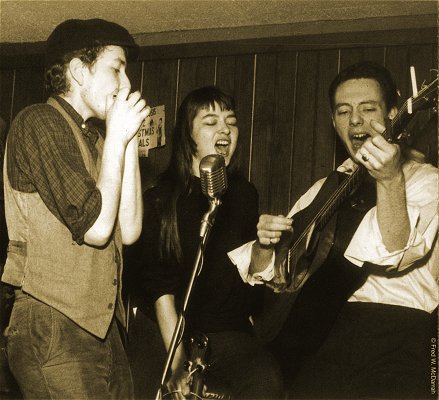
In 1960, Neil began to perform solo at the Cafe Wha?, as well as the Night Owl and Bitter End. By 1961, he was sometimes accompanied by Dylan and Karen Dalton, both pictured with Neil in this episode's show notes.

Neil was something of a musician's musician, influencing among others John Sebastian, who would go on to form the Lovin' Spoonful; Paul Kantner, who would lead Jefferson Airplane; Richie Havens, Felix Pappalardi, the producer of Cream (as well as the bassist for the group, Mountain), and both David Crosby and Stephen Stills. A story, possibly apocryphal, has it that Stills and Crosby originally wanted to call their supergroup with Graham Nash “The Sons of Neil.”

Neil compositions were recorded by both Buddy Holly and Roy Orbison; he also played as a session guitarist for Bobby Darin and Paul Anka. In 1968, Nilsson recorded a cover version of Neil's song "Everybody's Talkin'," which became a mega-hit when it was used as the theme song in the film Midnight Cowboy.

Neil semi-retired in the 1970s and passed away in 2001.

[Everybody's Talkin' excerpt]

Of Neil, Dylan writes,

"Freddy had the flow, dressed conservatively, sullen and brooding, with an enigmatical gaze, peachlike complexion, hair splashed with curls and an angry and powerful baritone voice that struck blue notes and blasted them to the rafters with or without a mike. He was the emperor of the place, even had his own harem, his devotees. You couldn't touch him. Everything revolved around him. Years later, Freddy would write the hit song 'Everybody's Talkin'.' I never played any of my own sets. I just accompanied Neil on all of his and that's where I began playing regular in New York."
In the same section, Dylan reveals his favorite singer at the Cafe Wha? was Karen Dalton.
"A tall white blues singer and guitar player, funky, lanky and sultry," Dylan writes. "Karen had a voice like Billie Holiday's and played the guitar like Jimmy Reed and went all the way with it."
Picture a room, empty except for an unmade bed. A woman lies on it, staring up at the ceiling, watching a fan turn, slowly pulling the smoke from her cigarette into its blades. A half-empty glass of wine is on the floor, by the woman's hands...

[Little Bit of Rain excerpt]

That's Karen Dalton, singing Fred Neil's Little Bit Of Rain on her first album, It's So Hard To Tell Who's Going To Love You The Best, originally released in 1969 and reissued on CD in 1997. As Dylan, and nearly everyone else who heard her noted, Karen's voice strongly resembles that of Billie Holiday's, in fact to the point where the Capitol press release for her first album described her as "the folksinger's answer to Billie Holiday."

Dalton's voice is also eerily similar to the modern day smoky voiced singer, Madeleine Peyroux, who herself is often compared to Holiday. Unlike Peyroux, Dalton never had that much popular success. In the little information available about her on the Web, that may have been because she was uncomfortable in the studio and had to be coaxed into recording the two albums she did produce, or perhaps because she rarely wrote her own songs, or perhaps because of drug and alcohol problems she reported struggled with until her death in 1993.

Fred Neil who had first brought her to the attention of Capitol Records wrote in his 1971 liner notes to her second album:
"She did 'Blues On The Ceiling' (which is my song) with so much feeling that if she told me she had written it herself I would have believed her. Her voice is so unique, to describe it would take a poet. All I can say is she sure can sing the shit out of the blues."
The country singer Lacy J. Dalton has said that she took her name from Karen, who had greatly influenced her singing style. Also known as "Sweet Mother K.D.", It is said that the song "Katie's Been Gone" by The Band was written about her.

A great, haunting talent that never got the audience she deserved, you can buy Karen Dalton's first album on Amazon or as separate tracks through iTunes.

There's apparently a European version of "It's So Hard…" just released in July of 2006, that includes a DVD described in a review at Amazon UK as, "a 25 minute home movie , directed by Dalton and shows her hanging out playing her guitar and performing four songs."

This has been Fred Bals with the Dreamtime podcast - occasional commentary on Bob Dylan's Theme Time Radio Hour – and occasionally commentary on other things that may or may not show up on Theme Time.

Until next time, sweet dreams.

Sources: FredNeil.com; Karen Dalton disography page; Nicholas Hill email on Karen Dalton; "Folk Revisited" by Steve Ritchey in The Student Underground, 2004 (Google cache link); Chronicles: Volume One by Bob Dylan