Google
Web Dreamtime
SiteSearch Google
Showing posts with label Cars. Show all posts

Friday, March 20, 2009

Theme Time Radio Hour Roundup

We have a couple of TTRH-related miscellanea to talk about, nothing  weighty enough for a post by itself, so we're hereby initiating the Dreamtime Theme Time Radio Hour Roundup Day, which, as all good Mouseketeers know, always comes on a Friday.

Our readers probably know by now that the "deluxe" edition of Together Through Life will include as a bonus disc the "Friends & Neighbors" Theme Time episode, first broadcast way back in Season 1, August of 2006. The track listing on Amazon matches up to the aired show, and I think one can safely assume that Our Host's commentary will be included.

"Friends & Neighbors" will be the second "official" full TTRH show to be released.  The first, of course, was the "Baseball" show from Season 1, itself a not-for-sale promotional CD that was haphazardly distributed to some stores such as the now-defunct Circuit City.  As I remember, you had to buy both Modern Times and at least one other Dylan CD at onerous CC prices in order to get your "free" copy of the "Baseball" show.  Being the total TTRH fanboy that I am, I have two copies of the show.  It still remains one of the best TTRHs ever aired, if, for no other reason, Mr. D's a capella rendition of the full Nellie Kelly version of Take Me Out To The Ball Game.

The Fan's Conundrum

Speaking of "official," there's been a minor kerfuffle in various online forums about Our Host's comments to a supposed email in this week's "Family" show.  In reply to a listener's aside that she copies various TTRH episodes to pass on to her family, Mr. D. notes that he "can't condone that," goes into Ann Landers' mode to straighten out the listener's family problems, and concludes his commentary with a stern, "And stop giving my shows away!" And stop making copies of my show! (Dylan's actual statement courtesy of our friends over at RightwingBob).

The comment generated some angst among fans.  Is he talking about us? Does he mean it?  What does that mean in relation to Mr. D.'s remark in an earlier show that listeners should go "illegally download" TTRHs that they've missed?

"Who knows?" is what we say here at Dreamtime.  You can drive yourself crazy trying to parse any Bob Dylan remark, of course.  If he said, "the sky is blue," there would be several articles - if not books -  written on its exact meaning, postulating everything that it had been an ironic commentary on the American political situation to proof positive that Dylan was a Freemason.

On the other hand, he might have meant that the sky was blue.

The whole bootleg/download thing is something that any Bob Dylan fan has to confront and deal with on an individual basis.  At Dreamtime we subscribe to Sirius XM as a means to assuage our conscience, and we encourage others in a position to do so to do the same.  We also make copies of the show, usually for personal use only.  Occasionally we make copies for family and friends. We don't sell them.

That still doesn't make it right.  Plus, we have to deal with the fact that bootlegging is one of the few issues I can remember where Dylan's position has been unchanging and unyielding.  Space travel is the only other subject I can think of where his opinion has been the same each time it's been brought up. He doesn't like either, period.  He's compared bootleggers to thieves and house-breakers and complained that they've diluted his artistic opus.  He won't play any new work on tour until it's been released on album for fear that the first release would be a bootlegged release... which, of course, it would.

So, we're dealing with a revered figure that has flatly said that he doesn't want us doing what we're doing, while we grasp at straws like, "some of these bootleggers they make pretty good stuff," in our defense. 

Yet we still do it.  Such is the conundrum of the fan.

It's a conundrum that even Our Host has fallen into at times.  In at least three instances Theme Time Radio Hour has played bootlegged music: a Frank Sinatra commercial for Pete Epsteen Pontiac in the "Cars" episode of Season 1, and more recently, the "Blood" and "War" shows featured two Jerry Lee Lewis songs that have never been officially released.  An obviously delighted Bob Dylan noted, "You know, if anybody ever asks me why I do this radio show, I could just play them that - Jerry Lee Lewis singing Shakespeare. That's what this show is all about."

Indeed.  And we all would have been the poorer if he hadn't played them.   Such is the conundrum of the fan.

Name That Tune

We'll leave it at that and with a question for our readership which is bugging the usually infallible crack Dreamtime research team. At the beginning of the "Truth & Lies" show, when Mr. D. claims that we're listening to Little Steven's Underground Garage, there's a song playing in the background.  It's annoyingly familar to me, I can even hum it all the way through, but damned if I can think of its title or the artist.  Can anyone clue me in?

Thursday, September 28, 2006

Episode 15 – I Ran at Bakersfield


[Intro]


Direct link to mp3


Subscribe to Dreamtime


[James Dean - Drive Safely]

Episode 15 – I ran at Bakersfield

This is the Dreamtime podcast - occasional commentary on Bob Dylan's Theme Time Radio Hour weekly show.

Sometimes you write the show, and sometimes the show decides to write you. This is one of those shows. This Saturday is September 30th, 2006. Fifty-one years ago, on September 30th, 1955, James Dean died.

I didn't remember that until a few days ago. The date – and the accident – used to be a lot more important to me some 30-odd years back. In the early '70s, I spent the good part of one Fall season driving back and forth between Northern and Southern California, down the Grapevine on Route 5 from Los Angeles, through the San Joaquin Valley and back to the college I was in the long, slow process of leaving.

There was a girl in Los Angeles. There's always a girl somewhere in every story. She was in the long, slow process of leaving me too, but I didn't know that then. So every Thursday I would take the Volkswagen, loaded with whatever passengers I could find who were willing to pony up $10 bucks for a roundtrip to LA and back and leave around 11 or so at night to go stay with my girl over the weekend. On Sundays, I'd make the reverse trip… 350 miles back.

On one trip back – by myself that time – I detoured off 5 after passing Bakersfield and headed west on Highway 46, pulling off at the intersection of 46 and 41. It was a little before six pm on September 30th, 19 and 71.

Sixteen years earlier, Dean's Porsche Spyder flew over the road I had just traveled, bearing down like a freight train on the downgrade to a bump-in-the-road town called Cholame. At the intersection of Highways 46 and 41, Dean would collide with a Ford Tudor, driven by a 23-year-old with the unlikely last name of Turnupseed. It was 5:45 in the early evening. The sun was just setting.

Turnupseed would survive the accident and live for another 40 years. He would never speak publicly about what had happened. Dean's one passenger also survived. Dean lived for a few moments after the crash, but was pronounced Dead On Arrival at Paso Robles Hospital.

Rebel without a Cause would premiere about a month later.

We all make pilgrimages. In 1988, Dylan, with an entourage of 15 in tow, visited the farm that Dean grew up on, in Fairmount, Indiana. "It was 1 or 2 o'clock in the morning,” said Marcus Winslow, one of Dean’s cousins. “He'd had a concert in Indianapolis, and he came with a bus to Fairmount. He came out here for a few minutes. ..."

That was probably the morning of July 16th, 19 and 88, the morning after Dylan finished a show at the Indiana State Fairgrounds during what would become the first year of the Never Ending Tour. As an aside, Dylan mentions in the liner notes of World Gone Wrong that the Never Ending Tour actually ended three years later in 1991, to be followed by a succession of others, including The Money Never Runs Out, The Southern Sympathizer and the Why Do You Look at Me So Strangely tours.

No word on what the current one is called, although I’m holding out hope that its name is The Search for Rejection tour in honor of Modern Times.

In 1955, Bob Dylan was 14 years old. Like hundreds of other teenagers he would see Rebel multiple times, and bought Rebel's iconic red jacket… just like James Dean’s.

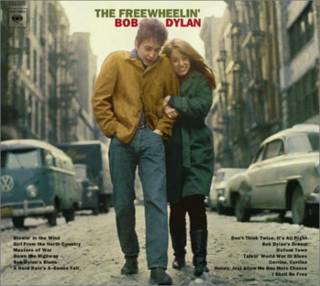
During the 1963 cover shoot for The Freewheelin' Bob Dylan, Dylan reportedly wanted to create Roy Schatt's 1954 photo of James Dean walking down West 68th in New York City. The Freewheelin' photo that would eventually be the cover uses Jones Street in Greenwich Village, a one-block street connecting West 4th and Bleeker, as its backdrop.

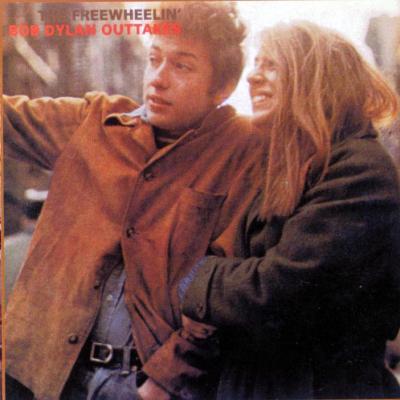
At least one other Don Hunstein photo from the same session has surfaced. Used as the cover art on The Freewheelin' Bob Dylan Outtakes bootleg, the picture also features Dylan's girlfriend at the time, Suze Rotolo, braced on his arm as he strikes an even more Dean-like pose.

We all emulate our heroes.

On the 50th anniversary of Dean's death, the state of California put up a sign at the intersection, naming it the James Dean Memorial Junction. If you travel about a quarter of a mile west, you'll find a memorial put up in 1977 by a Japanese Dean fan. It's engraved with Dean's name, date of birth and death, an infinity symbol, and what was reportedly Dean's favorite quote, "What is essential is invisible to the eye," from The Little Prince.

Back in the early `70s, none of that was there to see at the junctions of 41 and 46, just a lonely, dusty patch of California road. I sat on the hood of my car for awhile, watching the sun go down. And I got back in the VW, pulled onto the road, blinded then by the explosion of the sunset's glare, not able to see a thing.

And a car came out of the sunset light, engine screaming, horn blaring, swerving inches from my left bumper, and then gone.

I think it was a silver Porsche. It looked like a Porsche. But except for a lone, dark patch of rubber from its braking, there was nothing left to see.

I had stalled the VW in my fright. I started it up again and drove on. In a year I'd be in the Army, and on the road that would eventually lead me here, in my kitchen in New Hampshire, looking out the window at golden Fall light, writing this, in the year of our Lord, 2006.

[Rebel without a Cause theme]

This has been Fred Bals with the Dreamtime podcast, occasional commentary on Bob Dylan's Theme Time Radio Hour weekly show and occasionally commentary on other dreams. I'll be at Podcast Expo in Ontario, California on September 30th. If you're in the neighborhood, come by and say hello.

I'll be the guy wearing the red jacket... just like James Dean.

The opening Gig Young interview with James Dean on automobile safety and the closing Rebel theme were both taken from the beautifully produced Rebel without a Cause 2-disc DVD set. If you haven't seen Rebel - or haven't seen it in awhile, go watch it. The background music - provided tonight from the PodShow Podsafe Music Network. Check it out at 'music.podshow.com. The artist is nezecus.


Visit the Dreamtime Store

Sunday, August 27, 2006

Episode 11 - All mobbed up


Episode 11 - All Mobbed Up


Subscribe to Dreamtime


[Intro]

["A word from our sponsor," from the Cars episode of "Theme Time"]

[Frank - Ol' MacDonald goes to Pete Epsteen's Pontiac]

So why was Ol' Blue Eyes doing a radio commercial for a Skokie, Illinois car dealership?

Why do you think? Three little letters. M.O.B.

Most of the references on the Web claim that Sinatra did the gig for Sam Giancana, boss of bosses in Chicago from the late `50s to the mid-60s, a friend - if friend is the right word - of Sinatra's since 1958, and the person who Sinatra acted as the front for in his buy into a piece of the action of the Cal/Neva Casino in Lake Tahoe.

However, it's more likely that the favor was asked by one of the Fischetti brothers, Rocco, Charlie, and Joe. Charlie Fischetti was the Mob's political fixer in Chicago, and a friend of Sinatra's since the early `40s. Sinatra, nice guy that he was, used to go along with Charlie when he visited his mother in Brooklyn. Charlie died in 1951, but Sinatra and Joe Fischetti were also close friends. He took a trip to Cuba with the brothers in 1946, the so-called "Havana Summit" held by Lucky Luciano, a trip that would haunt Sinatra for the rest of his career.

But Frank still did a lot of favors for the Fischetti brothers. He once rode along on a plane ride from Palm Springs to Vegas so the Fischettis could impress a star struck automobile tycoon from Detroit who they were romancing for an agency franchise. In fact, Sinatra helped the Fischettis set up a string of auto dealerships - including Pete Epsteen Pontiac - by lending his name to the enterprise and doing commercials free of charge, at least from a cash aspect. Sinatra reportedly received at least two Thunderbirds that became the property of Sinatra Enterprises.

Interestingly, Lee Iacocca notes in his autobiography that Sinatra offered to do commercials for the failing Chrysler for the nominal fee of a buck… plus stock options. Frank had apparently learned that some things were better than money, and should have made a bundle from those options, according to Iacocca.

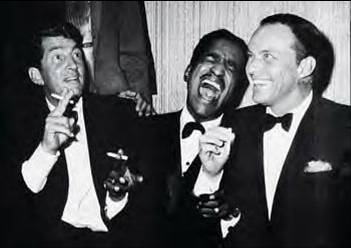
In any case, a helpful guy to his friends, Sinatra was. And hey, your other friends should help out your friends too, right? So Sinatra wasn't the only crooner to warble for Ol' Pete. He called in the Rat Pack.

[Sammy segment]

When the Chairman called for a favor, Sammy was always there, recording not one, not two, but three separate commercials for Pete Epsteen Pontiac.

Like his explanation for freebie gigs at the Villa Venice Supper Club - which indeed were done as favors for Sam Giancana, Sammy probably would have responded if asked, "I have to say it's for my man Francis." And if pressed might have answered, "Baby, let me say this. I got one eye, and that one eye sees a lot of things that my brain tells me I shouldn't talk about. Because my brain says that, if I do, my one eye might not be seeing anything after a while."

[Dino segment]

Like Sammy, Dino probably did the shtick as a favor for Frank without a second thought. Unlike Sammy, Martin probably gave less than a flying chiavare about whether the boys were involved. While Martin knew mobsters - as Jerry Lewis says in his memoir about Dean, "Dean and Me," it was impossible to work the nightclub circuit from the `40s to the `60s without becoming involved with the mob - he mostly ignored them, and in turn they mostly left him alone.

Unlike Frank, who had this thing about impressing mobsters and liked hanging with them, and unlike Sammy, who was a black guy in a white guy's world and trying to keep his other eye, Dino was known as an "okay guy" who the arm wasn't to be put on… at least not much.

So, Pete Epsteen. What do we know about him? The Sacramento Bee newspaper once published a story entitled, "Palm Springs - Where Stars, Pols - and Mobsters - Live in Style." Although not mentioned in the article, Pete Epsteen was referred to in a photo caption as "an automobile dealer financed by the Mafia."

Represented by Sinatra's attorney, Mickey Rudin, Epsteen filed a $6 million libel suit against the newspaper. He denied any affiliation with the Mafia and demanded a retraction. The Sacramento Bee published a story reporting Epsteen's denial but did not retract the charge.

Lawyers representing the newspaper hired a former FBI agent to investigate. He later told Kitty Kelly, author of "His Way," "I flew to Chicago and met with a lower-level Mob boss and told him we were going to subpoena all the top Chicago Mafia chieftains as hostile witnesses to prove their connections with Epsteen. He told me he'd pass the word up and a few weeks later Epsteen dropped his lawsuit."

According to a Google Search, Epsteen divorced his wife in the `70s, moved to California, and opened a Honda dealership. In 1995 he was prosecuted for his role in a kickback scheme in which dealers in 30 states gave executives of American Honda up to $15 million in cash and gifts in exchange for hot-selling cars and franchises. He was also convicted of perjury in the case, fined $200,000, and sentenced to six months in prison. He died in 1997, in Palm Springs, California.

They're all gone. Giancana. The Fischettis. Sammy took his bows in 1990. Dino would follow in 1995. And Sinatra walked off stage in 1998.

All that's left is the music… and the stories.

This has been Fred Bals with the Dreamtime podcast - occasional commentary on Bob Dylan's Theme Time Radio Hour weekly show. Dreamtime is not associated with XM Radio or Bob Dylan, and takes the Fifth about any association with known gangsters.

We'll be on vacation for a few weeks, so until next month, sweet dreams.

["Birth of the Blues" segment, Frank, Dean, and Sammy]

Sources: His Way: An Unauthorized Biography Of Frank Sinatra by Kitty Kelley; New York Times article, September 9, 1995 - "Two Sentenced in Honda Case"; Appeal from the
Circuit Court of Cook County
IN RE THE MARRIAGE OF: MARILYN D. EPSTEEN, Plaintiff,and MARY B. EPSTEEN, as Executrix of the Estate of PETER EPSTEEN, Defendant. Searches on variations of "Peter" and "Pete Epsteen."

There are various articles/accounts of Sinatra's involvement with the Fischettis and other mob figures, most notably Sam Giancana, available on the Web. My primary sources were CrimeLibrary.com and AmericanMafia.com. Shirley Maclaine's remembrance of an encounter with Sam Giancana while in her role as Rat Pack mascot was also instructive.

The "Theme Time" research team appear to have used the same source as I did for Sinatra's Pete Epsteen Pontiac commercial. I sampled it from a widely-circulated bootleg, "Dean Martin at the Sands," which is regularly available on eBay. The Martin and Davis commercials I use were also taken from the same CD, which includes as "bonus tracks" those commercials, as well as Davis also doing Pete Epsteen commercials using "Come Fly with Me," and "Rubber Tree Plant" (aka "High Hopes") as the music.

The closing music was taken from another Rat Pack bootleg, "Live at Villa Venice - 1962," a two-CD set of the Rat Pack in all their political incorrectness doing two free shows for Sam Giancana's night club; one story has it as payback for Giancana delivering West Virginia to JFK in the presidential primaries.

It's a tangled web.

Tuesday, July 25, 2006

Episode 5 - Two voices from Chronicles

[From Theme Time - "Cars"] - "A delivery boy makes a wrong turn."

Subscribe to Dreamtime


Direct link to mp3

This is the Dreamtime podcast - occasional commentary on Bob Dylan's Theme Time Radio Hour weekly show.

Episode 5 - "Two voices from Chronicles."

I'm changing gears in this episode, talking about two singers who have yet to appear on Theme Time... but probably will at some point. To correct a mistake I made in episode 4, Fred Neil was not the owner of the Cafe Wha?, but a singer/songwriter who ran the daytime show at the Wha? as Dylan notes in Chronicles. Thanks to "jump right in" for pointing out the error to me.

Born in Cleveland, Ohio in 1936 and raised in St. Petersburg Florida, Neil came to New York in the late '50s, working at the Brill Building as a staff writer. At the Brill, a musician could find a publisher and printer, cut a demo, promote the record, and cut a deal with radio promoters, all within one building.

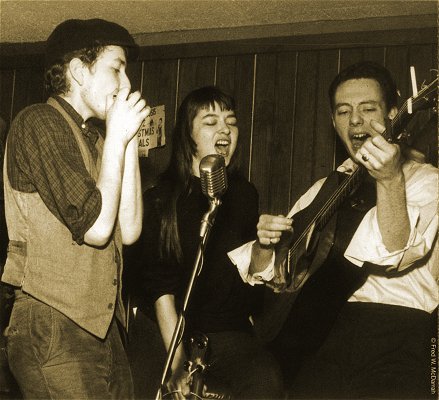
In 1960, Neil began to perform solo at the Cafe Wha?, as well as the Night Owl and Bitter End. By 1961, he was sometimes accompanied by Dylan and Karen Dalton, both pictured with Neil in this episode's show notes.

Neil was something of a musician's musician, influencing among others John Sebastian, who would go on to form the Lovin' Spoonful; Paul Kantner, who would lead Jefferson Airplane; Richie Havens, Felix Pappalardi, the producer of Cream (as well as the bassist for the group, Mountain), and both David Crosby and Stephen Stills. A story, possibly apocryphal, has it that Stills and Crosby originally wanted to call their supergroup with Graham Nash “The Sons of Neil.”

Neil compositions were recorded by both Buddy Holly and Roy Orbison; he also played as a session guitarist for Bobby Darin and Paul Anka. In 1968, Nilsson recorded a cover version of Neil's song "Everybody's Talkin'," which became a mega-hit when it was used as the theme song in the film Midnight Cowboy.

Neil semi-retired in the 1970s and passed away in 2001.

[Everybody's Talkin' excerpt]

Of Neil, Dylan writes,

"Freddy had the flow, dressed conservatively, sullen and brooding, with an enigmatical gaze, peachlike complexion, hair splashed with curls and an angry and powerful baritone voice that struck blue notes and blasted them to the rafters with or without a mike. He was the emperor of the place, even had his own harem, his devotees. You couldn't touch him. Everything revolved around him. Years later, Freddy would write the hit song 'Everybody's Talkin'.' I never played any of my own sets. I just accompanied Neil on all of his and that's where I began playing regular in New York."
In the same section, Dylan reveals his favorite singer at the Cafe Wha? was Karen Dalton.
"A tall white blues singer and guitar player, funky, lanky and sultry," Dylan writes. "Karen had a voice like Billie Holiday's and played the guitar like Jimmy Reed and went all the way with it."
Picture a room, empty except for an unmade bed. A woman lies on it, staring up at the ceiling, watching a fan turn, slowly pulling the smoke from her cigarette into its blades. A half-empty glass of wine is on the floor, by the woman's hands...

[Little Bit of Rain excerpt]

That's Karen Dalton, singing Fred Neil's Little Bit Of Rain on her first album, It's So Hard To Tell Who's Going To Love You The Best, originally released in 1969 and reissued on CD in 1997. As Dylan, and nearly everyone else who heard her noted, Karen's voice strongly resembles that of Billie Holiday's, in fact to the point where the Capitol press release for her first album described her as "the folksinger's answer to Billie Holiday."

Dalton's voice is also eerily similar to the modern day smoky voiced singer, Madeleine Peyroux, who herself is often compared to Holiday. Unlike Peyroux, Dalton never had that much popular success. In the little information available about her on the Web, that may have been because she was uncomfortable in the studio and had to be coaxed into recording the two albums she did produce, or perhaps because she rarely wrote her own songs, or perhaps because of drug and alcohol problems she reported struggled with until her death in 1993.

Fred Neil who had first brought her to the attention of Capitol Records wrote in his 1971 liner notes to her second album:
"She did 'Blues On The Ceiling' (which is my song) with so much feeling that if she told me she had written it herself I would have believed her. Her voice is so unique, to describe it would take a poet. All I can say is she sure can sing the shit out of the blues."
The country singer Lacy J. Dalton has said that she took her name from Karen, who had greatly influenced her singing style. Also known as "Sweet Mother K.D.", It is said that the song "Katie's Been Gone" by The Band was written about her.

A great, haunting talent that never got the audience she deserved, you can buy Karen Dalton's first album on Amazon or as separate tracks through iTunes.

There's apparently a European version of "It's So Hard…" just released in July of 2006, that includes a DVD described in a review at Amazon UK as, "a 25 minute home movie , directed by Dalton and shows her hanging out playing her guitar and performing four songs."

This has been Fred Bals with the Dreamtime podcast - occasional commentary on Bob Dylan's Theme Time Radio Hour – and occasionally commentary on other things that may or may not show up on Theme Time.

Until next time, sweet dreams.

Sources: FredNeil.com; Karen Dalton disography page; Nicholas Hill email on Karen Dalton; "Folk Revisited" by Steve Ritchey in The Student Underground, 2004 (Google cache link); Chronicles: Volume One by Bob Dylan