

[Intro]
Direct link to mp3
Subscribe to Dreamtime
[James Dean - Drive Safely]
Episode 15 – I ran at Bakersfield
This is the Dreamtime podcast - occasional commentary on Bob Dylan's Theme Time Radio Hour weekly show.
Sometimes you write the show, and sometimes the show decides to write you. This is one of those shows. This Saturday is September 30th, 2006. Fifty-one years ago, on September 30th, 1955, James Dean died.
I didn't remember that until a few days ago. The date – and the accident – used to be a lot more important to me some 30-odd years back. In the early '70s, I spent the good part of one Fall season driving back and forth between Northern and Southern California, down the Grapevine on Route 5 from Los Angeles, through the San Joaquin Valley and back to the college I was in the long, slow process of leaving.
 There was a girl in Los Angeles. There's always a girl somewhere in every story. She was in the long, slow process of leaving me too, but I didn't know that then. So every Thursday I would take the Volkswagen, loaded with whatever passengers I could find who were willing to pony up $10 bucks for a roundtrip to LA and back and leave around 11 or so at night to go stay with my girl over the weekend. On Sundays, I'd make the reverse trip… 350 miles back.
On one trip back – by myself that time – I detoured off 5 after passing Bakersfield and headed west on Highway 46, pulling off at the intersection of 46 and 41. It was a little before six pm on September 30th, 19 and 71.
Sixteen years earlier, Dean's Porsche Spyder flew over the road I had just traveled, bearing down like a freight train on the downgrade to a bump-in-the-road town called Cholame. At the intersection of Highways 46 and 41, Dean would collide with a Ford Tudor, driven by a 23-year-old with the unlikely last name of Turnupseed. It was 5:45 in the early evening. The sun was just setting.
Turnupseed would survive the accident and live for another 40 years. He would never speak publicly about what had happened. Dean's one passenger also survived. Dean lived for a few moments after the crash, but was pronounced Dead On Arrival at Paso Robles Hospital.
Rebel without a Cause would premiere about a month later.
We all make pilgrimages. In 1988, Dylan, with an entourage of 15 in tow, visited the farm that Dean grew up on, in Fairmount, Indiana. "It was 1 or 2 o'clock in the morning,” said Marcus Winslow, one of Dean’s cousins. “He'd had a concert in Indianapolis, and he came with a bus to Fairmount. He came out here for a few minutes. ..."
That was probably the morning of July 16th, 19 and 88, the morning after Dylan finished a show at the Indiana State Fairgrounds during what would become the first year of the Never Ending Tour. As an aside, Dylan mentions in the liner notes of World Gone Wrong that the Never Ending Tour actually ended three years later in 1991, to be followed by a succession of others, including The Money Never Runs Out, The Southern Sympathizer and the Why Do You Look at Me So Strangely tours.

No word on what the current one is called, although I’m holding out hope that its name is The Search for Rejection tour in honor of Modern Times.
In 1955, Bob Dylan was 14 years old. Like hundreds of other teenagers he would see Rebel multiple times, and bought Rebel's iconic red jacket… just like James Dean’s.
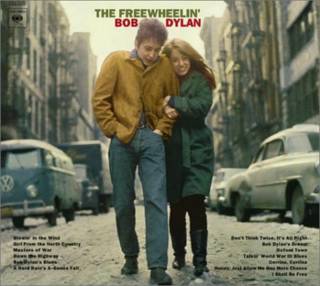
During the 1963 cover shoot for The Freewheelin' Bob Dylan, Dylan reportedly wanted to create Roy Schatt's 1954 photo of James Dean walking down West 68th in New York City. The Freewheelin' photo that would eventually be the cover uses Jones Street in Greenwich Village, a one-block street connecting West 4th and Bleeker, as its backdrop.
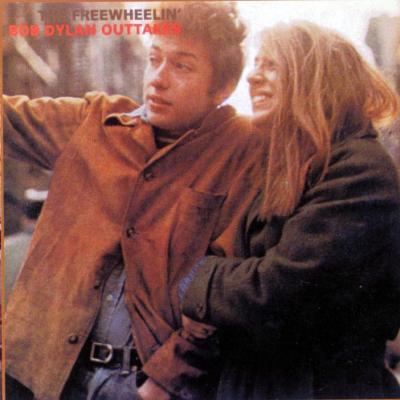 At least one other Don Hunstein photo from the same session has surfaced. Used as the cover art on The Freewheelin' Bob Dylan Outtakes bootleg, the picture also features Dylan's girlfriend at the time, Suze Rotolo, braced on his arm as he strikes an even more Dean-like pose.
We all emulate our heroes.
On the 50th anniversary of Dean's death, the state of California put up a sign at the intersection, naming it the James Dean Memorial Junction. If you travel about a quarter of a mile west, you'll find a memorial put up in 1977 by a Japanese Dean fan. It's engraved with Dean's name, date of birth and death, an infinity symbol, and what was reportedly Dean's favorite quote, "What is essential is invisible to the eye," from The Little Prince.
Back in the early `70s, none of that was there to see at the junctions of 41 and 46, just a lonely, dusty patch of California road. I sat on the hood of my car for awhile, watching the sun go down. And I got back in the VW, pulled onto the road, blinded then by the explosion of the sunset's glare, not able to see a thing.
And a car came out of the sunset light, engine screaming, horn blaring, swerving inches from my left bumper, and then gone.
I think it was a silver Porsche. It looked like a Porsche. But except for a lone, dark patch of rubber from its braking, there was nothing left to see.
I had stalled the VW in my fright. I started it up again and drove on. In a year I'd be in the Army, and on the road that would eventually lead me here, in my kitchen in New Hampshire, looking out the window at golden Fall light, writing this, in the year of our Lord, 2006.
[Rebel without a Cause theme]
This has been Fred Bals with the Dreamtime podcast, occasional commentary on Bob Dylan's Theme Time Radio Hour weekly show and occasionally commentary on other dreams. I'll be at Podcast Expo in Ontario, California on September 30th. If you're in the neighborhood, come by and say hello.
I'll be the guy wearing the red jacket... just like James Dean.
The opening Gig Young interview with James Dean on automobile safety and the closing Rebel theme were both taken from the beautifully produced Rebel without a Cause 2-disc DVD set. If you haven't seen Rebel - or haven't seen it in awhile, go watch it. The background music - provided tonight from the PodShow Podsafe Music Network. Check it out at 'music.podshow.com. The artist is nezecus.
Visit the Dreamtime Store
Thursday, September 28, 2006
Episode 15 – I Ran at Bakersfield

Thursday, September 14, 2006
Episode 13 - Stay away from planes and automobiles
[Intro]
Episode 13 - Stay away from planes and automobiles
Direct link to mp3
Subscribe to Dreamtime
[Dylan Email reading - from "Devil"]
"…I don't know what they're teaching in school nowadays, but here's a list for ya: Two princesses - Princess Grace of Monaco and Britain's Princess Diana; the famous 20th century dance innovator Isadora Duncan; Albert Camus, the author of "The Stranger;" James Dean, who died in his Porsche Spyder; action-painter Jackson Pollock; beautiful blonde actress Jayne Mansfield; and old blood'n'guts himself, General George Patton, Jr., all died in car accidents.
So be careful when you get behind the wheel. You never know when the checkered flag comes down and you find yourself in a race with the Devil."
[Dead Man's Curve excerpt]
Notably missing from Dylan's list in the "Theme Time" episode, "Devil," are any musicians. But, if you're a regular listener to "Theme Time," you'll know that Dylan has provided an ongoing roll call of musicians who have died in plane and automobile crashes since the first show, "Weather," and his introduction of "The Spaniels" version of "Stormy Weather."
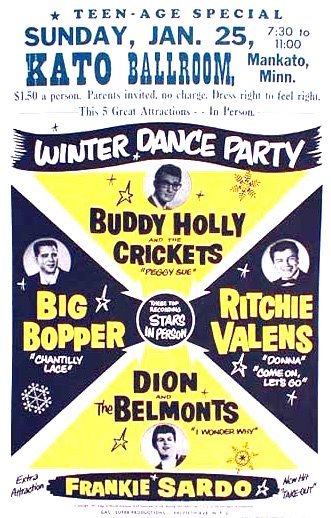 The Spaniels were on the Winter Dance Party Tour with Buddy Holly, Ritchie Valens and the Big Bopper in February of 1959, the day the music supposedly died, as Dylan relates with noticeable disgust in his voice, because the music can't die, of course. It's probably one of the few things in the world that's definitely indestructible, unkillable, invincible. But musicians are only human, and Buddy Holly, Ritchie Valens and the Big Bopper all did die that day in the infamous plane crash.
It's not easy being a DJ, Dylan mentions in the recent "Radio" episode, and it's not easy being a professional musician either. Bad food, a bad lifestyle where bottles, pills and needles are all too available. And there's too much travel, and nights staring out at a sea of faces that you can barely see through the lights. And the next day is the next town, and you have to get there somehow.
You wonder whether Dylan thinks about that on the Never-ending Tour, looking out the window as the bus takes him to another town.
Patsy Cline was another star claimed in a plane crash, on March 5th, 19 and 63, along with her manager, Randy Hughes, who was flying the yellow Piper Comanche, and Cline's fellow musicians, Cowboy Copas and Hawkshaw Hawkins. Dylan played Hawkin's Dog House Boogie on the 16th episode of "Theme Time." and Cowboy Copas' "Three Strikes and You're Out" on "Baseball."
As I mentioned in my last episode, Jack Anglin, of Johnnie & Jack, also died in 1963, driving alone to attend a memorial service for Patsy Cline not far from his home. Jack rounded a bend at high speed, crashed and was killed at age 46. Dylan hasn't played Johnnie & Jack yet on "Theme Time," but I bet he will.
Another artist who I'm betting will make a "Theme Time" appearance is Rick Nelson, who Dylan has high praise for in "Chronicles." Born Eric Hilliard Nelson in 1940, Rickie Nelson had the million-selling hit, "Travelin' Man" in 19 and 61. Shortly after the single topped the US charts, Nelson celebrated his 21st birthday and announced that he was changing his performing name from Ricky to Rick.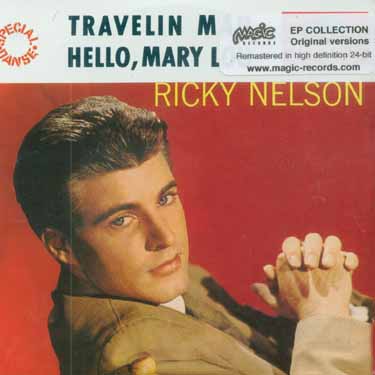
Ten years later, Nelson composed "Garden Party," an open letter to fans that he was determined not to become a living museum of `60s replays, like it or not. Ironically, "Garden Party" also became a million-seller and was Nelson's last hit record. On the 31st of December 19 and 85, a chartered plane carrying him to a concert date in Dallas crashed near De Kalb, Texas.
[Travelin' Man excerpt]
Planes are dangerous enough for musicians, as are helicopters, as Bill Graham among others would tell you, but for sheer body count, four-wheeled vehicles are the musician's major nemesis.
Eddie Cochran - Dylan played his "Summertime Blues" - was killed in England when his taxi suffered a burst tire and veered off the road and crashed. Gene Vincent was a badly injured passenger.
Keith Godchaux of the Grateful Dead - Dylan played their "Friend of the Devil," in the "Devil" show, although Pig Pen was still their keyboardist back then - was leaving a toll plaza and drove straight into the back of a flatbed truck, killing him instantly.
Speaking of the "Devil" episode, and as I mentioned in my own take on the Louvins, Ira Louvin died at age 40 in a head-on collision with a drunk driver as he drove home from a performance. Of course country music has a rich history of songs about car crashes, such as Porter Wagoner's "Carroll County Accident," which I think pretty much fits Dylan's recent exposition on what country music is all about.
[Carroll County Accident]
Tommy Perkins, the drummer for Bob Wills and his Texas Playboys died in 2003 driving home from a festival celebrating the "King of Western Swing."
J.B. Lenoir from the "Mother" episode of "Theme Time" died in 19 and 67 from a heart attack following a car crash.
Bessie Smith - lost at age 43 when her car was struck head-on by a truck. She survived the accident, but legend has it that she was denied treatment from several "whites only" hospitals in Mississippi before arriving at a "colored's only" hospital in Clarksdale. But by then it was too late for Bessie.
And I could go on but I think that's enough. It's a jungle out there, as Randy Newman sings, and many of the beasts have steel skins. So take care of yourself, and if you think of it, say a prayer for all the musicians on the road.
This has been Fred Bals with the Dreamtime podcast - occasional commentary on Bob Dylan's Theme Time Radio Hour weekly show. Dreamtime is not associated with XM Radio or Bob Dylan, and is obviously not associated with either the airline or automobile industries. Until next time, stay safe, and sweet dreams.
Links to music excerpted on the show:
Jan & Dean - Dead Man's Curve (Amazon link)
Rick Nelson - Travelin' Man

Porter Wagoner - The Carroll County Accident
The Nitty Gritty Dirt Band - Will the Circle Be Unbroken - Wreck On the Highway
Visit the Dreamtime Store for music from "Mothers"
Monday, August 21, 2006
Episode 10 – Too religious for the country crowd, too country for gospel fans
Subscribe to Dreamtime
[The Louvin Brothers - "When I Stop Dreaming" excerpt]
Gram Parsons paid friends to search for Louvin Brothers records. Elvis had advance copies of their records sent to him so he could give them to his mother. A young Johnny Cash waited by the side of the road to catch a glimpse of Ira and Charlie Louvin when they came through town.
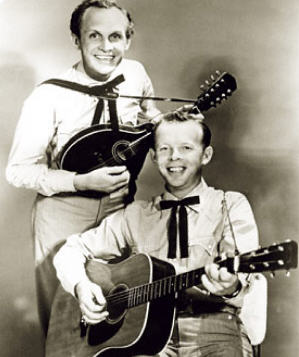
The Louvin Brothers. "[They were] without limits," says Tom Wilmeth, author of Heaven's Own Harmony, a 1999 book on the Louvins. "They could perform songs that would send you to church, then break your heart with a tale of lost love."
Lonnie Ira Loudermilk and Charlie Loudermilk were born and raised in the Alabama Appalachian mountains. Ira, born in 1924, was three years older than Charlie. They started their careers singing gospel songs in church, and listening to close harmony country brother acts - the Blue Sky Boys, the Delmore Brothers, the Callahan Brothers, the Monroe Brothers - on the radio. Ira began playing mandolin, while Charlie learned the guitar, and the two began harmonizing like their favorite radio acts. The duo began performing publicly in 1940, earning three dollars for singing all day at a 4th of July hootenanny.
They began performing on an early-morning show at a radio station in Chattanooga, Tennessee, but then Charlie enlisted in the Army in the early '40s, and Ira played with Charlie Monroe while his brother was gone. After Charlie's Army stint, the brothers moved their career to Knoxville, TN, where they played the radio circuit. It was in Knoxville that the two changed their Loudermilk last name to the more memorable stage name of Louvin.
In 1949, the Louvins recorded a single for Decca that disappeared without a trace. Two years later they signed with MGM, recorded 12 songs, again without much commercial success. In the early `50s the brothers were reduced to working as postal clerks in Memphis, TN during the day while doing concerts and radio gigs at night. Finally, they'd get a break with Capitol, and record a single that would become a minor hit in 1952, the gospel song, "The Family That Prays Together."
Things were beginning to look up for the Louvins, but then Charlie was called back into the Army because of the Korean War. When Charlie was discharged this time around, the Louvins relocated to Birmingham AL, where they planned to restart their careers. But they had problems getting back on the radio, as another duo had already carved out a close-harmony niche on the Alabama airwaves, ironically using several songs of the Louvins' own. Things weren't looking good, until Capitol Records was able to get the Louvins a gig on the Grand Ole Opry.
Here's where the story get a little flakey. Some reports have it the Louvins began singing secular material as soon as they landed a slot on the show, primarily because a tobacco company sponsoring its broadcast told the Opry and the Louvins "you can' sell tobacco with gospel music." But Charlie Louvin, who should know, says that Capitol had the boys straight-jacketed into a contract that allowed them to only record sacred songs, with the same restrictions carried over to their Grand Ole Opry performances. "The record company had no idea what to do with us," says Charlie. "They thought our songs were too religious for the country crowd, and too country for the gospel fans."
The powers at Capitol finally told Ira and Charlie that they could release one secular single, but if it didn't become a hit, then Capitol would cancel their contract. They chose one of Ira's originals, "When I Stop Dreaming." And the song would chart to #8 on the Billboard charts in 1955.
And the Louvin Brothers' career was off. That first chart-topper was followed shortly afterward by "I Don't Believe You've Met My Baby," which spent two weeks at number one early in 1956. Three of the duo's other singles -- "Hoping That You're Hoping," "You're Running Wild," and "Cash on the Barrel Head" -- reached the Top Ten that year, particularly impressive when you consider that rock & roll was starting to take over the airwaves by the mid-50s, as Dylan mentions as an aside in the "Dogs" episode of "Theme Time."
 [Satan is Real excerpt]
Part 2 - Satan is Real
And what about that album, "Satan is Real"?
[Dylan excerpt]
Ira Louvin designed the cover of what may be the Louvin Brothers' most famous album in 1958. If you took Dylan's advice and did a search through Yahoo or Google, you'd find a photograph of him and Charlie in matching white suits, pink shirts, and blue ties arms outstretched, before what looks like the pits of Hell. Behind their backs, standing in the flames is a gigantic red devil, complete with fangs, horns, and pitchfork.
"Ira built that set," said Charlie. "The devil was twelve feet tall, built out of plywood. We went to this rock quarry and then took old tires and soaked them in kerosene, got them to burn good. It had just started to sprinkle rain when we got that picture taken. Those rocks, when they get hot, they blow up. Pieces of rock up were going up into the air."
The brothers look pretty calm in the photo, considering they were being bombarded by burning rocks and almost burnt alive when the tire fire began to rage out-of-control.
The title track of "Satan Is Real" features a sermon by Ira, considering the proposition that if God exists, so must Satan.
[Ira preaching excerpt]
David Gates, who's written several articles about Dylan at various points in his career, reportedly was correcting a quote he was using from "Satan is Real," in the galleys of his novel, "Preston Falls," when Dylan called. During the course of the interview, Dylan started talking about religious songs, and remarked how frightening he felt the "Satan is Real" song was. "That's weird," Gates told him. "I'm looking at the lyrics right now." "It's a small world, Dave," Dylan said.
Part 3 - Out Past Where the Buses Run
"I think religion tortured Ira," Charlie once said. Ira had his demons, for sure, more dangerous than any plywood Satan. Ira was an alcoholic.
"Today they call it an illness," Charlie says. "In those days it was bein' mean." And Ira was about as mean as drunk as you would want to encounter. When Ira drank, he fought, as Dylan notes in this story he tells about Ira's encounter with Red Foley.
["An interesting story" - from "Dogs"]
And when Ira drank, he cheated on each of his four wives. Ira had three bullets near his spine-the work of his third wife, who had shot him five times in 1963, after Ira had tried to strangle her with a telephone cord.
And when Ira drank he was stupid-mean. He once succeeded in killing an opportunity to tour with a young Elvis Presley, already better known at the start of his career than Ira would ever be. Elvis was a devoted Louvins fan, until [Ira]* called him a "white nigger" and his rock 'n roll "trash."
As Dylan notes, Ira had finally "gone out past where the buses run."
Between declining sales and Ira's erratic temper, the Louvins decided to split up the act in 1963. Charlie went on to a long solo career, and remains a fixture at the Grand Ole Opry to this very day. In fact, you can email Charlie at his official web site…
Ira, as you could guess, didn't make it. He was with his fourth wife, Anne Young. performing a week of concerts in Kansas City in June of 19 and 65 when they were both killed in Williamsburg, MO, by a drunk driver.
Ira died with a warrant out for his arrest on his own DUI charges.
Drunk driving is the second-leading cause of death in the Louvin Brothers body of work, a fate exceeded only by murder.
Maybe Ira saw the writing on the wall.
["You're Running Wild" excerpt]
This has been Fred Bals with the Dreamtime podcast - occasional commentary on Bob Dylan's Theme Time Radio Hour weekly show. Dreamtime is not associated with XM Radio, Bob Dylan, or much of anything else. Until next week, don't stop dreaming.
*I misread the brother's name as "Charlie" in the podcast. It should be "Ira," of course - fhb
Sources: Satan is Real; Google Groups thread; CMT.com; Alabama Music Hall of Fame. Tom Wilmeth's liner notes from "Livin', Lovin' Losin': Songs of the Louvin Brothers. "Theme Time" excerpts from episodes 14 "Devil," and Episode 16 "Dogs."

