Missed Dreamtime? We've missed you too, and we're pleased to announce that after an eight-year absence we're returning with Episode 63 - Beneath the Underdog airing on MVY Radio (88.7 FM, serving Cape Cod, Martha's Vineyard, and Newport RI) on Monday, December 17th at 9 PM ET, with a rebroadcast the following Sunday at 10 PM.
Not in the area? You can listen live online at the MVY website or through TuneIn Radio, and of course we'll eventually have the show up here too.
Listen to excerpts from Mr. D.'s 2015 MusiCares speech with musical commentary!
Guest appearances from the Jones clan, including Jailbait, Joyride, and cousin Junebug!
Very little logorrhea from Your Host, Fred Bals!
All this and more in an hour of theme-packed Dreamtime! Don't you dare miss it!
A film noirish video promoting "The Night We Called it a Day" and Shadows in the Night. The other male lead in the video is Robert Davi, who interestingly, released an album of Sinatra covers in 2011 (corrected ~ fhb). His album "Davi Sings Sinatra: On the Road to Romance," is on Spotify, and well worth the listen.
It's always fun to see if the locations used in the video can be pinpointed. With "The Night We Called It a Day,", the opening scene was shot in front of Màs Malo, an east-LA-style Chicano resturant located at 515 W. 7th Street.
Mr. D walks past the Màs Malo storefront to the door you can see in the alley on the right. The neon "Club" sign shown in the video apparently came from the prop department.
A post in the EDLIS Café Facebook page relates that the other notable location for the video shoot was The Ardmore Wilshire at 722 Ardmore Avenue in Korea Town Los Angeles on January 12th of this year.
A member of the café posted the color photo below of the building's atrium, which was featured in a wide-angle shot in the video.
Frank rehearsed constantly for the next three weeks, afternoons at the Palladium nightclub, in Los Angeles, before Tommy showed up, just Frank and Lyle (Skitch) Henderson or Joey Bushkin on the piano behind him, in the quiet stillness of the huge, empty dance hall. He knew exactly which songs he wanted to wax. They were all ballads, naturally, all dripping with romance: there was “The Night We Called It a Day,” by these new kids Matt Dennis and Tom Adair, who’d written “Let’s Get Away from It All” and “Violets for Your Furs.” There was a sweet Hoagy Carmichael number that hadn’t been recorded much, “The Lamplighter’s Serenade.” And then two classics: Kern and Hammerstein’s “The Song Is You” and Cole Porter’s equally immortal “Night and Day,” whose lyrics he’d once blown in front of the great man himself when Porter stopped by the Rustic Cabin...
The recording session, which took place at RCA’s Los Angeles studios on the afternoon of Monday, January 19, 1942, went off perfectly. Pointedly, there was no drummer. Nor did Dorsey attend the session—both of the singles that resulted (released on RCA’s discount Bluebird label) were credited to Frank Sinatra with “Orchestra conducted by Axel Stordahl.” ~ Frank: The Voice
One of the things you learn about Bob Dylan is there's always something more to learn about Bob Dylan. I had never heard of this documentary about Earl Scruggs, variously known as "Earl Scruggs Bluegrass Banjo Legend," "Earl Scruggs: Family and Friends" and "The Bluegrass Legend" among other various titles, and the info about it is slim and as mysterious as the title changes or why Roger McGuinn's last name is spelled as "McGwinn" in the opening credits. The film was shot by documentary filmmaker David Hoffman, probably sometime between 1969 and 1972, and aired on PBS (then known as NET, appropriately enough) in either 1970, 1971 or 1972. You can find various sources claiming all those titles and dates.
How Dylan - or Joan Baez or The Byrds - became involved in the documentary and listed as "Friends" is another mystery, although I suspect Bob Johnston, who was both Dylan's and Scruggs producer at the time, played a role. According to the "Bob Dylan Roots" site:
Basically, Bob Johnston, with his emphasis on the new breed of singer-songwriters (as opposed to the staunch-traditional country and bluegrass songwriters) contributed to the break-up of Flatt & Scruggs. While Earl Scruggs expressed a growing boredom with traditional bluegrass ("I was playing the same thing over and over every night. I just couldn't stand it any longer."), Lester Flatt felt uneasy with Bob Johnston: "He also cuts Bob Dylan and we would record what he would come up with, regardless of whether I liked it or not. I can't sing Bob Dylan stuff, I mean. Columbia has got Bob Dylan, why did they want me?"
- Neil V. Rosenberg, Liner notes for "Flatt & Scruggs", Time-Life Records TLCW-04, 1982
Dylan is playing with Earl Scruggs and Scruggs' sons Gary and Randy, collectively known as "The Earl Scruggs Revue," formed after Scruggs broke up with long-time partner Lester Flatt. The documentary can be found at Amazon aalthough I suggest you read the reviews before making a purchase decision. The documentary can also be viewed online at Dailymotion.
Some edits made in 2014 with new info from a Dreamtime correspondent.
A thread over at the Expecting Rain forums had me searching out the history of the photo to the left, one of a series taken in March 1965 by Daniel Kramer at a cabin located on Albert Grossman's Bearsville estate. The location is a storage shack on Peter Yarrow's mother's (Vera Yarrow) property in Woodstock, according to a conversation between Kramer and Bob Egan, of the fabulous PopSpots site. According to Kramer, most of the "weird ephemera" were books, magazines and family memorabilia from the Yarrow family -- including the photo of the man on the left.
Bob Dylan is in the foreground with Sara Lowndes - soon to be Sara Dylan - standing in the doorway.
This is one in a group of five or six shots taken by Kramer and intended (as Kramer relates in his 1967 book of photos, Bob Dylan) for the cover of Tarantula. Kramer and Dylan intentionally tried to replicate the look-and-feel of Kramer's iconic cover for Bringing It All Back Home, a little too successfully, as the photos were ultimately rejected as being too similar.
As with the Bringing It All Back Home photo, Dylan is surrounded by a variety of weird ephemera, and as with the better-known photo, there's a tendency to read more into their significance than they probably deserve. Both Kramer and Sally Grossman have said in various interviews that most of the props used in the Bringing It All Back Home shoot happened to be at hand and Kramer used because he thought they fit. The same can probably be said of the props for the unused "Tarantula" photos.
I've only be able to identify a few of the props. From the bottom center and moving clockwise:
Playing Cards: Ace of Spades, Facedown card, Queen of Spades, Jack of Spades, Joker
Woman's Day Book of American Needlework by Rose Wilder Lane (1963)
Unidentified box. The word "Religious" can be read at the upper right corner.
Cardboard cut-out of Beagle.
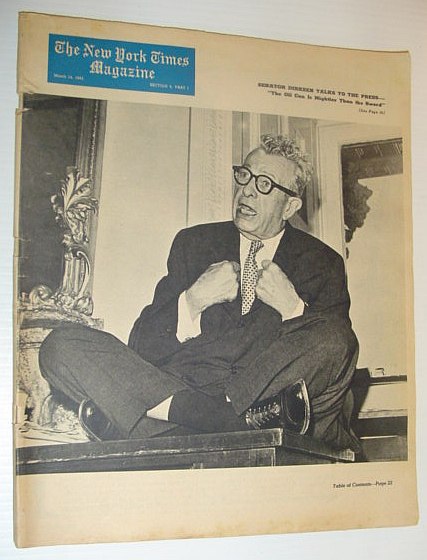
Unidentified magazine. The magazine is the Sunday, March 14th, 1965 edition of the New York Times Magazine, and the person portrayed is indeed Senator Everett Dirksen, a politician probably best-remembered today for the phrase, "A billion here, a billion there, and pretty soon you're talking real money." (in fact, Dirksen probably didn't say that, but the quote is usually ascribed to him).
Paper with Handwritten ALWAYS!!! A faint sketch of a face can be seen below the words.
Unidentified photo.
Unidentified record cover. Label is Verve. The cover is likely DVORAK: Slavonic Dances. JEAN MARTINON conducting the London Symphony Orchestra. RCA VICTROLA STEREO Record Album (VICS 1054).
Unidentified record cover (not seen in all photos in the series): "The (unreadable) Jug Band." As also noted in the comments, The album is a 1962 compilation on the OJL label, titled "The Great Jug Bands."
Needlepoint reading "Be True To Me. Let Me Be True to Myself."
Dylan is holding a copy of The Bhavans Journal in his right hand, probably belonging to Sara, a magazine focused on Indian culture, life, and literature, established in 1954 and still being published. His cloth "sailor's cap" is in his left hand.
Howard Stern: ...bringing up Dylan. So Gary's driving in his car the other night aaaah, listening to Sirius XM. And y'know, it's really kinda funny, 'cause when Sirius and XM were two separate companies, I used to be somewhat envious of the fact that XM had Bob Dylan doing a show. Like I had only heard about it. I never actually heard the show. But I was envious saying, 'Wow, it's really cool that they had Bob Dylan.' They probably had to pay him some decent money to get him to do it, because he's such a recluse. That's a cool move, being such a recluse than when you do anything it's a big deal. So I said, 'Wow, if there's any programming I'm envious of on XM it's because they've got the Bob Dylan... it's like called 'The Family Hour,' and he would spin records and he would talk about his life.
But I never actually heard the show. And Gary called me over vacation and he goes, 'Did you ever actually hear the Bob Dylan show?' And I go, 'Uh, no. Is it awesome?' And he goes, 'I don't know a fuckin' thing he said.'
It's a cool thing to say you have Bob Dylan, but if you actually listen to the show, he's unintelli-- it's like his music, when he performs [does stock bad Dylan imitation] - he sounds like a rabbi or something. When he's talking, I defy you to figure out what he's talking about. And the music he plays is kinda out there. It's nothing, y'know it's nothing you'd really want to hear...
It's been a depressing week for Theme Time Radio Hour news - the anniversary passing of when we could look forward to the start of a new season; the unofficial cancellation - apparently - of the TTRH Compendium book. I debated with myself on whether to bother to post the clip above, nine minutes of Howard Stern and crew insulting Bob Dylan and Theme Time Radio Hour. But Self pointed out that Dreamtime's mission statement is to be the premiere source of TTRH news and commentary on the Web, good or bad.
So here it is. I should point out that some of the audio and accompanying visuals could be considered NSFW, so be forewarned. As I said, the clip is nine minutes plus, with Stern playing what sounds like deliberately distorted clips from TTRH to bolster his "unintelligble" argument.. I say "deliberately distorted" since I have better-quality copies of the show, so you would think someone with the resources of Howard Stern could find them too. I'm not sure when this clip originally aired. It was posted on YouTube about a month ago.
Stern goes on to make predictable fun of the various Dylan commentaries and ends on the usual Howard Sternesque whiny note, reading glowing excerpts about Theme Time from an old Washington Post article while complaining about how his show is treated by the Post.
It's taken about a week, but most of the "professional" media outlets we cited as running the farcical Bob Dylan "Sat Nav GPS" story as fact have published retractions with varying degrees of embarrassment. One of the original sources of the story, The "Guardian.Co.UK" noted in its "Corrections and Clarifications" section....
"We reported Bob Dylan saying on his syndicated radio programme that a number of car companies wanted him to be the voice of their satellite navigation systems (No direction home, 26 August, page 8). We should have made clear this was a repeat of a programme broadcast by the BBC in February, though the satnav remark – whether truth or deadpan joke – went unreported at the time"
I've also seen corrections from NPR and The Washington Post, among others, although in most instances the retraction is separate from the original story, which is also usually still there. But since yesterday's digital stories have at least one thing in common with their analog brethren - they're only good for wrapping virtual fish - it probably doesn't matter much. The parade marches on.
I returned from vacay to find a few emails from people who felt that my original article was too ill-tempered (at least one of my correspondents writing I should have stayed focused on vacation). Most argued that the majority of the stories were written tongue-in-cheek and never meant as serious journalism. And that's a valid perspective. But my stock reply is that if you run something as fact, you're required to make at least some effort to check the fact. Otherwise you should bill yourself as an entertainer, not as a journalist.
I know enough about the business that I can pretty well describe the process of how any of the given articles came about. You have a deadline and you need to fill n amount of column inches. You see a story on-line. It features Bob Dylan, which you know is an automatic pass from most editors - see "the smelly Malibu toilet" or "Dylan arrested as vagrant" stories earlier this year. Dylan is always good copy. It's a quirky story, easy to make a couple of jokes about and to maybe get a few people to post comments about - which always looks good to editors too. So, you rewrite the original story, editing it enough so you won't get whacked with a plagiarism call and citing your source, just like you learned in journalism class. In the old days, the bigger outlets like The Washington Post or The New York Times would have had a copy editor or fact checker go over the story before releasing it, even a small story destined for the "Entertainment" section. But those days are gone, plus the media doesn't have the luxury of time anymore, just the pressure to be as close to first as possible.
These days they use unpaid "experts" like me or Expecting Rain to correct them after the fact, whether on when a Theme Time show originally aired or who wrote "Little Buddy." And, in most cases, no foul, no penalty. You print the small correction. Maybe it goes in the journalist's file to bring up at review time that s/he needs to be more careful about self-fact-checking. As I said, then the parade moves on.
Apropos of yesterday's post. Bob Dylan with a fine cover of Elvis' "Heartbreak Hotel", August 16th 2009, as a U.F.O. hovers over Lake Tahoe.
Kind of makes you wish for an "Elvis" project too, doesn't it? Of course it'd be nice to have the Hank Williams Project sometime within this decade, too.
Thanks to Dreamtime pal John Caruth, and others for the links.
Above a <1-minute audio clip of Bob Dylan and the Cowboy Band playing a snippet from George M. Cohan's Yankee Doodle Boy (more popularly known as Yankee Doodle Dandy) yesterday, July 4, in the Year of Our Lord 2000 and 9, which I will suspect will be grist for a blog post by our friend over at RightWingBob.
And below, a fascinating, if politically incorrect, 9-minute clip from the little-known The Phantom President of 19 and 32. What makes this film especially unique is that it features the original song-and-dance man and Yankee Doodle Boy born on the 4th of July - George M. Cohan - who was trying to move from a sagging theater career into film with The Phantom President.
Watch Cohan's blackface routine in this clip and it's easy to see where Jimmy Cagney got his spot-on phrasing and moves for Yankee Doodle Dandy, the movie.
Cohan would make but one more movie in 1934 (Gambling), that - like Phantom President - would meet with indifferent public reaction. He'd return to Broadway and revive his career in his last successful show, the Rodgers & Hart hit of 19 and 37, I'd Rather be Right, where he'd play a dancing FDR. Yankee Doodle Dandy, the movie, by the way, re-creates a scene from I'd Rather be Right in its opening sequence.
Stick around through the entire 9-minute clip, and you'll also catch appearances by Jimmy Durante and Sidney Toler. Toler is probably best-known for playing the lead in the equally politically incorrect Charlie Chan series. An entire generation has grown up without knowing anything about Jimmy Durante, which is their loss. The Ol' Schnozzola was a Runyonesque one-of-a-kind who for a period of time was one of the most popular performers in the U.S. I'm old enough to remember his TV show, and was always delighted as a kid when an old movie would air on one of the UHF stations and feature Durante. These days you'll still occasionally see/hear a Durante cartoon impersonation on The Simpsons or Family Guy, although I suspect most of the audience doesn't have a clue that it even is an impersonation.
Outside of not being that good - Cohan plays a surprisingly unsympathetic character - one of the reasons that The Phantom President is seldom seen anymore is the blackface, of course. As regular readers of Dreamtime know, I'm fascinated by the medicine and minstrel show genres, which have a history stretching from the 19th century to Spike Lee's Bamboozled. Blackface routines in movies of the `30s and `40s, and even somewhat unbelievably into the `50s, were more common than you might expect.
Mickey Rooney and Judy Garland would appear in blackface in 1939's Babes in Arms and 19 and 41's Babes on Broadway. Jimmy Stewart in 1939 for It's a Wonderful World. Shirley Temple in 1935's The Littlest Rebel. Fred Astaire put on the cork in 1936's Swing Time. Bing Crosby appeared in blackface in 1942's Holiday Inn, the precursor to the better-known White Christmas, released in 1954, and which also included a minstrel show number, but which, happily, was not done in blackface. Frank Sinatra and Dean Martin donned blackface for the original Ocean's 11, released in 19 and 60. The Black and White Minstrel Show was a popular British television series with a 20-year run into the `70s that presented traditional American "Deep South" songs - often performed in blackface.
Among Jefferson Airplane fans there's a story that Grace Slick deliberately put on blackface in 1968 for a Smothers Brothers Comedy Hour appearance, fueled by the fact that Slick closed her performance with the Black Power salute, and occasionally appeared on stage wearing a Hitler mustache. But video of the Smothers Brothers segment shows Slick looking more like she had had a very bad session at the tanning salon rather than doing a deliberate blackface turn. Slick later noted in an interview that the makeup hadn't meant to be political, more of a statement antithetical to her white-bread appearance after she had been given unsupervised access to the makeup table, but she did regret not doing the full "Al Jolson with the lips."
For obvious reasons most of the films I noted above aren't broadcast widely anymore. You can occasionally find a bootleg edition of The Phantom President on eBay. If you share my fascination in the old time minstrel shows and the very strange - and very racially insensitive, it should be noted - art of blackface, you may also be interested in a film I've mentioned before: Yes Sir, Mr. Bones, a 54-minute movie from 19 and 51, which contains the only known footage of the legendary blackface singer and comedian Emmett Miller in action.
The movie is available as 1/2 of Showtime USA, a DVD that also contains Square Dance Jubilee, featuring Spade Cooley. As a commenter noted on the Amazon page, Yes Sir, Mr. Bones is probably as close as we're likely to get to a reconstruction of an actual minstrel show, from the opening "end man" comedy routines, featuring Miller, to the "olio" including sentimental ballads performed by an "Irish Thrush," to an amazing softshoe on sand routine, to the closing burlesque numbers. The movie supposedly takes place in a show biz retirement home; a young boy wanders in and the residents - thanks to the magic of imagination - recreate a minstrel show.
If you're offended by blackface material - some of it very crude, by the way - you don't want to watch Yes Sir, Mr. Bones, as one of the audio commentaries puts it right at the beginning. If you're interested in it as a historical document - especially of Emmett Miller - you do.
"I used to know that song, I don't know... Oh," the young Bob Dylan says before breaking into Scott Wiseman's Remember Me (When the Candlelights Are Gleaming), with what seems a very uncomfortable Joan Baez providing harmony.
Remember Me was written in 19 and 39, and released by Wiseman and his wife/singing partner Myrtle Cooper under their stage names of Lulu Belle and Scotty on the Conqueror label in September 19 and 40. The song was the B-side to a now mostly forgotten Lulu Belle and Scotty tune, Did You Ever Go Sailing? proving once more Mr. D's contention on Theme Time Radio Hour that we're the poorer in these Modern Times without singles and flip sides which often held more interesting and enduring music than the A-side.
Lulu Belle and Scotty were both from North Carolina, hooking up in 19 and 33, when Scotty was 24 and Myrtle 20 and Scotty joined The National Barn Dance, the nation's most popular country music radio show during the 1930s and 1940s, broadcasting from Chicago on station WLS. Lulu Belle was already an established star on the Barn Dance, Myrtle Cooper having assumed the persona of a wisecracking, boy-crazy rube and partnered up with Red Foley in an act the audience loved, Lulu Belle and Burrhead. But Foley had recently married, and his new bride wasn't particularly enthused about his 19-year-old co-star, so Lulu Belle and the then-"Skyland Scotty" tried a few routines together. They hit it off, both with each other and the Barn Dance listeners, and by 19 and 34 they were married and known as "The Sweethearts of Country Music." The two were almost married on the air, but Scotty vetoed the idea. A few jealous girlfriends were still in the wings, and Wiseman was concerned about what would happen if they got to the "any reason why this marriage shouldn't take place" part and one of his ex-'s decided to air their dirty laundry on the air.
Remember Me was written when Lulu Belle and Scotty were starring in their own radio show, Boone Country Jamboree, airing from Cincinnati on station WLW. "In our guest room at home when I was a child there was a fancy old cup and saucer which sat on the dresser," Wiseman later recalled for Dorothy Horstman's book, Sing Your Heart Out, Country Boy. "The phrase 'Remember Me' was on the cup in fancy gold lettering. We children were not allowed to touch this memento of the sentimental Gay Nineties, somehow connected with the courtship of Mother and Dad. Feeling a bit homesick and sentimental during the bustle of radio shows and road trips, I made up the song while riding in the car to personal appearance jobs."
Besides composing Remember Me, Wiseman had a hand in the classic (Good Ol') Mountain Dew, rewriting the lyrics to a melody originally composed by Bascom Lunsford. "Lulu Belle and I cut a Vocalion record of it in 1939 in Chicago," Wiseman wrote. "Roy Acuff and other Nashville singers learned it from our record and started singing it. Station WLS, where we sang for 25 years, would never allow any mention of giggle water or tobacco in those days, so we were never allowed to sing it on the National Barn Dance."
Lunsford traveled to Chicago, heard the reworked version of Mountain Dew, gave it his approval, and said, "I believe I know how to pay my bus fare back to Asheville; I'll just sell Scotty my interest in 'Mountain Dew' for $25." Wiseman would later instruct the publisher to send Lunsford 50 percent of the song;'s royalties.
Lulu Belle and Scotty's best known song is probably Have I Told You Lately I Love You? of 19 and 45, a contender as one of the first country songs to make a successful crossover into pop and covered by everyone from Hank Williams Sr., to Bob Hope, to the Andrews Sisters, to Lulu Belle's one-time partner, Red Foley. Confined to the hospital for several weeks in 19 and 44, Scotty Wiseman composed the song after Lulu Belle whispered the words in his ear. He wrote the song in one night, and sang it to Lulu Belle the next day. Gene Autry made the first recording of the song in late 1945 on Columbia, with Lulu Belle and Scotty releasing their own version on a Vogue Picture Record, patriotically displaying a serviceman embracing his love.
To wind up yesterday's one-day wonder, Christie's issued a statement acknowledging that "Little Buddy" was written by country-western great, Hank Snow, not by the 16-year-old Bob Zimmerman, and have corrected the description on their site to read: "Handwritten lyrics to the Hank Snow song Little Buddy by the teenage Bob Dylan as a camper at Herzl Camp in Northwestern Wisconsin during the mid-1950s for publication in the camp newspaper The Herzl Herald."
It's good to see that the auction goes on, as the proceeds from the transcript's sale will go to Herzl Camp. And as the Christie's statement to the press maintains- albeit disingenously - it is one of the earliest known transcriptions in Bob Dylan's hand, if not actually a "Bob Dylan lyric."
Whatever name you want to call this rose, it's more than just an interesting document for those of us fascinated by Dylan's roots, as "Little Buddy" appears to be the second known transcription he made of a Hank Snow song as a young man. The first was "The Drunkard's Son," a lugubrious tune with a sentiment closer to Victorian times than 19 and 47, which is when Snow originally released it on the Bluebird label. As many of Snow's songs were, "The Drunkard's Son" was re-released in April 1950 on the RCA Victor label, and is very probably another 78 that Bobby Zimmerman owned.
In an old dusty attic of a tenement house
I happened to wander one day
And there on the rafters 'neath shavings and chips
A drunkard's poor little boy lay..."The Drunkard's Son" ~ Hank Snow
Dylan's transcription of of "The Drunkard's Son" appeared in the August-September, 1992 edition of ISIS, which dated the manuscript circa 1952-'55, making the young Bob Zimmerman somewhere between 11 and 14. Although I don't have a copy of that magazine at hand, commentary on the Web suggests that the transcription was first thought - just like "Little Buddy" - to be a very early example of a Dylan attempt at songwriting, or more accurately poetry, apparently used by the young Bobby Zimmerman to woo a girl he was sweet on.
In an old dusty attic
In a little house, I happened to wander one day
And there in the rafters, mid shavings and chips
A drunkard's poor little boy lay... "The Drunkard's Son" ~ Bobby Zimmerman
After the manuscript was published, someone eventually pointed out that the young Zimmerman's "Drunkard's Son," was actually Hank Snow's "Drunkard's Son," almost exactly paralleling the "Little Buddy" story.
While I suspect that if we had looked through Bobby Zimmerman's record collection in the late `50s and early `60s, we would have found a wealth of Hank Snow, we know for certain he owned at least one other Hank Snow record. Clinton Heylin, in Bob Dylan: Behind the Shades (reissued in 2003 as Bob Dylan: Behind the Shades Revisited), quotes Dylan as remarking that he had owned the 1960 LP "Hank Snow Sings Jimmie Rodgers' Songs," as a boy, an album that impressed him so much that he was still calling it "different from the norm" in 1997.
The normally reliable Heylin also mentions the Bobby Zimmerman "The Drunkard's Son" manuscript in the next paragraph, but confuses it with a Jimmie Rodgers song, "The Drunkard's Child," claiming that Dylan's version is modeled after that piece, which it isn't, and shares similar opening lines, which it doesn't.
My father is a drunkard my mother she is dead
And I am just an orphan child no place to lay my head
All through this world I wander they drive me from their door
Someday I'll find a welcome on heaven's golden shore... "The Drunkard's Child," ~ Jimmie Rodgers
Adding to the confusion, Heylin then goes on to paraphrase the closing lines "I'm hiding with Jesus, who I'll always be by / And my mother, who I love so well," which are indeed from Dylan's (and Snow's) "The Drunkard's Son," but don't appear in Rodgers' 1930 song, "The Drunkard's Child."
Apparently still unaware into 2003 that "The Drunkard's Son" was nearly a word-for-word transcription of Hank Snow's song, Heylin may have conflated it with Rodgers' "The Drunkard's Child" because of the similarities in the titles. In another weird coincidence, Snow actually did cover " The Drunkard's Child" in 19 and 59, putting it on his "theme" L.P. When Tragedy Struck, an album which also included "Little Buddy," just to bring us full circle, and probably yet another Hank Snow record that could be found in Bobby Zimmerman's collection.
All art begins with imitation, Aristotle states in his Poetics, and all artists model themselves on the artists who come before them as they learn their craft. It's interesting that the two Dylan Hank Snow transcriptions that have come to light are both story songs... one on the death of a beloved dog at the hands of a drunk, the other of a miserable child left to die in an attic by a drunken father. Look back into the past, to Minnesota in the mid-`50s, and maybe you'd find a boy in his room laboriously copying out the lyrics to one of those Hank Snow songs as it played on his turntable. Looking down at the words, trying to figure out why they moved him, why they would move other listeners...
Figuring out how he could do it himself.
Special thanks to "Johanna Moore" and "The Great Wandu" over at the Expecting Rain forums, and sometime Dreamtime commenters, whose posts put me onto "The Drunkard's Son"
Saying more about the state of reportage than anything else, various media outlets are announcing that Christie's will be auctioning off a poem titled "Little Buddy" submitted to his camp newspaper in 19 and 57 by a 16-year-old Bob Zimmerman.
"Bob Dylan's social consciousness and artistry were evident in a poem he penned about a little dog who met a tragic end" gushes the lead for The Washington Post. "It's a very early example of his brilliance," the article quotes a Christie's "pop culture specialist," who goes on to say, "It comes from the mind of a teenager (with) some very interesting thoughts kind of percolating in his brain."
Actually, it came from the mind of a teenager whose brain was percolatin' with the music of Hank Snow, the Yodellng Ranger, who released "Little Buddy" as a single in the late `50s '40s (See the "Addendums" below on the recording history of "Little Buddy").
Broken hearted and so sad
Big blue eyes all covered with tears
Was a picture of sorrow to see
Kneeling close to the side
Of his pal and only pride
A little lad, these words he told me..." ~ "Little Buddy" by Bob Zimmerman
Broken hearted and so sad, golden curls all wet with tears,
'twas a picture of sorrow to see.
Kneeling close to the side of his pal and only pride,
A little lad these words he told me... ~ "Little Buddy" by Hank Snow
The editor of the camp newspaper apparently kept the handwritten transcription of "Little Buddy" for some 52 years. "Do what you want with it," Dylan reportedly told camp officials, possibly with tongue firmly in cheek, when contacted about it.
Hank Snow made some 840 commercial recordings between 1936 and 1985, according to his bio on the County Music Hall of Fame web site. Eighty-five of his singles hit the Billboard charts from 1949 to 1980, although apparently not "Little Buddy."
Known variously as the "Singing" and "Yodeling" Ranger, Snow seldom used his last name in his early career. During the mid-'40s Snow incorporated a trick riding display into his traveling road show, featuring "Shawnee the Wonder Horse." In a typical show, Snow would ride in on Shawnee, play a couple of tunes on horseback, and then perform some rodeo stunts, including the crowd-pleasing "death drag," and a comedy routine where Shawnee would steal a blanket from a sleeping Snow.
By 1948, Snow was in Dallas, Texas, working in a club owned by Jack Ruby, later infamous for becoming the assassin of John F. Kennedy's assassin, Lee Harvey Oswald.
In early 1950, Snow made it to the stage of the Grand Ole Opry and was introduced onstage by Hank Williams, Sr., who joked that they should refer to each other as "short and tall" Hank to avoid confusion. Snow's first hit was on RCA, the monster "I’m Moving On" a piece that Snow’s producer had not even wanted him to cut. The song stayed the charts for forty-four weeks through 1950 and 1951.
Hank Snow averaged two or three Top Ten hits a year during the `50s and `60s, including "A Fool Such as I” (1952), and “I’ve Been Everywhere” (1962). He was also one of the originators of the country "theme" (you knew we were going to get that in somewhere) concept LP, and one of the earliest champions of Elvis Presley. Snow's 19 and 85 duet album with Willie Nelson was his last recording.
It'd be interesting to know how Dylan came across "Little Buddy." Did he have the single (Possibly. See the "addendums" below)? Did he hear Snow perform it on WSM from the stage of the Grand Ole Opry? However he first heard it, it impressed him enough to memorize "Little Buddy." Although not an original Dylan, "Little Buddy" is in his handwriting, and probably still worth something even if not as an example of the young Bob Zimmerman being "way before his time" as one of the articles has it.
Maybe what it does show is what Bob Zimmerman was up to that summer in 19 and 57, banging on the piano in the rec. room of Herzl Camp in Webster, Wisconsin, head filled with Hank Snow, on his way to becoming Bob Dylan.
A late addendum... The single pictured above was apparently only for radio use. As far as I can determine, "Little Buddy" was only commercially released on one of Hank Snow's first "theme" LPs, "When Tragedy Struck." The album was issued on the RCA label in January of 19 and 59, according to the LP Discography site. and the song was recorded for the album on Apr 17, 1958 at RCA Victor Studio, Nashville in the great state of Tennessee. It's copyrighted "1958" according to the album liner notes. (I'm wrong. See the "Yet Another Addendum" below).
This brings up the obvious question about how did Bob Zimmerman provide "Little Buddy" to his camp newspaper in the summer of 19 and 57. Possibly after all these years, memories fade and the players got the date wrong about when Dylan attended the camp. Maybe the LP's liner notes have both the recording and copyright dates wrong, although that's unlikely.
But it's more likely that the young Bob Dylan, sponge that he was, heard Snow perform it on the radio, scribbled down the lyrics, and during the summer of 19 and 57 was figuring out how the song was put together. What worked. What didn't. Why one song would tug at your heart and another make you shudder at the saccharine.
On his way, as I said, to becoming Bob Dylan.
Yet Another Addendum: Thanks to the efforts of "The Chief," (see Comments section) we now know how the young Bob Zimmerman could have transcribed "Little Buddy" in 19 and 57 . Even though Hank Snow apparently copyrighted the song in 1958, he first recorded it at least a decade earlier, once on the Canadian "Bluebird" label in 1948, and later that year as a U.S. re-issue on RCA. As "The Chief" notes, was Hank Snow's "Little Buddy"/"You Played Love" part of the teenage Bob Zimmerman's record collection in the early `50s?
.
Journeyman ~ a technically competent, but undistinguished, boxer.
It's all in the eye of the beholder.
"Mouse could walk on his hands across a football field," Bob Dylan says of Bruce "The Mouse" Strauss in a recent Rolling Stone interview. "He taught me the pugilistic rudiments back a while ago, maybe 20 or 30 years."
Probably sometime in the late `70s or `80s, then. The Mouse fought his last professional match in 19 and 89 at age 37, winning a unanimous decision over Terry Jesmer in the sixth round. It was Mouse's 136th battle in a pro career stretching over 13 years. During that time he stood up for 736 rounds, won 77 fights (55 by knockouts), lost 53 (28 where Mouse was KO'd himself), and fought six opponents to a draw.
Those are the numbers. Numbers don't tell you much. But maybe I can.
Think about it. 136 fights over 13 years. Probably doesn't sound like a lot. It only averages out to around 10 bouts a year, a fight a month or so. But in contrast, as David Letterman remarks in the video clip at the end of this article, Muhammad Ali fought just a total 61 times in his 21-year professional career. Mike Tyson retired after 58 fights, Smokin' Joe Frazier stepped into the ring only 37 times as a pro.
And we've only produced the record for one Bruce "The Mouse" Strauss, stats that may be suspect anyway, as another on-line authority claims says Strauss had 145 fights and a 79-60-6 record. But, we still haven't counted in the fights of "Pretty Boy" Floyd Bernstein, "Machine Gun" Kelly Jones, and the boxer with the very Dylanesque moniker of "Reuben Bardot." All Bruce Strauss under a variety of pseudonyms.
By his own count, Mouse guesses he had somewhere around 250 fights, and was in the ring an average of two to three times a week. Even if that's an exaggeration, we're still talking about a fight nearly every week every month for 13years.
Picture getting clearer?
The kinder name is "Opponent." The term used in the gym and in the back rooms where the deals are signed is a lot cruder: "Tomato Can." The name reportedly comes out of the `20s, with a manager telling his fighter, "Listen kid, you got nothing to worry about. That guy is as easy to knock over as an empty tomato can." Maybe it comes from the fact that most tomato cans are bleeders, squirting out that ol' tomato juice, losing many of their fights on a decision because they cut too easily.
Bleeder or not, a tomato can is a boxer who can take a lickin' and keep on tickin' until knocked out or the fight is stopped. He's the one who can be relied on to put up a good fight and put on a good show... no complaints about tanking. Back before the AIDs scare your classic tomato can would be a crowd-pleasing bleeder, squirting out that tomato juice into the seats back to the third row.. Chuck Wepner, the Bayonne Bleeder who almost upset Muhammad Ali, was the epitome of tomato cans, fighting Ali into the 15th with a broken nose and cuts over both eyes masking his face with blood. Rocky Balboa, who was based on Chuck Wepner, is the movie idealization of a tomato can.
What a tomato can can best be counted on is for losing if the other fighter is any good. He's the one you get when your boy is on the way up and needs a shot of confidence. The one you look for when you need a tune-up fight or good workout. The one you pick when your champ doesn't want to work too hard - one of Ali's string of unknowns during the `70s, or Joe Louis' "bum of the month." He's the one the promoter signs for the undercard, usually a local who you've never heard of unless you follow club fighters. Lost in the smoke and lights, noisy crowd ignoring him until he goes down or starts bleeding, making a few hundred for the night.
Although he didn't squirt out the tomato juice (and indeed retained his good looks to the end of his career), Bruce "The Mouse" Strauss was the very model of a tomato can, a sobriquet he cheerfully applied to himself. "I've been knocked out on every continent except Antarctica," the Mouse claimed in several interviews, noting that he had missed out on the South Pole only because he didn't like the cold. "I have been knocked out more than any other fighter. And I am the losing participant in the world's shortest fight - 11 seconds, counting the 10-count." The Mouse is so comfortable with the tag as one of the biggest tomato cans in history that he staged his Kayo boxing card to reflect his usual ring position - knocked down, eyes blacked, gamely grabbing the rope as he stares into the camera and prepares to get back on his feet and back to work.
Born in Omaha, Nebraska in 19 and 52, the Mouses' boxing career began at age 24, when he went backstage to visit a friend who was on that night's boxing card. The promoter needed a replacement for a pug who had a last-minute case of an ailment known in boxing circles as frigis pedis, and recruited Strauss. Even though his entire experience with fighting up to that point was as a college wrestler, the soon-to-be Mouse stepped into the ring and defeated his opponent in a four-round decision. Strauss liked the squared circle so much that he signed on for a fight the very next night in Topeka, Kansas. He knocked his opponent out in the third round.
It was the brilliant start to what could charitably be called an uneven pro boxing career. The Mouse guesstimates that he lost roughly half of his estimated 250 fights, once losing two fights in the same night, which has to be some sort of record. After getting knocked out in an earlier fight, Strauss regained consciousness to find the promoter arguing with another boxer who had come down with a severe case of frigis pedis and refused to get into the ring. The Mouse convinced the promoter that with a change of trunks he could go on as a replacement with no one the wiser. "Wait a second," a ringsider yelled as Strauss headed into battle a second time. "Didn't I just see that bum get knocked out?"
"That was my twin brother," the Mouse calmly replied. "I'm 'Moose' Strauss."
"Moose" retained the family honor, getting knocked out too. But he collected two paychecks for his efforts. The Mouse also wasn't shy about changing divisions if the price was right, simply dropping a few weights into his trunks to move from light- to middle- to heavyweight before getting on the scales.
By the mid-'80s, the tomato can lifestyle was getting hard to maintain, with tighter health and safety regulations and computerized records making it close to impossible for a fighter to endure two or three beatings a week or mysteriously changing weight divisions from fight to fight. The Mouse retired in `89, having taking on future world champions Marlon Starling (welterweight), Mike McCallum (middleweight), and Bobby Czyz (light-heavyweight and cruiserweight) over the course of his career. Typically, he lost all three fights.
About a decade late Strauss' life story was made into a movie titled with his nickname, The Mouse; starring John Savage in the title role, Burt Young (Paulie in Rocky), Randall "Tex" Cobb, another tomato can and close friend of the Mouse, Dominic Chianese (Junior Soprano), and Rip Torn.
How, when, and where The Mouse hooked up with Bob Dylan is unknown. As the Rolling Stone article implies, Mouse was a regular for many a year in The Bob Dylan Show touring cadre. He was probably also a fixture at the gym Dylan is rumored to own somewhere in Santa Monica where' he's knocked and been knocked about by luminaries such as Quentin Tarantino (Dylan reportedly dropped him on his ass), Gina Gershon (she reportedly dropped Dylan on his ass), and Sean Penn (outcome unknown). "Tex" Cobb's wife noted that Mouse was a close friend of Dylan's, and introduced her and Tex to him in the early `80s. Dylan himself gave a shout-out to the Mouse in an April 2000 Omaha concert, saying from the stage with tongue firmly-in-cheek, "I want to say hello to my good friend World Champion Boxer Mouse Strauss. Mouse if you're out there, stand up and take a bow."
But as chatty and full of stories as Bruce "the Mouse" Strauss could be, he was - and is - consistently mum on one subject. If you write about the man long enough, you find that's not unusual. The people closest to Bob Dylan don't talk about Bob Dylan.
It's kind of like the first rule of Fight Club.
Below, Bruce "The Mouse" Strauss on David Letterman.
I've been reading Douglas Brinkley's interview of Bob Dylan in the latest issue of Rolling Stone, which I hadn't thought much of until Sean over at RightWingBob linked to "out-takes" from the interview that hadn't made it to publication.
Rolling Stone has since removed that additional material, unfortunate, as they helped to clarify what seems to me a very disjointed and superficial interview with Dylan. As just one example, Dylan's remark to Nicolas Sarkozy about "the whole global thing" being over, which reads in the print version as either an off-the-cuff joke or a Dylanesque non sequiter, was actually part of a larger conversation about globalization, which Dylan apparently takes very seriously (he's agi'n it).
In any case, I commend Sean's posts at the link above to your attention, as well as the clip he posted on YouTube of Brinkley being interviewed about the interview. If you sometimes weary of Bob Dylan's complaints that he's held to a different standard than the Average Bear, you might reflect on how many people there are in the world whose interviewer would command their own interview, simply on the strength of having interviewed you.
Brinkley mentions in that clip that Dylan likes pilgrimages and, in fact, encourages his fans to check out his old stomping grounds in Hibbing and Dinkytown. Brinkley's article touches on the various pilgrimages Dylan has taken himself, the famous one to see Carl Sandburg in `64, his recent trip to Neil Young's boyhood home ("I wanted to walk the steps that Neil walked every day"), and the less well-known pilgrimages to the homes or graves of Buddy Holly, Jack Kerouac, and Elvis.
Back in the late `80s, Dylan made a pilgrimage to the farm James Dean grew up on. I did a podcast about that trip way back when I was just starting Dreamtime. It was a story I felt a deep connection with because I had had made my own James Dean pilgrimage about a decade earlier. Here's I Ran at Bakersfield, a 9 1/2 minute audio dream, first broadcast on Dreamtime in September 2006, 51 years after the death of James Dean. It remains one of my favorite episodes.
This is the Dreamtime podcast - occasional commentary on Bob Dylan's Theme Time Radio Hour weekly show.
Sometimes you write the show, and sometimes the show decides to write you. This is one of those shows. This Saturday is September 30th, 2006. Fifty-one years ago, on September 30th, 1955, James Dean died.
I didn't remember that until a few days ago. The date – and the accident – used to be a lot more important to me some 30-odd years back. In the early '70s, I spent the good part of one Fall season driving back and forth between Northern and Southern California, down the Grapevine on Route 5 from Los Angeles, through the San Joaquin Valley and back to the college I was in the long, slow process of leaving.
There was a girl in Los Angeles. There's always a girl somewhere in every story. She was in the long, slow process of leaving me too, but I didn't know that then. So every Thursday I would take the Volkswagen, loaded with whatever passengers I could find who were willing to pony up $10 bucks for a roundtrip to LA and back and leave around 11 or so at night to go stay with my girl over the weekend. On Sundays, I'd make the reverse trip… 350 miles back.
On one trip back – by myself that time – I detoured off 5 after passing Bakersfield and headed west on Highway 46, pulling off at the intersection of 46 and 41. It was a little before six pm on September 30th, 19 and 71.
Sixteen years earlier, Dean's Porsche Spyder flew over the road I had just traveled, bearing down like a freight train on the downgrade to a bump-in-the-road town called Cholame. At the intersection of Highways 46 and 41, Dean would collide with a Ford Tudor, driven by a 23-year-old with the unlikely last name of Turnupseed. It was 5:45 in the early evening. The sun was just setting.
Turnupseed would survive the accident and live for another 40 years. He would never speak publicly about what had happened. Dean's one passenger also survived. Dean lived for a few moments after the crash, but was pronounced Dead On Arrival at Paso Robles Hospital.
Rebel without a Cause would premiere about a month later.
We all make pilgrimages. In 1988, Dylan, with an entourage of 15 in tow, visited the farm that Dean grew up on, in Fairmount, Indiana. "It was 1 or 2 o'clock in the morning,” said Marcus Winslow, one of Dean’s cousins. “He'd had a concert in Indianapolis, and he came with a bus to Fairmount. He came out here for a few minutes. ..."
That was probably the morning of July 16th, 19 and 88, the morning after Dylan finished a show at the Indiana State Fairgrounds during what would become the first year of the Never Ending Tour. As an aside, Dylan mentions in the liner notes of World Gone Wrong that the Never Ending Tour actually ended three years later in 1991, to be followed by a succession of others, including The Money Never Runs Out, The Southern Sympathizer and the Why Do You Look at Me So Strangely tours. No word on what the current one is called, although I’m holding out hope that its name is The Search for Rejection tour in honor of Modern Times.
In 1955, Bob Dylan was 14 years old. Like hundreds of other teenagers he would see Rebel multiple times, and bought Rebel's iconic red jacket… just like James Dean’s.
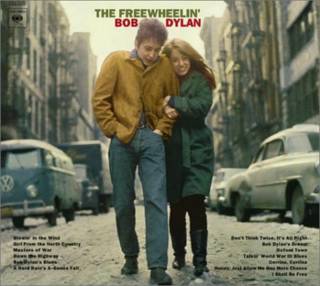
During the 1963 cover shoot for The Freewheelin' Bob Dylan, Dylan reportedly wanted to create Roy Schatt's 1954 photo of James Dean walking down West 68th in New York City. The Freewheelin' photo that would eventually be the cover uses Jones Street in Greenwich Village, a one-block street connecting West 4th and Bleeker, as its backdrop.
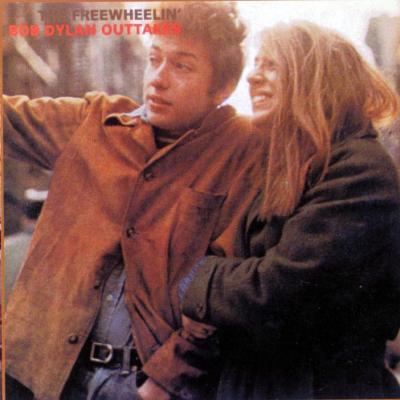
At least one other Don Hunstein photo from the same session has surfaced. Used as the cover art on The Freewheelin' Bob Dylan Outtakes bootleg, the picture also features Dylan's girlfriend at the time, Suze Rotolo, braced on his arm as he strikes an even more Dean-like pose.
We all emulate our heroes.
On the 50th anniversary of Dean's death, the state of California put up a sign at the intersection, naming it the James Dean Memorial Junction. If you travel about a quarter of a mile west, you'll find a memorial put up in 1977 by a Japanese Dean fan. It's engraved with Dean's name, date of birth and death, an infinity symbol, and what was reportedly Dean's favorite quote, "What is essential is invisible to the eye," from The Little Prince.
Back in the early `70s, none of that was there to see at the junctions of 41 and 46, just a lonely, dusty patch of California road. I sat on the hood of my car for awhile, watching the sun go down. And I got back in the VW, pulled onto the road, blinded then by the explosion of the sunset's glare, not able to see a thing.
And a car came out of the sunset light, engine screaming, horn blaring, swerving inches from my left bumper, and then gone.
I think it was a silver Porsche. It looked like a Porsche. But except for a lone, dark patch of rubber from its braking, there was nothing left to see.
I had stalled the VW in my fright. I started it up again and drove on. In a year I'd be in the Army, and on the road that would eventually lead me here, in my kitchen in New Hampshire, looking out the window at golden Fall light, writing this, in the year of our Lord, 2006.
[Rebel without a Cause theme]
This has been Fred Bals with the Dreamtime podcast, occasional commentary on Bob Dylan's Theme Time Radio Hour weekly show and occasionally commentary on other dreams. I'll be at Podcast Expo in Ontario, California on September 30th. If you're in the neighborhood, come by and say hello.
I'll be the guy wearing the red jacket... just like James Dean.
The opening Gig Young interview with James Dean on automobile safety and the closing Rebel theme were both taken from the beautifully produced Rebel without a Cause 2-disc DVD set. If you haven't seen Rebel - or haven't seen it in awhile, go watch it. The background music - provided tonight from the PodShow Podsafe Music Network. Check it out at 'music.podshow.com. The artist is nezecus.