Google
Web Dreamtime
SiteSearch Google

Wednesday, January 13, 2010

The Annotated “Flowers” Theme Time Radio Hour - Episode 11 (Part 1)

Being the 1st Part of a Compleat Transcript with Commentary on Episode #11 of Theme Time Radio Hour, "Flowers"

Original air date: July 12, 2006


***

There's much of note in Episode 11 -- "Flowers" -- of Theme Time Radio Hour, including monster lists, the largest group of def poetry readings in the show's history, quotations from Buddha, Isiah, and H.L. Mencken among others, a mystery laugh, appearances by two Dylan contemporaries from the Greenwich Village scene of the `60s, and some evidence that Our Host was wingin' his commentary as much as reading from a script. 

The transcript/commentary length was way past what I think a typical blog reader would tolerate, so I've split the "Flowers" transcript into two parts, Part Two can be found here. ~fhb


The Woman in Red: It’s nighttime in the Big City. Outside the dogs are barking. A woman walks barefoot, her high heels in her handbag. It’s Theme Time Radio Hour with your Host, Bob Dylan.

Bob Dylan: It’s time for Theme Time Radio Hour, and tonight we’re going to be talking about the most beautiful things on Earth – the fine-smelling, colorful, bee-tempting world of flowers: the Bougainvillea, the Passion Flower, the Butterfly Clerodendrum, the Angel’s Trumpets, the Firecracker plant.

Bob Dylan: We’re gonna be talking about rosa rugosa, the Angel Face, All that Jazz, Double Delight, the Gemini, and the Julia Child. We’re going to be talking about the Knockout Shrub, the New Dawn, the Mister Lincoln. And that’s only the roses! We’re also gonna hit on the Silver King, the German Statice, the Globe Thistle, and the Joe Pye Weed. The Violet, the Daisy. The lovely Chrysthanthemum. The Yarrow and the Tansy. We’ll be hittin’ on the Bachelor’s Button, the Coxcomb and the Lion’s Ear, the Love in the Mist and the Victoria’s Sorghum… I just made that one up. (laughs)”

[background laughter]

Bob Dylan: We’re gonna be talkin’ about… flowers. On Theme Time Radio Hour.

Commentary

“We’re gonna be talkin’ about… flowers.”

Richard F. Thomas notes in his 2007 essay, “The Streets of Rome: the Classical Dylan,” that “… Dylan’s surreal humor, consisting of absurdist juxtaposition, has become a trademark feature of his Theme Time Radio Hour... The [Flowers] list is arranged to form a poem, almost a talking blues of flower names.”

Thomas also points out that Gemini is Dylan’s birth sign. Whether that was in his mind or not, the Gemini hybrid tea rose that Dylan names is a favorite of rose exhibitors.

Other plants probably not familiar to the casual listener include the Silver King, commonly known as white sage, the German Statice, favored in dried floral designs, the Globe Thistle, a perennial that produces metallic-blue blossoms with perfectly round flower heads, and the wonderfully named “Joe Pye/Pie Weed” which takes its name from a legendary Indian healer who used the plant to cure typhus fever in colonial America.

Yarrow and Tansy are two inhabitants of old-fashioned herb gardens, the names probably more familiar to Shakespearean scholars than today’s gardeners. The crushed leaves of Yarrow are an astringent, still used by herbalists to help heal cuts. Legend has it that the Achilles used it for healing his soldiers after battle. It is also said to reduce inflammation, increase perspiration and relieve indigestion.

“…and the Victoria’s Sorghum… I just made that one up (laughs)”.

Dylan obviously enjoyed having an audience with him when taping his Theme Time narrative: the sounds of laughter, off-stage voices, even a kitten meowing can be heard during several shows.

The identity of the person heard laughing in the background during some TTRH segments, including this one, is unknown. Candidates include Eddie Gorodetsky, who was reportedly with Dylan during the taping of many of the early shows, and Damian Rodriguez, a San Antonio-based musician and sound engineer who has quietly worked in the background on several major Bob Dylan projects, including Theme Time Radio Hour. Together with XM Radio engineer Rob Macomber and associate producer, “Sonny Webster,” Rodriguez was the third member of the composite who would later be credited as “Studio Engineer, Tex Carbone.”

Bob Dylan: Thomas Beecher said, “Flowers are the sweetest things God ever made and forgot to put a soul into.” Anything that beautiful is going to inspire a lot of songs, and the next hour is gonna be chock-full of `em. We’re going to start things off with a Morning Glory of a song by the King of Western Swing… the man who pretty much invented it, Bob Wills and His Texas Playboys doing his theme song, “The New San Antonio Rose.” A bridal potpourri.

Commentary

“Thomas Beecher said…”

Most authorities cite Thomas Beecher’s sibling, the more famous Henry Ward Beecher, as the originator. Both Beechers were the brothers of the even more famous Harriet Beecher Stowe.

It’s interesting that Dylan mistakes Thomas for Henry, as even a casual web search on the quote brings up Henry Ward Beecher’s name. It’s likely that Dylan already knew the quote, was familiar with both Henry Ward and Thomas Beecher, and inadvertently used the wrong brother’s name on Theme Time when reciting the “Flowers are the sweetest things…” line from memory.

Thomas Beecher was a study in contradictions who would appeal to Gemini Bob Dylan. He was far more politically and socially conservative than his siblings. He opposed both abolition and the woman's rights movement, yet participated in the Underground Railroad and joined the Union army. While strongly against women’s emancipation, he publicly acknowledged his wife's role in running his parish, and accepted a woman as his own minister after he retired.

[Bob Wills and His Texas Playboys - “The New San Antonio Rose”]


Bob Dylan: Bob Wills and “The New San Antonio Rose.” It was called “The New San Antonio Rose” because he recorded a fiddle instrumental called “San Antonio Rose” eight years earlier.

Bob Dylan: Perhaps the most famous rose garden is the one in the West Wing area of the White House. It was established in 19 and 13 by Ellen Deweese [sic, actually “Loise”] Wilson, wife of Woodrow “Woody” Wilson.

Bob Dylan: Let’s move out of the Rose Garden for a second and move over to the boxwood border of the grass and go grazing with the Friends of Distinction. This song was written by South African trumpet player Hugh Masekela, but it became a big hit when it was recorded by The Friends of Distinction. “Grazin’ in the Grass.” “I can dig it, you can dig it.” We can all dig it. Let’s dig it together, shall we?

[The Friends of Distinction – “Grazin’ in the Grass”]

Bob Dylan: That was The Friends of Distinction, “Grazin’ in the Grass.” Speaking of grass, George Jones once had to drive down a freeway on his riding lawn mower. His wife, Tammy Wynette, was sick of his constant drinking. She emptied the house of liquor; she took away his car keys, and made him a virtual prisoner in an attempt to wean him off the booze. One afternoon, alone in the house, George wanted drink. The house was quite a distance from Nashville, too far to walk. So George hopped on the only vehicle he still had the keys to. You could see George heading down the side of the highway, going towards the liquor store on his riding lawnmower. Here’s George Jones with “A Good Year for the Roses.”

[George Jones -- “A Good Year for the Roses.”]


Commentary

The “riding lawn mower” is the stuff of George Jones legend, told not only by Jones in his autobiography, “I Lived to Tell It All,” but also by Tammy Wynette in her autobiography, “Stand By Your Man.” Jones also parodied the incident in his “Honky Tonk Song.”

I saw those blue lights flashin'
Over my left shoulder
He walked right up and said,
"Get off that riding mower."
I said, "Sir, let me explain
Before you put me in the tank.
She took my keys away
And now she won't drive me to drink."

Whether George Jones ever rode a mower to the liquor store – or did so more than once, as Jones also tells the story about his first wife, Shirley Conley, rather than Tammy – it’s too good a story not to tell, whether true or not. “When the legend becomes fact, print the legend.”

Bob Dylan: “I can hardly bear the sight of lipstick on the cigarette’s there in the ashtray.” “A Good Year for the Roses,” George Jones.

Bob Dylan: Robert Frost had something to say about roses in his poem called, “A Rose is a Rose.” It goes like this:

A rose is a rose
And was always a rose
But the theory now goes
That the apple’s a rose
And the pear is and so is
The plum, I suppose.


The dear only knows
What will next prove a rose
You, of course, are a rose
But were always a rose ~ Robert Frost, frosty poet.

Bob Dylan: ‘Course, Gertrude Stein took it one step further, with her immortal poem, “A rose is a rose is a rose.” And of course there is, “Roses are red, violets are blue. Some poems rhyme. This one doesn’t.”


Bob Dylan: Paul Clayton also has a song about roses. Paul has a lot of songs. He traveled all around the country collecting `em. During the Fifties, he made a collecting tour with Liam Clancy and together they found a whole bunch of blues, ballads and gospel music. I don’t know if this one was among `em, but it sure is a great song. All about young Bonaparte. Concerning the bonny bunch of roses. Paul Clayton.

Commentary

“Paul has a lot of songs.”

Indeed, Paul did have a lot of songs. Clayton and Dylan were contemporaries in the Greenwich Village music scene during the early Sixties. Dylan’s “Don’t Think Twice, It’s Alright” was based on a song Clayton had copyrighted, “Who’s Gonna Buy Your Ribbons When I’m Gone?” While from all reports, Clayton was flattered by Dylan’s appropriation, their respective publishers engaged in a legal battle over who was entitled to the royalties for Dylan’s version. A court eventually ruled that Clayton’s version was based on an even older song, “Who’s Gonna Buy Your Chickens When I’m Gone?” in the public domain.

“During the Fifties, he made a collecting tour with Liam Clancy and together they found a whole bunch of blues, ballads and gospel music. I don’t know if this one was among `em, but it sure is a great song.”

“Bonny Bunch of Roses” was collected by Clayton on that trip in the summer of 1956 and released on his 1957 album, "American Broadside Ballads in Popular Tradition."

[Paul Clayton – “The Bonny Bunch of Roses”]

Bob Dylan: That was Paul Clayton and “Bonny Bunch of Roses” on Theme Time Radio Hour.

Bob Dylan: Roses have been named after a lot of famous people. There’s the Cinderella Rose, the Cary Grant Rose. The General MacArthur Rose. Roses have been named after Judy Garland, Lady Diana, Snow White, Sir Lancelot, and Chevy Chase. However, the Himalayan Blue Poppy has nobody named after it.

Commentary

“Roses have been named after a lot of famous people.”

The Chevy Chase rose was named after the Maryland community and not the comedian. While the Blue Poppy doesn’t have anyone named after it, and even isn’t a rose by any other name, it is associated with the Tibetan Buddhist goddess known as Green Tara, the Buddha of enlightened activity. Perhaps that was what earned the flower a TTRH shout-out, a poppy among a half-dozen roses.


Bob Dylan: Christopher Marlowe wrote in “The Passionate Shepherd to His Love”:

Come live with me and be my love
And we will all the pleasures prove
That valleys groves, hills and fields
Woods or steepy mountain yields


And we will sit upon the rocks
Seeing the Shepherds feed their flocks
By shallow rivers to whose falls
Melodious birds sing madrigals


And I will make thee beds of roses
And a thousand fragrant posies
A cap of flowers and a kirtle
Embroider’d all with leaves of myrtle

That’s how Christopher Marlowe said it. Kim Shattuck and her band, The Muffs have another way of putting it.

Commentary

“That’s how Christopher Marlowe said it.”

Dylan appears to be reciting the first three stanzas of “The Passionate Shepherd to His Love” from memory. His version of the first stanza varies noticeably from the “official” version:

COME live with me and be my Love,
And we will all the pleasures prove
That hills and valleys, dale and field,
And all the craggy mountains yield.

[The Muffs — “Laying on a Bed of Roses”]

Bob Dylan: That was the Muffs, raisin’ Cain and laying on a bed of roses on Theme Time Radio Hour where we’re talking about flowers. Maybe a little too much about roses. They’re not the only flowers, and we know that. There’s all sorts of flowers, and they’re all beautiful. As a matter of fact, here are some official state flowers:

Bob Dylan: For our friends in Alabama, you got the Camilla. In Alaska, we have the Forget-Me-Not. In Arkansas, it’s the Apple Blossom. California it’s the California Poppy. In Delaware, it’s the Peach Blossom. For our friends in Georgia, it’s the Cherokee Rose. In Minnesota, it’s the Pink-and-White Lady Slipper. Mississippi has the Magnolia. In Nebraska, it’s the Goldenrod. New Mexico of course has the Yucca Flower. In New Hampshire it’s the Purple Lilac and in Tennessee it’s the Iris. “Aloha!” to our friends in Hawaii where the official flower is…. the Pua aloalo. And of course in Wyoming, it’s the Indian Paintbrush.

[Commercial clip: “Surround your home with natural beauty. Add charm to your private world. Landscape for personalized luxury.”]

Bob Dylan: If I was born with the name, Lucius Venable Millinder, I would be happy with that. But he changed it to “Lucky” and fronted one of the swinginest bands that ever played. If nothing else, he was the man who introduced singer and guitarist Sister Rosetta Tharpe to the American audience. But he made plenty of records on his own, and none of them swung better than this tribute to the fruit-bearing vine of the grape. Which only makes sense, ‘cause Lucky Millinder retired from music and spent his later years as a liquor salesman. Here’s Lucky Millinder, and his “Grape Vine.’ I wondered if he used this as his theme song?

[Lucky Millinder & His Orchestra – “The Grape Vine”]

Bob Dylan: Oooo, I’m starting to see pink elephants on that one. “Milk and honey are mighty fine, but I like the juice from the good grape vine.” Lucky Millinder, “The Grape Vine.”


[Duke Ellington & His Orchestra – “Tulip or Turnip?” (background)]

Bob Dylan: Here’s a song about some choices. “Tulip or turnip? Rosebud or rhubarb? Filet or plain beef stew?” This one’s by Duke Ellington and His Orchestra.

[Duke Ellington & His Orchestra – “Tulip or Turnip?”]

Bob Dylan: That was Duke Ellington and His Orchestra, featuring the great Ray Nance as vocalist. Ray was also a great trumpet player and one of the most famous jazz violinists.

Bob Dylan: The tulip was introduced to Europe in the middle of the 16th century, and soon became very popular in the Netherlands. It rapidly became a coveted luxury item and status symbol. A single bulb could cost as much as a thousand Dutch florins. By 1635, they were worth a hundred times as much. A sale of 40 bulbs was made for 100,000 florins. Just to give you an idea of how much that was a ton of butter only cost a hundred florins. And eight fat swine 240 florins. In February of 1637, tulip traders could no longer get these inflated prices. They began to sell and the bubble burst. It was worse than Black Friday, the stock market crash of 19 and 29. To this day economists use the phrase, “tulip mania” to refer to any large economic bubble. They might have been better off with turnips.

Commentary

Our Host’s information about “tulip mania,” including the line about “eight fat swine” is taken almost verbatim from its Wikipedia article.

[End Part 1 transcript.  Part 2 to come]

Wednesday, December 23, 2009

Requiem for a Top Cat - Arnold Stang 1918-2009


via The New York Times: "Arnold Stang, a character actor whose bespectacled, owlish face and nasal urban twang gave him a singular and recognizable persona, whether on radio or television, in the movies or in advertisements, or even in cartoons, died on Sunday in Newton, Mass. He was 91 and lived in Needham, Mass."

Which means he was living about 45 miles from me.  I wish I had known that.  I would have tried to have visited, and perhaps even interview, Mr. Stang if I knew he was that close.  Missed opportunity.

Among his other accomplishments, Arnold Stang was the voice of Top Cat, whose best friends got to call him T.C. "providing it was with dignity," as the theme song goes. And that's the Theme Time Radio Hour connection, if you're wondering. 

If you're around my age, you knew Stang from a variety of appearances, as the classic 96 lb. weakling on television shows and commercials and even paired with Arnold Schwarzenegger in the latter's first movie, "Hercules in New York."  You may also know Stang from his great comedic turn in It's a Mad, Mad, Mad, Mad World. According to Mark Evanier, "...Arnold was one of the few participants in that film to suffer an injury. At the hotel where the cast was staying, he slipped by the swimming pool and broke his wrist. The cast is well-concealed during the famous scene where he, Marvin Kaplan and Jonathan Winters destroy a gas station."

He will be missed.  Image above courtesy of Dreamtime pal "astang55," aka Carol, whose screen name always makes me smile.  The original was a gif animation, which got lost in translation.  Carol also passes on this wonderful Arnold Stang Flicker set, a very nice memorial to his memory.

Tuesday, October 27, 2009

Dreamtime's 2nd 3rd Annual Halloween Encore Special


As we've said before, what's good enough for Mr. D. and Eddie G. is good enough for Dreamtime too, and so it's time again for our traditional rebroadcast of  one of our favorite shows. First released in October, 2007, Episode 44 - The 2nd 3rd Annual Dreamtime Halloween Show.

Direct link to mp3.

Subscribe to the Dreamtime podcast


Listen now with the Dreamtime Player


Welcome to your other home for Halloween schemes, ghostly themes, and Kandy-Korn dreams. It's Dreamtime's 2nd 3rd Annual Halloween Show, the one time of the year where we get to let down our hair and pretend to be our favorite monster, superhero, actor, or deejay...

... and we all know who that would be, don't we?

Playing in the background, Haunted House, from Leon Redbone's first album. A dead man's party is where we're headed to first on tonight's musical Halloween tour. Here's Oingo Boingo with Dead Man's Party. See you on the other side, and make sure to leave your body at the door.

[Dead Man's Party - Oingo Boingo]

Oingo Boingo was founded in 1972 as the Mystic Knights of the Oingo Boingo, later changing their name to Oingo Boingo, and then to Boingo. If the band had stayed together they might have shortened it down even further to just Boing, but they broke up in 19 and 95.

The original Oingo Boingo appeared on Chuck Barris' The Gong Show in 19 and 76, getting a score of 24 points out of a possible 30 with an act that featured both a rocket ship and a dragon, and winning them $500 to boot. You can see that appearance on YouTube. Go check it out. As Chuck Barris says, "[They're] an act who may first shock you, but once you get to know them, they'll boggle your mind."

We all know Lord Invader from TTRH. Well, there was another calypso lord - Lord Intruder - who wrote a song called Jumbie Jamberee back in 19 and 53. "Jumbies" were spirits in the song who danced "back to back, belly to belly" in a Trinidad graveyard. Intruder published Jumbie Jamberee, but it would take some other groups to make the song popular in the United States. And they changed "jumbies" to "zombies" and the graveyard location to New York along the way. The Kingston Trio had a big hit with Zombie Jamboree in the mid-'50s, and Harry Belafonte liked the song so much he recorded it three times during the `60s and `70s. One of those versions is what we're going to listen to right now: Harry Belafonte and Zombie Jamboree.

[Zombie Jamboree - Harry Belafonte]


Did you hear that line about Bridget Bardot? Back in the '60s she probably been voted as the girl you'd most want to dance belly-to-belly with. At least, I would have voted for her.

You're listening to the Dreamtime podcast - where every show we do is an encore for somebody somewhere.

If you're a regular Dreamtime listener you already know our love of all things witchy, and what better time to do some more witch songs than our Halloween Special?


Kip Tyler and the Flips recorded She's My Witch way back in November of 19 and 58. Although you don't hear much about Kip these days, he and the Flips were a major California rockabilly force and the pride of the legendary El Monte Legion Stadium rock shows back in the `50s. Kip never made it to the big time, but members of The Flips would later work with Gene Vincent, Duane Eddy, and the Beach Boys. Spooky, sexy, and pure rockabilly: Kip Tyler and the Flips with She's My Witch.

[She's My Witch - Kip Tyler & The Flips]

Louis Armstrong had his first big movie break with this Johnny Burke tune from 19 and 36 we're going to play next. Satchmo originally recorded it with the Jimmy Dorsey Orchestra, and he and the song were featured in a spooky nightclub scene complete with dancing skeleton in the Bing Crosby musical comedy, Pennies from Heaven.

[The Skeleton in the Closet - Louis Armstrong]

We get all sorts of email in at Dreamtime, and I gotta tell you, I've fallen way behind in answering them. But, when you think that the Dreamtime team is just me, two cats and a couple of honky-tonkin' good-time gals, I'm lucky to get anything done. Anyway, here's an old email from last Halloween that I'm just getting around to answering. It's from a Peggy B. of New Harbor, Maine:
Dear Dreamtime: Love the show, although Jailbait and Joyride Jones aren't on enough. They should do their own show! But that's not why I'm writing. I was watching The Simpsons' Halloween Special and Bart Simpson said that Casper was the ghost of Richie Rich! I never thought of it before, but they do look a lot alike. Any truth to the story?

Thanks for writing, Peggy, but I think you need to get out more if you're starting to believe what a cartoon says.

No, there's no truth to the urban legend that the Friendly Ghost, Casper, is really the spirit of Richie Rich, even though it is a bit suspicious that you never see the two together. However, there's always been a question about whether Casper ever died or not, and whether he's a real ghost. Casper started his career in the early 1940s as the ghost of a little boy, but by the 1960s he had ghost parents, who apparently had ghost sex, and Casper was the result. But by 1995 and the Casper movie he was the spirit of a dead person again.

A very confusing situation, and we haven't even gotten into the question about how The Ghostly Trio became his uncles.

The Dreamtime podcast - answering all your ghostly trivia questions whether you asked them or not.

Two more witchy songs are coming on the turntable. You heard this first one last Halloween on Theme Time, with Screamin' Jay Hawkins doing the honors. Jay first cut the song back in 19 and 49, and it was the first single he ever released under the name Screamin' Jay. Nina Simone would cover it about 20 years later, in 19 and 65, and use it for the title of her autobiography: You already know what song I'm talking about, so let's get going.

[I Put a Spell on You - Nina Simone]

Nothing more needs to be said about our next artist or the song except this: here's Ol' Blue Eyes with the classic, Witchcraft.

[Witchcraft - Frank Sinatra]

[Trivia: Halloween around the World]

[Poetry reading: Halloween (excerpt) - Robert Burns, spooky poet]

We were just talking about that fender-bender of a poet, Edgar Allan Poe. Bob Dylan read his Annabel Lee on the Women's Names show back in Season One. So I don't need to, which you're probably all relieved to hear.

Poe wrote Annabel Lee in 18 and 49, and was his last complete poem before his death that same year. A lot of good artists have put Annabel Lee to music over the years, including this pretty version by Joan Baez, who included the song on her 1967 album Joan.

[Annabel Lee - Joan Baez]

Joan Baez and Annabel Lee on the Dreamtime podcast Halloween Special.


You might be familiar with Gene Simmons' - the other Gene Simmons, not the guy from Kiss - version of Haunted House from 19 and 64. We're not going to play that one, but the original from Johnny Fuller, which has a faster beat and a more interesting sound, I think. Listen to that wild guitar plucking to understand what I mean.

Johnny Fuller began recording in 1954, and probably is best remembered for his single All Night Long. That one and Haunted House landed him a spot on one of the `50s package shows, where he toured with Paul Anka and Frankie Avalon. Here's the first of the two 45s he'd cut for the Speciality label: Johnny Fuller and Haunted House.

[Haunted House - Johnny Fuller]

Bruce Springsteen covered that song too, during The River tour on a Halloween show. Bruce was carried onstage in a coffin.

By 19 and 62 Johnny had more or less retired from the music business, although he'd release one more album in 19 and 74. He worked as a garage mechanic until his death in 1985. I think he might have worked on my car once.

You're listening to the Dreamtime podcast, where we've commandeered Studio B of the Abernathy Building for Halloween night.

One of the hardest things about putting together tonight's Halloween theme show was finding a good country song about Halloween. You want songs about drinking, car wrecks, and fooling around, they're easy to find. But goblins, spooks, and monsters, no. I was thinking about using Porter Wagoner's Cold Hard Facts of Life, but I want to do a Murder show later this season, and that song's too much a natural for that one. (Porter Wagoner passed away during the production of this episode: He'll be sorely missed. - fhb)

I finally settled on Eddie Noack's Dolores. You remember Eddie, we featured Eddie's Psycho back in Dreamtime 28. You can go read more about him there, but right now we're going to play his Dolores.

[Dolores - Eddie Noack]

The 100-proof Texas honky-tonk, Eddie Noack, who would drink himself to death by age 47.

Dreamtime has a lot of listeners and readers from Great Britain, and we wanted to thank you with what I think is the oldest song on tonight's playlist, recorded on October 30, 1931 by Ray Noble and the New Mayfair Orchestra. I don't have a lot more information on this one... maybe one of my listeners from Merry Olde England can help me out. A trip through yet another haunted house on tonight's Dreamtime Halloween tour, here's the New Mayfair Orchestra and The Haunted House.

[The Haunted House - The New Mayfair Orchestra]

Dreamtime has a long history with this next artist. I'm part of the crowd noise on the album Where's the Money recorded live at the Troubadour back in 19 and 71, when Your Host was all of 19 years of age. And in about a year I'd find myself at the Winterland Ballroom in San Francisco watching Symphony Sid Page and Papa John Creach do a burn-the-house-down duet on this song. I Scare Myself is about... it's about.... Well, it's about five minutes long.

[I Scare Myself - Dan Hicks and his Hot Licks]


Dylan told us to "go Google" Kay Starr after he played her Wheel of Fortune on the Luck episode, and Dreamtime has another Kay Starr cut for you, appropriate, as they say, to the season.

Bing Crosby originally recorded The Headless Horseman in 19 and 49 for Disney's The Adventures of Ichabod & Mr. Toad. Kay covered the song a few months after the movie. She's backed here by the Billy Butterfield Quintet and - I kid you not - The Three Beaus and a Peep. Kay Starr and The Headless Horseman.

[The Headless Horseman - Kay Starr]

Kay Starr with a pretty spooky thing. And that sounds like a cue for our last song. We couldn't let Rocktober pass without at least one Classic Rock song, and here's a good one, the Classics IV with their first national hit. From 19 and 67 on the Imperial Records label, the original (non-instrumental) Spooky.

[Spooky - Classics IV]

I hear the banging on Studio B's door, so I think it's time to get out of here before they start using the fire axes. Tex, thanks for letting me sit in The Man's Seat for this Halloween. Hope I filled his shoes in my own small way and if there's anyone from Cadillac out there - the address is dreamtimepodcast@gmail.com . I'm always available to fill in.

[Close]


Tonight's Playlist

1. Haunted Mansion - (Disney)
2. Intro (Bed Music) Haunted House - Leon Redbone
3. Dead Man's Party - Oingo Boingo
4. Zombie Jamboree - Harry Belafonte
5. She's My Witch - Kip Tyler & the Flips
6. Skeleton in the Closet - Louis Armstrong
7. I Put a Spell on You - Nina Simone
8. Witchcraft - Frank Sinatra
9. Annabel Lee - Joan Baez
10. Haunted House - Gene Simmons
11. Dolores - Eddie Noack
12. The Haunted House - New Mayfair Dance Orchestra
13. I Scare Myself - Dan Hicks and His Hot Licks
14. Headless Horseman - Kay Starr
15. Spooky - Classics IV

Many of the songs for tonight's show were inspired by Mark Harvey's article for the on-line Halloween Magazine.

***

You've been listening to the Dreamtime podcast – occasional commentary on Bob Dylan's Theme Time Radio Hour. Dreamtime is researched and written by Fred Bals and is a Not Associated With production. As the name says, we're not associated with XM Radio, Bob Dylan, or much of anything else.

Some of the music on Dreamtime is provided via the Podsafe Music Network. Check it out at music.podshow.com.

Remember that the Dreamtime team loves to get email. You can write us at dreamtimepodcast@gmail.com

The Dreamtime top cats are Curly Lasagna and Shaggy Bear. Our announcers are the notorious honky-tonkin' sisters, Jailbait and Joyride.

Until next time, dream well.


Sunday, October 18, 2009

100 Theme Time Radio Hour Polaroids


I think even the most diehard, hopeful fan would admit that Theme Time Radio Hour is over. Sirius XM shows no sign of ending the re-runs, although I suspect one Wednesday we'll tune in and the show will have been replaced with "The Wit & Wisdom of Tom Waits" or something. But over or not, there are still many things to document about TTRH, and we expect to be around for a while longer.

One of the things that has always delighted us about Theme Time was how it inspired so many people in so many ways. Over the past three years, we've heard more than a half-dozen hommages to the show, using anything from reggae to Canadian artists to movies to Bob Dylan's own work as source material. Many were as good as any episode of TTRH. We've seen the show, its artists, the music - even jokes and recipes - all artfully documented. And several fans have created "cover art" for the episodes, including my favorites from a fan who calls himself simply "Man-on-the-Street."

MotS has updated and uploaded all 100 of his TTRH "Polaroids" on Flickr. Whether you use them as CD cover art or not, you'll want to take a look at the collection if you're a TTRH fan. Many of the 100 covers are very funny visual puns, worthy of the show itself. If the TTRH team wander across the 100 Theme Time Radio Hour Polaroids at some time, I think they'll be pleased with what they inspired.
"[He] hates for you to tell him how much he meant to you all your life, through your young years -- he doesn't want to hear that. What he wants to do is tell you the good things about you, so that you can do your own work; he doesn't want you to be involved with him, he would rather inspire you to do your own work..." ~ Patti Smith on Bob Dylan

Monday, October 12, 2009

Betties & Ditty-Bops: Deconstructing Christmas in the Heart's Credits


I have the admittedly weird tic of reading credits and acknowledgments from beginning to end, word-for-word, partly because I dated a lady in the movie biz who got me into the habit of watching a film's end credits as the rest of the audience filed out. "I like to see which of my friends is working," she told me as gaffers, sound synchers and "best boys'" names scrolled down. So be it movie, book, or music, it's always interesting to me to to see the credits of the team that put a project together. Here's some background on the "Christmas in the Heart" credits.

Front Cover

Designer Coco Shinomiya found the CD's Victorian sleigh cover illustration - which many people feel has a distinctly Russian bent to its look - at visuallanguage.com, one of the 150 images on a CD titled "Victorian Scrapbook Treasures II."

As all true Theme Time Radio Hour fans should know, Shinomiya is a graphic designer and art director and two-time Grammy nominee. Look at the credits of any Bob Dylan project of recent years and it's likely that Shinomiya had a hand in its design, including creating the Theme Time Radio Hour iconic logo.


Inside Photo

At the beginning of this article, a detail from Leonard Freed's inside photo for "Christmas in the Heart," a 2000 image taken in Rome of Italian street musicians breaking from their Santa rounds.

Born in Brooklyn in 19 and 29, Leonard Freed began his career in photography while in the Netherlands in 1953. He moved to Amsterdam in 1958 and photographed the Jewish community there, pursuing the theme in numerous books and films. His book on Jews in Germany was published in 1961, and "Made in Germany," about post-war Germany, appeared in 1965.

Working as a freelance photographer, Freed photographed blacks in America, the Yom Kippur War in 1973, and a series documenting the New York City police department from 1972 through 1979. He passed away in 2006.


Back Cover Illustration

The back cover illustration of the Three Kings following that Star of Wonder was created by the delightfully named Edwin Fotheringham, a name which sounds as if it could easily belong to "Christmas in the Heart's sleigh driver. Fotheringham was educated at the University of Washington School of Art in Seattle, where he lives today with his family.

According to his on-line bio, "...Fotheringham made a career change from fine artist/stockboy to illustrator in 1992...Having certain band members as housemates afforded Mr. Fotheringham the opportunity to illustrate their CD covers..."

Among his other credits, Fotheringham has illustrated album covers for the band, Mudhoney, and provided illustrations for Neiman Marcus, The New Yorker and Ladies' Home Journal. He's also illustrated two children's books, "What To Do About Alice?" and "Mermaid Queen." "Mr. Fotherigham," as he appears to like to refer to himself, has a great web site, well worth the visit.

Mixed Voice Singers

If anything gives "Christmas in the Heart" that late `50s/early `60s vintage feel it's the "mixed voice" chorus which sounds as if teleported directly from a Ray Conniff Christmas Special. Two members of that chorus - Amanda Barrett and Abby DeWald - are better known as The Ditty Bops, an L.A.-based duo with five albums to their credit.

Six of The Ditty Bop's songs have aired on the TV show "Grey's Anatomy," with their song "There's a Girl" appearing on the series soundtrack. The duo has also made appearances on Garrison Keillor's Prairie Home Companion.

The "Notorious" Bettie Page

The once and forever "Queen of the Pin-Ups," Bettie Page lived as complicated a life and career as Bob Dylan. Somewhat like Bob Dylan, Page's public image evolved into a series of archetypes - Jungle Queen, Girl Next Door, Good Girl Gone Bad - during the `50s. She faded away into obscurity and then saw her legend revived once again in the 1980s.

In 1950, during a walk along the Coney Island shore, a 26-year-old Bettie Page met Jerry Tibbs, a police officer with an interest in photography, and a member of what was euphemistically termed an "outdoor camera club." While there were numerous legitimate camera clubs of amateur photographers operating in the `40s and `50s, Tibbs belonged to one of the quasi-legal groups whose main purpose was to photograph young ladies in various states of déshabille... only for "art use" of course.

Within a few months, Page was posing for various men's magazines of the era, with titles such as Wink, Eyeful, Titter, and Tab. In 1955, Bettie won the title "Miss Pinup Girl of the World" and in January 1955, hit the big time as centerfold in Playboy in a photo session that would inspire the Olivia illustration used for "Christmas in the Heart."

Page's life was plagued by exploitation - even of the relatively mild pin-up and stag film "girlie" industry variety - bad marriages, and in her later life, clinical depression. By 1959, she had ended her pin-up career and had refocused her life on Christianity. In the early 1980s, comic book artist Dave Stevens based his hero's love interest on Bettie Page in the ground-breaking series "The Rocketeer." The popularity of the comic, along with a fanzine titled "The Betty Pages," which included photos from the camera club days, sparked renewed interest in Page's life and career. Dave Stevens would eventually become a close friend of Page, remarking in one interview that he could never have imagined that he would be cashing Page's social security checks and picking up groceries for her when he created "Betty Page" in "The Rocketeer."

Bettie Page passed away on December 6, 2008, leaving behind many fond memories for the boys and men who grew up with the images of "That Girl Next Door."

Out of curiosity, I ran "Bettie Page" and "Bob Dylan" together in a Google search, discovering that they had been separated from each other by a mere five degrees of dating, according to one web site. Probably more fantasy than fact, since Bettie Page's "date" with Sammy Davis Jr. apparently consisted of a shared taxi ride, but there's something attractive about the idea.

Thursday, September 24, 2009

The "Tarantula" Photo Session

Some edits made in 2014 with new info from a Dreamtime correspondent.

A thread over at the Expecting Rain forums had me searching out the history of the photo to the left, one of a series taken in March 1965 by Daniel Kramer at a cabin located on Albert Grossman's Bearsville estate. The location is a storage shack on Peter Yarrow's mother's (Vera Yarrow) property in Woodstock, according to a conversation between Kramer and Bob Egan, of the fabulous PopSpots site.  According to Kramer, most of the "weird ephemera" were books, magazines and family memorabilia from the Yarrow family -- including the photo of the man on the left.

Bob Dylan is in the foreground with Sara Lowndes - soon to be Sara Dylan - standing in the doorway.

This is one in a group of five or six shots taken by Kramer and intended (as Kramer relates in his 1967 book of photos, Bob Dylan) for the cover of Tarantula. Kramer and Dylan intentionally tried to replicate the look-and-feel of Kramer's iconic cover for Bringing It All Back Home, a little too successfully, as the photos were ultimately rejected as being too similar.

As with the Bringing It All Back Home photo, Dylan is surrounded by a variety of weird ephemera, and as with the better-known photo, there's a tendency to read more into their significance than they probably deserve. Both Kramer and Sally Grossman have said in various interviews that most of the props used in the Bringing It All Back Home shoot happened to be at hand and Kramer used because he thought they fit. The same can probably be said of the props for the unused "Tarantula" photos.

I've only be able to identify a few of the props. From the bottom center and moving clockwise:

Playing Cards: Ace of Spades, Facedown card, Queen of Spades, Jack of Spades, Joker

Woman's Day Book of American Needlework by Rose Wilder Lane (1963)

Unidentified box. The word "Religious" can be read at the upper right corner.

Cardboard cut-out of Beagle.

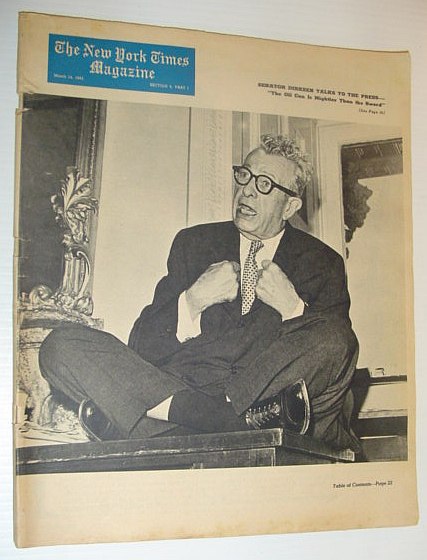
Unidentified magazine. The magazine is the Sunday, March 14th, 1965 edition of the New York Times Magazine, and the person portrayed is indeed Senator Everett Dirksen, a politician probably best-remembered today for the phrase, "A billion here, a billion there, and pretty soon you're talking real money." (in fact, Dirksen probably didn't say that, but the quote is usually ascribed to him).

Paper with Handwritten ALWAYS!!! A faint sketch of a face can be seen below the words.

Unidentified photo.

Unidentified record cover. Label is Verve. The cover is likely DVORAK: Slavonic Dances. JEAN MARTINON conducting the London Symphony Orchestra. RCA VICTROLA STEREO Record Album (VICS 1054).

Unidentified record cover (not seen in all photos in the series): "The (unreadable) Jug Band."  As also noted in the comments, The album is a 1962 compilation on the OJL label, titled "The Great Jug Bands."

Needlepoint reading "Be True To Me. Let Me Be True to Myself."

Dylan is holding a copy of The Bhavans Journal in his right hand, probably belonging to Sara, a magazine focused on Indian culture, life, and literature, established in 1954 and still being published. His cloth "sailor's cap" is in his left hand.

The full series of photos can be found at Dylanstubs.

Wednesday, September 23, 2009

From The Hank Williams Project: Lucinda Williams - I'm Happy I Found You


Sometimes you write an article so you can write the article. I was hoping that if I tossed some bread out on the water it might get returned threefold, and lo and behold, Dreamtime correspondent "Joe," wrote to tell us,

"...I was in Minnesota Friday (September 18, 2009) for Lucinda's show and her on-stage wedding. Before the ceremony she sang her Hank Williams collaboration..."
With a little luck and judicious searching, I found this well-shot video of Lucinda Williams performing for the first time live her song from The Hank Williams Project, "I'm Happy I Found You." Her introduction to "I'm Happy I Found You" begins at 4:52 seconds into the clip.
"...this was written by Hank and me. The reason I say that, it's interesting, because some lyrics were found of Hank Williams without the music. So I was asked to choose a song and write the music... for an album that Bob Dylan was putting together... it's still not out yet, I don't what's going on with it...but anyway... it's a very unusual set of lyrics for Hank.  The other, special reason I'm doing a Hank Williams song is because Hank Williams was married on stage. And I figured... if it's good enough for Hank,  it's good enough for us.  This is called, 'I'm Happy I Found You'."
After the song Williams married her manager and sweetie, Tom Overby, in an on-stage ceremony, borrowing the idea from Hank Williams' wedding to Billie Jean Jones Eshlimar on October 19, 1952.  Williams actually had married Eshlimar a day earlier in a private ceremony, but staged two public ceremonies on the 19th at the New Orleans Civic Auditorium where 14,000 seats were sold for each ceremony.  Apropos for Williams' complicated life, a judge ruled after his death that none of the weddings were legal due to Billie Jean’s divorce not being finalized until eleven days after she had married Williams.  A quarter of a century after the marriage, a federal court finally ruled it valid.

"I'm Happy I Found You." is another pretty piece, equal to Norah Jones "How Many Times Have You Broken My Heart?" and as Lucinda says, has an unusual sentiment for a Hank Williams song. Here's hoping we get to hear the remainder of the songs from The Hank Williams Project before the end of 2009.  If any of our readers have any news to add, let us know at dreamtimepodcast@gmail.com.

Thursday, September 17, 2009

Howard Stern on 'The Family Hour', With His Usual Sense of Class


Howard Stern: ...bringing up Dylan. So Gary's driving in his car the other night aaaah, listening to Sirius XM. And y'know, it's really kinda funny, 'cause when Sirius and XM were two separate companies, I used to be somewhat envious of the fact that XM had Bob Dylan doing a show. Like I had only heard about it. I never actually heard the show. But I was envious saying, 'Wow, it's really cool that they had Bob Dylan.' They probably had to pay him some decent money to get him to do it, because he's such a recluse. That's a cool move, being such a recluse than when you do anything it's a big deal. So I said, 'Wow, if there's any programming I'm envious of on XM it's because they've got the Bob Dylan... it's like called 'The Family Hour,' and he would spin records and he would talk about his life.

But I never actually heard the show. And Gary called me over vacation and he goes, 'Did you ever actually hear the Bob Dylan show?' And I go, 'Uh, no. Is it awesome?' And he goes, 'I don't know a fuckin' thing he said.'
It's a cool thing to say you have Bob Dylan, but if you actually listen to the show, he's unintelli-- it's like his music, when he performs [does stock bad Dylan imitation] - he sounds like a rabbi or something. When he's talking, I defy you to figure out what he's talking about. And the music he plays is kinda out there. It's nothing, y'know it's nothing you'd really want to hear...
It's been a depressing week for Theme Time Radio Hour news - the anniversary passing of when we could look forward to the start of a new season; the unofficial cancellation - apparently - of the TTRH Compendium book. I debated with myself on whether to bother to post the clip above, nine minutes of Howard Stern and crew insulting Bob Dylan and Theme Time Radio Hour. But Self pointed out that Dreamtime's mission statement is to be the premiere source of TTRH news and commentary on the Web, good or bad.

So here it is. I should point out that some of the audio and accompanying visuals could be considered NSFW, so be forewarned. As I said, the clip is nine minutes plus, with Stern playing what sounds like deliberately distorted clips from TTRH to bolster his "unintelligble" argument.. I say "deliberately distorted" since I have better-quality copies of the show, so you would think someone with the resources of Howard Stern could find them too. I'm not sure when this clip originally aired. It was posted on YouTube about a month ago.

Stern goes on to make predictable fun of the various Dylan commentaries and ends on the usual Howard Sternesque whiny note, reading glowing excerpts about Theme Time from an old Washington Post article while complaining about how his show is treated by the Post.

I wonder why.

Tuesday, September 15, 2009

Theme Time Radio Hour Compendium, ah, Update?

The little book that wasn't there, the Theme Time Radio Hour Compendium, recently had a title change on its Amazon page to: "Bob Dylan Untitled Christmas Book" (Hardcover).  The book, which has been listed on Amazon since 2008, also had a publication date change, now advanced to November 1, 2011.

You'll note if you go to the Amazon page that it still uses the TTRH Compendium cover mock-up, pictured to your left.

If I had to hazard a guess, I'd guess that this is simply a placeholder by Amazon for a book that may or may not get published and probably won't have anything to do with TTRH if/when it does get published.  It's worth noting that the book, under any title, no longer appears in the Simon & Schuster catalog.

I know something of the background of the planned Compendium, as I was in discussions at one point with the TTRH team to do some work on the project.  But eventually they decided they couldn't do the book they wanted to do within the delivery time that Simon and Schuster wanted, which was for a Christmas `08 release.

That begs the question of why the book wasn't moved to the Christmas `09 season, and for that question I don't have an answer. Timing may have had something to do with it. My impression was that Dylan's camp already had its attention turned towards other projects by late 2008 and from their perspective TTRH was a closed book (no pun intended).

I also don't know what the planned content for the Compendium was - I'm not sure the book even got to the planning stage.  But at its advertised 176 pages I suspect it would have been a piece of mostly visual ephemera similar to the Bob Dylan Scrapbook, probably a good Christmas present for the Dylan fan or TTRH listener in your family.  "The Bob Dylan Scrapbook" sold a very respectable 125,000+ copies in 2005 according to Publishers Weekly, and perhaps the Compendium would have done as well.  In any case, an opportunity missed for them - and for me - but maybe it will turn out to have been a Good Thing for me and my book in progress.

There was also some talk in the TTRH camp in late 2008/early 2009 about a series of "Theme" books, too, tying into and extending the TTRH franchise after the show's radio run.  Again, I don't know whether that idea has been back-burnered or abandoned, probably the latter would be my guess. But it's possible that the "untitled Christmas Book" might be the first of those theme books. It's just as possible that, still under contract to deliver a book, Dylan's people said, "Yep, yep. We'll have that book for you Real Soon Now - sometime between now and when the contract expires in 2011."

Monday, September 14, 2009

This Week in Theme Time Radio Hour History

A sad milestone this week.  Two years ago, on Wednesday, September 19, 2007, Season 2 of Theme Time Radio Hour began with the "Hello" show. As well as airing some notable shows, "Classic Rock," "Lock & Key," and "California" among them, Season 2 would hold several surprises for listeners:

While never completely phased out, email readings would gradually lose ground to a new segment - listener phone calls to Studio B.

TTRH finally aired the series' long-promised "Classic Rock" episode, with music featuring rocks of the mineral sort.

The first TTRH rerun aired on October 31st 2007, a repeat of Season 1's "Halloween" show.

TTRH would do a second "Countdown" show with all-new material, the series first theme to cross two seasons.

Season 2 would end without explanation with the "Cold" show on April 2, 2008 after only 25 episodes being aired, in contrast to Season 1's 50 shows.

I get email on a regular basis asking if I have any information - positive or negative - about a Season 4 of TTRH.  Season 3 of TTRH began on Wednesday October 3, 2008 with almost no fanfare...only mentioned in a press release from Sony and in some media articles a week or so earlier. Given that Dylan's Christmas album, Christmas in the Heart, is scheduled for release on October 13, there's a very slim possibility that October 14 would be the logical start date of a Season 4.  But, there's currently no evidence of that likelihood and, in truth, more evidence against the possibility.  Mr. D. made it clear in his May 2009 Rolling Stone interview that his work on TTRH was over, although he did offer up the slight hope that he "didn't know" whether he would continue, and that Sirius XM seemed eager for more episodes. While Sirius XM continues to mention Dylan and TTRH in its publicity materials, it has yet to make an official announcement on the show's future.  At present, the show has become the I Love Lucy of radio rebroadcasts, as one commenter pithily put it.

All good things come to an end, and my opinion is that the series has ended. But we have those 100 shows, and our memories. During an interview with one of the members of the TTRH team, I asked if there had been any resentment on their side about  the show being copied and distributed over the internet within days - sometimes within hours - of being broadcast on XM. 

"We were much more concerned about a show getting bootlegged before it 'officially' aired on the radio," he answered. "And we devoted most of our energies to making sure that didn't happen, rather than trying to stop what we knew we couldn't stop. Actually, we thought it was kind of cool that all the shows ended up on the web.  It means Theme Time Radio Hour will live forever."

Tuesday, September 08, 2009

Swingin' the Alphabet: The Three Stooges


"And no, I didn't wanna to play it, but I get requests for 'Swinging the Alphabet,' every show. Must be a lot of Larry, Moe, and Cheese fans out there." ~ Eddie Gorodetsky, Saturday Night Hi-Fi Party, 1978

Cheesy, yes, but catchy, too.  If you're one of the multitude who grew up watching the terrible trio on TV, "Swinging the Alphabet" is likely to be one of your clearest memories from a Three Stooges short. The novelty number was sung by the boys in their 19 and 38 film, Violent is the Word for Curly, a parody of the title of a popular film from a few years earlier, Valiant is the Word for Carrie. The version that Eddie G. played on his WERS radio show was probably taken from a 19 and 59 LP on the Coral label,  "The Nonsense Songbook," where it was retitled as "The Alphabet Song."

Although everyone from director Charley Chase to one or all of the Three Stooges was credited with composing "Swinging the Alphabet," it was actually adapted from a song written some 60-odd years earlier by one Septimus Winner under the title, "The Spelling Bee," a discovery not made until 2005 by film historian and Stooges buff, Richard Finegan.

Now let me see what you can do,
And spell for me, Bicki-bi-bo-bu.

CHORUS 1: B, A, Ba, B, E, Be,
B, I, Bicki-bi, B, O, Bo,
Bicki-bi-bo, B, U, Bu,
Bicki-bi-bo-bu. ~ "THE SPELLING BEE" (1875) Humorous Song and Chorus.

Interestingly Winner, a popular 19th century songwriter, also composed "Listen to the Mockingbird," which was used as the theme music for the early Three Stooges shorts, until eventually replaced by "Three Blind Mice." According to Finegan's article, director Charley Chase's maid was fond of singing "The Spelling Bee"'s chorus to his children, and he brought the tune into the studio for the Stooges when they needed a melody to break up the action in Violent is the Word for Curly.

Monday, September 07, 2009

Theme Time Radio Hour Season 2: New Compilation from Ace Records. U.K.

The good people over at Ace Records U.K. were kind enough to send Dreamtime an early review copy of their second compilation of Theme Time Radio Hour music, "Theme Time Radio Hour Season 2," available today (September 7, 2009) in the U.K. and tomorrow (September 8, 2009) in the U.S. at better retail outlets everywhere.  You can pick it up in the United Kingdom by following the Ace Records link above. Get it in the Amazon U.S. store through the image or title links above.

As its title implies, the new 2-CD set includes 50 cherries plucked from the 375 tracks played over Season 2 - opening with The Sherman Williams (not Sherwin Williams Our Host would remind us) Orchestra's "Hello," and closing with Rilo Kiley's "With Arms Outstretched."

Sandwiched between is music spanning eight decades, from The Georgia Crackers 1927 "Diamond Joe," to Jolie Holland's "Goodbye California," released in 2004. Jump, jive jazz. Nouveau wave and novelty. Captain Beefheart and Desmond Dekker. Parties, Pretty Girls, and Cadillacs. The Cold Hard Facts of Life, Gloomy Sundays and a Young Man's Blues. The package inludes a "fully illustrated 40-page book packed full of rare photographs and memorabilia including detailed notes on each track..." according to the Ace publicity blurb. That material wasn't ready when they sent me the review CDs, so I can't comment on it.

Unless you happen to be TTRH producer, Eddie Gorodetsky, who had a hand in putting this compilation together, or a very dedicated listener to the series, the chances are you'll hear several songs you've never heard before that will amuse and delight you.

However, there's an inherent flaw with Ace's TTRH: Season 2, as there is with the half-dozen other collections of music inspired by the radio show, and we might as well get that issue of the way now. TTRH: Season 2 is not TTRH: The Show. It does not include any of Bob Dylan's commentary on the songs, nor any of the other features that made Theme Time Radio Hour so memorable. No def poetry, no bad jokes. No jingles, no airchecks, no phone calls. No Ellen Barkin. No Top Cat behind the ending credits. Just the music, folks. I emphasize this because you wouldn't believe the bitter email I get from people who feel that they're being rooked out of their hard-earned shekels every time a new TTRH music compilation is released, no matter how much a label like Ace emphasizes that they're only offering the music.

Given that, do I still recommend TTRH: Season 2? Yes, with the qualification that you understand you're not getting the show itself. But as with the first Ace compilation covering Season 1, listening to TTRH: Season 2 is like listening to a mixtape put together by a very musically-knowledgable pal, maybe a sneak peek into Eddie Gorodetsky's fabled music collection, maybe a chance to hear some of the music on Bob Dylan's lost iPod, as a fortunate few were rumored to have done way back in 2005.

Being the compleat collector that I am, I have every TTRH music compilation in existence, as well as a bunch of other weird ephemera associated with the show, including a half-eaten burrito stolen off of Tex Carbone's sound board. Of the half-dozen compilations, Ace's "Theme Time Radio Hour Season 2," and its Season 1 predecessor are easily the best collections of TTRH music currently available. That's not only because both have the imprimatur of the Theme Time team, but also because Ace went to the trouble of including contemporary music still under copyright, as well the older, royalty-free pieces used in the various other collections. Unlike other compilations of the show's music, with TTRH: Season 2 you get a taste of the full breadth and depth of the music played on Theme Time Radio Hour. At Dreamtime we say, "accept no substitutes."

Thursday, September 03, 2009

And Even More "Richards"

You never know what's going to inspire reader reaction, but yesterday's post on "Open the Door, Richard" generated a ton of email. The Dreamtime transcriptions are apparently popular, as several correspondents asked for a transcription of what Mr, D. had specifically said about the song, Dusty Fletcher, and Jack McVea. So here we go, with appropriate accompaniment...

Our Host: "This is Theme Time Radio Hour and we're talking about Locks and Keys. One guy who talked a lot about `em was a comedian named Dusty Fletcher. He played in vaudeville and traveled the chitlin' circuit. He had a live routine that became one of the most famous records of the `40s. He'd walk out on-stage with a ladder, lean against the curtain, and call up to his friend Richard. He had locked himself out of the house, and he needed Richard to come down and open the door. Richard wasn't much help as he was probably intoxicated. It's actually much more interesting when you hear Dusty Fletcher tell it. Let's listen to a little bit of Dusty."

("Open the Door Richard" - Part 1 Dusty Fletcher [excerpt], January 1947)


Our Host: "Dusty's record reached #2 in the R&B charts, but another performer named Jack McVea recorded a more rhythmic version, and it made the song a national phenomena. By 1947, there were at least 22 versions of it. Louis Jordan did it. Dick Haymes, The Pied Pipers. There was a group called The Yokels that sang it in Yiddish. Bob Hope and Fred Allen would just mention Richard and the studio audience would crack up. Everybody was quoting the song like they quote [? ] today. Here's Jack McVea, with 'Open the Door, Richard.'"

("Open the Door, Richard" Jack McVea & His All Stars January 1947)


Our Host: "And listen to this..."

("Open the Door" Clive and Naomi 1965 [excerpt])


Our Host: "Not only were there country, polka, pop, and Yiddish versions, almost 20 years later it was inspiring ska musicians. Listen to a tiny bit of this, by Clive and Naomi....

Our Host: "'Open the Door' by Clive and Naomi. You see, that song can be done any kinda way. 'Bout time for it to come back again. Maybe I'll even do it...".


("Open the Door, Homer" Bob Dylan and the Band 1967 [unreleased out-take])

And Some Notes

Even after repeated listening, I still can't make out what word Mr D. says in the line, "Everybody was quoting the song like they quote [ ? ] today," It sounds like "Bo-ad" or maybe "Bo-at." Maybe someone with a better ear can decipher it.

I received several emails on the controversy over who "wrote" "Open the Door, Richard," with one correspondent - who prefers to remain anonymous - feeling I had given Dusty Fletcher short shrift. Anon. noted, "Fletcher was actually filmed performing 'Open the Door Richard' two years earlier [than McVea's recording] in 19 and 45, so he has to be considered the undisputed 'Richard' champ."

Well, no. As I replied to anon., the film is of Fletcher's comedy routine, not of him performing the song. You can see the 1945 short "Open the Door Richard" at the internet archive, if you're interested. The "Richard" routine starts about three minutes into the 9 minute film. Was McVea's song based on Fletcher's routine? No dispute there. Did McVea create a separate, musical work? I say yes.

A few people questioned which came first, McVea's or Fletcher's recording of "Richard." It sounded to me that Our Host implied that Fletcher's recording was first, although his remarks can be taken either way. In any case, both recordings were released in January 1947. Labels tended to move fast when there was a hit - and money - in the air. This Time magazine article, which also appears to be one the sources for Mr. D.'s commentary, notes that eighteen cover versions of the song were either in print or in the chute within a month after the original's release. Interestingly, the reporter writes that John Mason was "hastily cut in for half the profits," after his lawyers contacted McVea, but makes no mention of Fletcher or his "Richard."

According to various sources, McVea's "Richard" was recorded in either September or October 1946, although not released until January 1947. All the evidence points to Fletcher going into the studio and recording his cover literally days after after McVea's release. The label of Fletcher's National single notes him as the "originator" of "Richard," evidence that there was another "Richard" already out there. And, of course, the melody is obviously from McVea's "Richard."

And finally, the appropriately named "Richard" wrote in with this nugget. "The identity of the mysterious "Don Howell" [who shared co-writing credits with Fletcher for the music after the lawsuit dust settled] was none other than Decca owner, Dave Kapp. Current releases of 'Richard' credit Kapp. I guess Jack McVea was right that he was screwed out of his just due."

Thanks to all for writing in.

Wednesday, September 02, 2009

Open the Door, Richard


Yesterday's (Tuesday, September 1, 2009) Expecting Rain news page had a couple of interesting links provided by über-correspondent, Scott Miller, pertaining to the novelty hit single of 19 and 47, "Open the Door, Richard." One of the links was to a detailed Wikipedia article on the history of the song, which I commend to your attention. The nature of Wikipedia is such that it's often hit and miss when it comes to either accuracy or quality. But you'll occasionally find well-written articles that carefully cite their sources, as does this one. I question some of the anonymous author's conclusions, but that's what makes horse races.

Although the article says "Open the Door, Richard" started out life as a vaudeville routine, it's more likely that it was first a song on the blackface circuit, written by the great Bob Russell, who was working in a troupe called "The Florida Blossoms" during the mid-1900s. According to Pigmeat Markham, he of "Here Come De Judge" fame and one of several performers who would popularize the "Open the Door, Richard" routine, Russell wrote the song for a skit called, "Oh, You Mr. Rareback," and it was performed and possibly expanded by "Spider Bruce" (John) Mason. According to the book This is Pop, Mason claimed to have been doing the song as early as 1919, and definitely was performing it in a Broadway show called Bamboola in the late `20s.

One of Mason's co-actors in the show was a young comedian named Dusty Fletcher, who would later make his version of "Open the Door, Richard" a hit at the Apollo. The history Showtime at the Apollo describes Fletcher appearing on stage, "... dressed in rags, drunkenly weaving, and with a ladder as his only prop." With ladder planted center stage, Fletcher would bang on an imaginary door (sound effects provided by the orchestra pit), while imploring roommate Richard to open up in drunken semi-song. "I know he's inside," Fletcher would mutter. "I'm wearing our only suit." With Richard uncooperative, unresponsive, and likely in the embrace of love's sweet arms, Fletcher would next use the ladder to try to get in, only to crash to the floor.

Repeat for as long as the jokes would hold out.

Some sources say saxophonist Jack McVea saw Pigmeat Markham, who had inherited the routine from the retired Fletcher, perform "Open the Door, Richard." Other sources say he learned it directly from Dusty Fletcher himself. In either case, McVea decided that "Open the Door, Richard" would make a great novelty tune, similar to the stuff that Louis Jordan and his Tympany Five were getting action with, and came up with what he called "that simple melody," performing it along the R&B circuit, and gradually building up the story until it was a full-fledged musical fable.

In late 19 and 46, Jack McVea and His All-Stars went into the studio, recorded "Richard," and it was released on the Black & White label in January 1947. It was an immediate jukebox hit, sales outstripping supply so quickly that Black & White was out-of-stock of the single by February, when its "Richard" hit #3 on the Billboard charts. 10,000 copies of the single were shipped to New York City alone to meet demand.

As usual, a hit attracted the other big "M" often associated with music, "Money." Dusty Fletcher and John Mason surfaced, both claiming authorship of "Open the Door, Richard." In fact, Dusty Fletcher, being no fool, came out of retirement and into the studio and recorded his cover of "Open the Door, Richard" just days after McVea's release. Interestingly, Fletcher would also claim that one of his original versions of the song had been called, "Open the Door, Homer," a title later used for a much different version by a certain musician living semi-retirement in Woodstock during the late `60s.

Eventually it was decided there was enough moola from "Richard" to go around for (almost) everyone, and the song would be credited in later releases as, "Words by Dusty Fletcher and John Mason" and "music by Dusty Fletcher and Don Howell." Notably missing from the credits was Jack McVea. Nobody knows who the hell "Don Howell" was, although McVea's contention that the name was a pseudonymous front chiefly designed to screw him out of his rightful royalties is probably accurate.

There were dozens of covers of "Open the Door, Richard," including one by the Count Basie Orchestra, which hit the #1 slot just a month after the original's release. About every take on the song you can imagine was cut - bop versions, doo-wop versions, hillbilly versions, calypso versions, versions in French, Spanish, Swedish, Hungarian, Yiddish versions, white-guy versions by Jimmy Durante, Bing Crosby, Jack Benny, and Burl Ives among others, and the slightly blue version by Walter Brown with the Tiny Grimes Sextet that we included above.

"Open the Door, Richard" would become a catch-phrase in both black and white communities for a decade, and may have sparked the first full-bore marketing craze of the post-war era, with everything from perfume to beer carrying the slogan. The song would lose its luster in the black community in the `60s, some feeling it was Uncle Tomish and on a par with "Zip-A-Dee Doo-Dah." But its legacy lives on, bringing a smile to the faces of those of a certain age... just as long as they aren't named "Richard."


The original Royal Street Bachelors circa 1968.
From left: Jack McVea on clarinet, Herb Gordy on bass and Harold Grant on guitar.
Jack McVea only earned a few thousand dollars from his hit, calling it "just another song" from a money perspective. In his later career, he led a strolling group of Dixeland musicians at Disneyland for 27 years, from the `60s into the 1980s. My father was a gigantic Dixeland fan, always pausing our family on Disneyland's Main Street or in New Orleans Square when the band came by. It's likely I saw and listened to Jack McVea, not knowing who he was, while I impatiently waited to get to Adventureland.

McVea died in 2000. Eight years later, his "Open the Door, Richard" would be played during the "Lock and Key" episode of Theme Time Radio Hour, almost 60 years to the day after the song was first released. Our Host prefaced McVea's "Richard" with an excerpt from Dusty Fletcher's version, mistakenly crediting that one as the original.

Or maybe it was. Only Richard could tell us, and he ain't answering.

And for even more on the story, see "And Even More Richards"