Some edits made in 2014 with new info from a Dreamtime correspondent.
A thread over at the Expecting Rain forums had me searching out the history of the photo to the left, one of a series taken in March 1965 by Daniel Kramer at a cabin located on Albert Grossman's Bearsville estate. The location is a storage shack on Peter Yarrow's mother's (Vera Yarrow) property in Woodstock, according to a conversation between Kramer and Bob Egan, of the fabulous PopSpots site. According to Kramer, most of the "weird ephemera" were books, magazines and family memorabilia from the Yarrow family -- including the photo of the man on the left.
Bob Dylan is in the foreground with Sara Lowndes - soon to be Sara Dylan - standing in the doorway.
This is one in a group of five or six shots taken by Kramer and intended (as Kramer relates in his 1967 book of photos, Bob Dylan) for the cover of Tarantula. Kramer and Dylan intentionally tried to replicate the look-and-feel of Kramer's iconic cover for Bringing It All Back Home, a little too successfully, as the photos were ultimately rejected as being too similar.
As with the Bringing It All Back Home photo, Dylan is surrounded by a variety of weird ephemera, and as with the better-known photo, there's a tendency to read more into their significance than they probably deserve. Both Kramer and Sally Grossman have said in various interviews that most of the props used in the Bringing It All Back Home shoot happened to be at hand and Kramer used because he thought they fit. The same can probably be said of the props for the unused "Tarantula" photos.
I've only be able to identify a few of the props. From the bottom center and moving clockwise:
Playing Cards: Ace of Spades, Facedown card, Queen of Spades, Jack of Spades, Joker
Woman's Day Book of American Needlework by Rose Wilder Lane (1963)
Unidentified box. The word "Religious" can be read at the upper right corner.
Cardboard cut-out of Beagle.
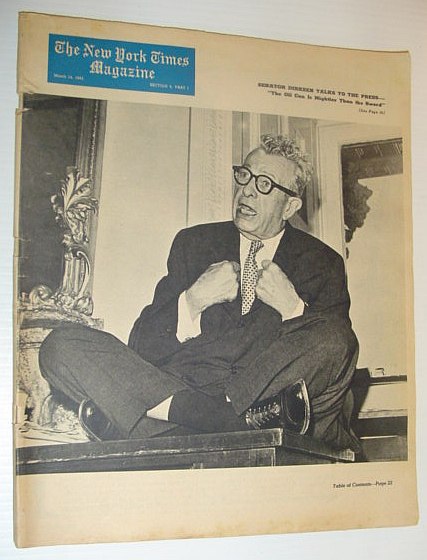
Unidentified magazine. The magazine is the Sunday, March 14th, 1965 edition of the New York Times Magazine, and the person portrayed is indeed Senator Everett Dirksen, a politician probably best-remembered today for the phrase, "A billion here, a billion there, and pretty soon you're talking real money." (in fact, Dirksen probably didn't say that, but the quote is usually ascribed to him).
Paper with Handwritten ALWAYS!!! A faint sketch of a face can be seen below the words.
Unidentified photo.
Unidentified record cover. Label is Verve. The cover is likely DVORAK: Slavonic Dances. JEAN MARTINON conducting the London Symphony Orchestra. RCA VICTROLA STEREO Record Album (VICS 1054).
Unidentified record cover (not seen in all photos in the series): "The (unreadable) Jug Band." As also noted in the comments, The album is a 1962 compilation on the OJL label, titled "The Great Jug Bands."
Needlepoint reading "Be True To Me. Let Me Be True to Myself."
Dylan is holding a copy of The Bhavans Journal in his right hand, probably belonging to Sara, a magazine focused on Indian culture, life, and literature, established in 1954 and still being published. His cloth "sailor's cap" is in his left hand.
Sometimes you write an article so you can write the article. I was hoping that if I tossed some bread out on the water it might get returned threefold, and lo and behold, Dreamtime correspondent "Joe," wrote to tell us,
"...I was in Minnesota Friday (September 18, 2009) for Lucinda's show and her on-stage wedding. Before the ceremony she sang her Hank Williams collaboration..."
With a little luck and judicious searching, I found this well-shot video of Lucinda Williams performing for the first time live her song from The Hank Williams Project, "I'm Happy I Found You." Her introduction to "I'm Happy I Found You" begins at 4:52 seconds into the clip.
"...this was written by Hank and me. The reason I say that, it's interesting, because some lyrics were found of Hank Williams without the music. So I was asked to choose a song and write the music... for an album that Bob Dylan was putting together... it's still not out yet, I don't what's going on with it...but anyway... it's a very unusual set of lyrics for Hank. The other, special reason I'm doing a Hank Williams song is because Hank Williams was married on stage. And I figured... if it's good enough for Hank, it's good enough for us. This is called, 'I'm Happy I Found You'."
After the song Williams married her manager and sweetie, Tom Overby, in an on-stage ceremony, borrowing the idea from Hank Williams' wedding to Billie Jean Jones Eshlimar on October 19, 1952. Williams actually had married Eshlimar a day earlier in a private ceremony, but staged two public ceremonies on the 19th at the New Orleans Civic Auditorium where 14,000 seats were sold for each ceremony. Apropos for Williams' complicated life, a judge ruled after his death that none of the weddings were legal due to Billie Jean’s divorce not being finalized until eleven days after she had married Williams. A quarter of a century after the marriage, a federal court finally ruled it valid.
"I'm Happy I Found You." is another pretty piece, equal to Norah Jones "How Many Times Have You Broken My Heart?" and as Lucinda says, has an unusual sentiment for a Hank Williams song. Here's hoping we get to hear the remainder of the songs from The Hank Williams Project before the end of 2009. If any of our readers have any news to add, let us know at dreamtimepodcast@gmail.com.
Howard Stern: ...bringing up Dylan. So Gary's driving in his car the other night aaaah, listening to Sirius XM. And y'know, it's really kinda funny, 'cause when Sirius and XM were two separate companies, I used to be somewhat envious of the fact that XM had Bob Dylan doing a show. Like I had only heard about it. I never actually heard the show. But I was envious saying, 'Wow, it's really cool that they had Bob Dylan.' They probably had to pay him some decent money to get him to do it, because he's such a recluse. That's a cool move, being such a recluse than when you do anything it's a big deal. So I said, 'Wow, if there's any programming I'm envious of on XM it's because they've got the Bob Dylan... it's like called 'The Family Hour,' and he would spin records and he would talk about his life.
But I never actually heard the show. And Gary called me over vacation and he goes, 'Did you ever actually hear the Bob Dylan show?' And I go, 'Uh, no. Is it awesome?' And he goes, 'I don't know a fuckin' thing he said.'
It's a cool thing to say you have Bob Dylan, but if you actually listen to the show, he's unintelli-- it's like his music, when he performs [does stock bad Dylan imitation] - he sounds like a rabbi or something. When he's talking, I defy you to figure out what he's talking about. And the music he plays is kinda out there. It's nothing, y'know it's nothing you'd really want to hear...
It's been a depressing week for Theme Time Radio Hour news - the anniversary passing of when we could look forward to the start of a new season; the unofficial cancellation - apparently - of the TTRH Compendium book. I debated with myself on whether to bother to post the clip above, nine minutes of Howard Stern and crew insulting Bob Dylan and Theme Time Radio Hour. But Self pointed out that Dreamtime's mission statement is to be the premiere source of TTRH news and commentary on the Web, good or bad.
So here it is. I should point out that some of the audio and accompanying visuals could be considered NSFW, so be forewarned. As I said, the clip is nine minutes plus, with Stern playing what sounds like deliberately distorted clips from TTRH to bolster his "unintelligble" argument.. I say "deliberately distorted" since I have better-quality copies of the show, so you would think someone with the resources of Howard Stern could find them too. I'm not sure when this clip originally aired. It was posted on YouTube about a month ago.
Stern goes on to make predictable fun of the various Dylan commentaries and ends on the usual Howard Sternesque whiny note, reading glowing excerpts about Theme Time from an old Washington Post article while complaining about how his show is treated by the Post.
The little book that wasn't there, the Theme Time Radio Hour Compendium, recently had a title change on its Amazon page to: "Bob Dylan Untitled Christmas Book" (Hardcover). The book, which has been listed on Amazon since 2008, also had a publication date change, now advanced to November 1, 2011.
You'll note if you go to the Amazon page that it still uses the TTRH Compendium cover mock-up, pictured to your left.
If I had to hazard a guess, I'd guess that this is simply a placeholder by Amazon for a book that may or may not get published and probably won't have anything to do with TTRH if/when it does get published. It's worth noting that the book, under any title, no longer appears in the Simon & Schuster catalog.
I know something of the background of the planned Compendium, as I was in discussions at one point with the TTRH team to do some work on the project. But eventually they decided they couldn't do the book they wanted to do within the delivery time that Simon and Schuster wanted, which was for a Christmas `08 release.
That begs the question of why the book wasn't moved to the Christmas `09 season, and for that question I don't have an answer. Timing may have had something to do with it. My impression was that Dylan's camp already had its attention turned towards other projects by late 2008 and from their perspective TTRH was a closed book (no pun intended).
I also don't know what the planned content for the Compendium was - I'm not sure the book even got to the planning stage. But at its advertised 176 pages I suspect it would have been a piece of mostly visual ephemera similar to the Bob Dylan Scrapbook, probably a good Christmas present for the Dylan fan or TTRH listener in your family. "The Bob Dylan Scrapbook" sold a very respectable 125,000+ copies in 2005 according to Publishers Weekly, and perhaps the Compendium would have done as well. In any case, an opportunity missed for them - and for me - but maybe it will turn out to have been a Good Thing for me and my book in progress.
There was also some talk in the TTRH camp in late 2008/early 2009 about a series of "Theme" books, too, tying into and extending the TTRH franchise after the show's radio run. Again, I don't know whether that idea has been back-burnered or abandoned, probably the latter would be my guess. But it's possible that the "untitled Christmas Book" might be the first of those theme books. It's just as possible that, still under contract to deliver a book, Dylan's people said, "Yep, yep. We'll have that book for you Real Soon Now - sometime between now and when the contract expires in 2011."
A sad milestone this week. Two years ago, on Wednesday, September 19, 2007, Season 2 of Theme Time Radio Hour began with the "Hello" show. As well as airing some notable shows, "Classic Rock," "Lock & Key," and "California" among them, Season 2 would hold several surprises for listeners:
While never completely phased out, email readings would gradually lose ground to a new segment - listener phone calls to Studio B.
TTRH finally aired the series' long-promised "Classic Rock" episode, with music featuring rocks of the mineral sort.
The first TTRH rerun aired on October 31st 2007, a repeat of Season 1's "Halloween" show.
TTRH would do a second "Countdown" show with all-new material, the series first theme to cross two seasons.
Season 2 would end without explanation with the "Cold" show on April 2, 2008 after only 25 episodes being aired, in contrast to Season 1's 50 shows.
I get email on a regular basis asking if I have any information - positive or negative - about a Season 4 of TTRH. Season 3 of TTRH began on Wednesday October 3, 2008 with almost no fanfare...only mentioned in a press release from Sony and in some media articles a week or so earlier. Given that Dylan's Christmas album, Christmas in the Heart, is scheduled for release on October 13, there's a very slim possibility that October 14 would be the logical start date of a Season 4. But, there's currently no evidence of that likelihood and, in truth, more evidence against the possibility. Mr. D. made it clear in his May 2009 Rolling Stone interview that his work on TTRH was over, although he did offer up the slight hope that he "didn't know" whether he would continue, and that Sirius XM seemed eager for more episodes. While Sirius XM continues to mention Dylan and TTRH in its publicity materials, it has yet to make an official announcement on the show's future. At present, the show has become the I Love Lucy of radio rebroadcasts, as one commenter pithily put it.
All good things come to an end, and my opinion is that the series has ended. But we have those 100 shows, and our memories. During an interview with one of the members of the TTRH team, I asked if there had been any resentment on their side about the show being copied and distributed over the internet within days - sometimes within hours - of being broadcast on XM.
"We were much more concerned about a show getting bootlegged before it 'officially' aired on the radio," he answered. "And we devoted most of our energies to making sure that didn't happen, rather than trying to stop what we knew we couldn't stop. Actually, we thought it was kind of cool that all the shows ended up on the web. It means Theme Time Radio Hour will live forever."
"And no, I didn't wanna to play it, but I get requests for 'Swinging the Alphabet,' every show. Must be a lot of Larry, Moe, and Cheese fans out there." ~ Eddie Gorodetsky, Saturday Night Hi-Fi Party, 1978
Cheesy, yes, but catchy, too. If you're one of the multitude who grew up watching the terrible trio on TV, "Swinging the Alphabet" is likely to be one of your clearest memories from a Three Stooges short. The novelty number was sung by the boys in their 19 and 38 film, Violent is the Word for Curly, a parody of the title of a popular film from a few years earlier, Valiant is the Word for Carrie. The version that Eddie G. played on his WERS radio show was probably taken from a 19 and 59 LP on the Coral label, "The Nonsense Songbook," where it was retitled as "The Alphabet Song."
Although everyone from director Charley Chase to one or all of the Three Stooges was credited with composing "Swinging the Alphabet," it was actually adapted from a song written some 60-odd years earlier by one Septimus Winner under the title, "The Spelling Bee," a discovery not made until 2005 by film historian and Stooges buff, Richard Finegan.
Now let me see what you can do,
And spell for me, Bicki-bi-bo-bu.
CHORUS 1: B, A, Ba, B, E, Be,
B, I, Bicki-bi, B, O, Bo,
Bicki-bi-bo, B, U, Bu,
Bicki-bi-bo-bu. ~ "THE SPELLING BEE" (1875) Humorous Song and Chorus.
Interestingly Winner, a popular 19th century songwriter, also composed "Listen to the Mockingbird," which was used as the theme music for the early Three Stooges shorts, until eventually replaced by "Three Blind Mice." According to Finegan's article, director Charley Chase's maid was fond of singing "The Spelling Bee"'s chorus to his children, and he brought the tune into the studio for the Stooges when they needed a melody to break up the action in Violent is the Word for Curly.
The good people over at Ace Records U.K. were kind enough to send Dreamtime an early review copy of their second compilation of Theme Time Radio Hour music, "Theme Time Radio Hour Season 2," available today (September 7, 2009) in the U.K. and tomorrow (September 8, 2009) in the U.S. at better retail outlets everywhere. You can pick it up in the United Kingdom by following the Ace Records link above. Get it in the Amazon U.S. store through the image or title links above.
As its title implies, the new 2-CD set includes 50 cherries plucked from the 375 tracks played over Season 2 - opening with The Sherman Williams (not Sherwin Williams Our Host would remind us) Orchestra's "Hello," and closing with Rilo Kiley's "With Arms Outstretched."
Sandwiched between is music spanning eight decades, from The Georgia Crackers 1927 "Diamond Joe," to Jolie Holland's "Goodbye California," released in 2004. Jump, jive jazz. Nouveau wave and novelty. Captain Beefheart and Desmond Dekker. Parties, Pretty Girls, and Cadillacs. The Cold Hard Facts of Life, Gloomy Sundays and a Young Man's Blues. The package inludes a "fully illustrated 40-page book packed full of rare photographs and memorabilia including detailed notes on each track..." according to the Ace publicity blurb. That material wasn't ready when they sent me the review CDs, so I can't comment on it.
Unless you happen to be TTRH producer, Eddie Gorodetsky, who had a hand in putting this compilation together, or a very dedicated listener to the series, the chances are you'll hear several songs you've never heard before that will amuse and delight you.
However, there's an inherent flaw with Ace's TTRH: Season 2, as there is with the half-dozen other collections of music inspired by the radio show, and we might as well get that issue of the way now. TTRH: Season 2 is not TTRH: The Show. It does not include any of Bob Dylan's commentary on the songs, nor any of the other features that made Theme Time Radio Hour so memorable. No def poetry, no bad jokes. No jingles, no airchecks, no phone calls. No Ellen Barkin. No Top Cat behind the ending credits. Just the music, folks. I emphasize this because you wouldn't believe the bitter email I get from people who feel that they're being rooked out of their hard-earned shekels every time a new TTRH music compilation is released, no matter how much a label like Ace emphasizes that they're only offering the music.
Given that, do I still recommend TTRH: Season 2? Yes, with the qualification that you understand you're not getting the show itself. But as with the first Ace compilation covering Season 1, listening to TTRH: Season 2 is like listening to a mixtape put together by a very musically-knowledgable pal, maybe a sneak peek into Eddie Gorodetsky's fabled music collection, maybe a chance to hear some of the music on Bob Dylan's lost iPod, as a fortunate few were rumored to have done way back in 2005.
Being the compleat collector that I am, I have every TTRH music compilation in existence, as well as a bunch of other weird ephemera associated with the show, including a half-eaten burrito stolen off of Tex Carbone's sound board. Of the half-dozen compilations, Ace's "Theme Time Radio Hour Season 2," and its Season 1 predecessor are easily the best collections of TTRH music currently available. That's not only because both have the imprimatur of the Theme Time team, but also because Ace went to the trouble of including contemporary music still under copyright, as well the older, royalty-free pieces used in the various other collections. Unlike other compilations of the show's music, with TTRH: Season 2 you get a taste of the full breadth and depth of the music played on Theme Time Radio Hour. At Dreamtime we say, "accept no substitutes."
You never know what's going to inspire reader reaction, but yesterday's post on "Open the Door, Richard" generated a ton of email. The Dreamtime transcriptions are apparently popular, as several correspondents asked for a transcription of what Mr, D. had specifically said about the song, Dusty Fletcher, and Jack McVea. So here we go, with appropriate accompaniment... Our Host: "This is Theme Time Radio Hour and we're talking about Locks and Keys. One guy who talked a lot about `em was a comedian named Dusty Fletcher. He played in vaudeville and traveled the chitlin' circuit. He had a live routine that became one of the most famous records of the `40s. He'd walk out on-stage with a ladder, lean against the curtain, and call up to his friend Richard. He had locked himself out of the house, and he needed Richard to come down and open the door. Richard wasn't much help as he was probably intoxicated. It's actually much more interesting when you hear Dusty Fletcher tell it. Let's listen to a little bit of Dusty."
("Open the Door Richard" - Part 1 Dusty Fletcher [excerpt], January 1947)
Our Host: "Dusty's record reached #2 in the R&B charts, but another performer named Jack McVea recorded a more rhythmic version, and it made the song a national phenomena. By 1947, there were at least 22 versions of it. Louis Jordan did it. Dick Haymes, The Pied Pipers. There was a group called The Yokels that sang it in Yiddish. Bob Hope and Fred Allen would just mention Richard and the studio audience would crack up. Everybody was quoting the song like they quote [? ] today. Here's Jack McVea, with 'Open the Door, Richard.'"
("Open the Door, Richard" Jack McVea & His All Stars January 1947)
Our Host: "And listen to this..."
("Open the Door" Clive and Naomi 1965 [excerpt])
Our Host: "Not only were there country, polka, pop, and Yiddish versions, almost 20 years later it was inspiring ska musicians. Listen to a tiny bit of this, by Clive and Naomi....
Our Host: "'Open the Door' by Clive and Naomi. You see, that song can be done any kinda way. 'Bout time for it to come back again. Maybe I'll even do it...".
("Open the Door, Homer" Bob Dylan and the Band 1967 [unreleased out-take])
And Some Notes
Even after repeated listening, I still can't make out what word Mr D. says in the line, "Everybody was quoting the song like they quote [ ? ] today," It sounds like "Bo-ad" or maybe "Bo-at." Maybe someone with a better ear can decipher it.
I received several emails on the controversy over who "wrote" "Open the Door, Richard," with one correspondent - who prefers to remain anonymous - feeling I had given Dusty Fletcher short shrift. Anon. noted, "Fletcher was actually filmed performing 'Open the Door Richard' two years earlier [than McVea's recording] in 19 and 45, so he has to be considered the undisputed 'Richard' champ."
Well, no. As I replied to anon., the film is of Fletcher's comedy routine, not of him performing the song. You can see the 1945 short "Open the Door Richard" at the internet archive, if you're interested. The "Richard" routine starts about three minutes into the 9 minute film. Was McVea's song based on Fletcher's routine? No dispute there. Did McVea create a separate, musical work? I say yes.
A few people questioned which came first, McVea's or Fletcher's recording of "Richard." It sounded to me that Our Host implied that Fletcher's recording was first, although his remarks can be taken either way. In any case, both recordings were released in January 1947. Labels tended to move fast when there was a hit - and money - in the air. This Time magazine article, which also appears to be one the sources for Mr. D.'s commentary, notes that eighteen cover versions of the song were either in print or in the chute within a month after the original's release. Interestingly, the reporter writes that John Mason was "hastily cut in for half the profits," after his lawyers contacted McVea, but makes no mention of Fletcher or his "Richard."
According to various sources, McVea's "Richard" was recorded in either September or October 1946, although not released until January 1947. All the evidence points to Fletcher going into the studio and recording his cover literally days after after McVea's release. The label of Fletcher's National single notes him as the "originator" of "Richard," evidence that there was another "Richard" already out there. And, of course, the melody is obviously from McVea's "Richard."
And finally, the appropriately named "Richard" wrote in with this nugget. "The identity of the mysterious "Don Howell" [who shared co-writing credits with Fletcher for the music after the lawsuit dust settled] was none other than Decca owner, Dave Kapp. Current releases of 'Richard' credit Kapp. I guess Jack McVea was right that he was screwed out of his just due."
Yesterday's (Tuesday, September 1, 2009) Expecting Rain news page had a couple of interesting links provided by über-correspondent, Scott Miller, pertaining to the novelty hit single of 19 and 47, "Open the Door, Richard." One of the links was to a detailed Wikipedia article on the history of the song, which I commend to your attention. The nature of Wikipedia is such that it's often hit and miss when it comes to either accuracy or quality. But you'll occasionally find well-written articles that carefully cite their sources, as does this one. I question some of the anonymous author's conclusions, but that's what makes horse races.
Although the article says "Open the Door, Richard" started out life as a vaudeville routine, it's more likely that it was first a song on the blackface circuit, written by the great Bob Russell, who was working in a troupe called "The Florida Blossoms" during the mid-1900s. According to Pigmeat Markham, he of "Here Come De Judge" fame and one of several performers who would popularize the "Open the Door, Richard" routine, Russell wrote the song for a skit called, "Oh, You Mr. Rareback," and it was performed and possibly expanded by "Spider Bruce" (John) Mason. According to the book This is Pop, Mason claimed to have been doing the song as early as 1919, and definitely was performing it in a Broadway show called Bamboola in the late `20s.
One of Mason's co-actors in the show was a young comedian named Dusty Fletcher, who would later make his version of "Open the Door, Richard" a hit at the Apollo. The history Showtime at the Apollo describes Fletcher appearing on stage, "... dressed in rags, drunkenly weaving, and with a ladder as his only prop." With ladder planted center stage, Fletcher would bang on an imaginary door (sound effects provided by the orchestra pit), while imploring roommate Richard to open up in drunken semi-song. "I know he's inside," Fletcher would mutter. "I'm wearing our only suit." With Richard uncooperative, unresponsive, and likely in the embrace of love's sweet arms, Fletcher would next use the ladder to try to get in, only to crash to the floor.
Repeat for as long as the jokes would hold out.
Some sources say saxophonist Jack McVea saw Pigmeat Markham, who had inherited the routine from the retired Fletcher, perform "Open the Door, Richard." Other sources say he learned it directly from Dusty Fletcher himself. In either case, McVea decided that "Open the Door, Richard" would make a great novelty tune, similar to the stuff that Louis Jordan and his Tympany Five were getting action with, and came up with what he called "that simple melody," performing it along the R&B circuit, and gradually building up the story until it was a full-fledged musical fable.
In late 19 and 46, Jack McVea and His All-Stars went into the studio, recorded "Richard," and it was released on the Black & White label in January 1947. It was an immediate jukebox hit, sales outstripping supply so quickly that Black & White was out-of-stock of the single by February, when its "Richard" hit #3 on the Billboard charts. 10,000 copies of the single were shipped to New York City alone to meet demand.
As usual, a hit attracted the other big "M" often associated with music, "Money." Dusty Fletcher and John Mason surfaced, both claiming authorship of "Open the Door, Richard." In fact, Dusty Fletcher, being no fool, came out of retirement and into the studio and recorded his cover of "Open the Door, Richard" just days after McVea's release. Interestingly, Fletcher would also claim that one of his original versions of the song had been called, "Open the Door, Homer," a title later used for a much different version by a certain musician living semi-retirement in Woodstock during the late `60s.
Eventually it was decided there was enough moola from "Richard" to go around for (almost) everyone, and the song would be credited in later releases as, "Words by Dusty Fletcher and John Mason" and "music by Dusty Fletcher and Don Howell." Notably missing from the credits was Jack McVea. Nobody knows who the hell "Don Howell" was, although McVea's contention that the name was a pseudonymous front chiefly designed to screw him out of his rightful royalties is probably accurate.
There were dozens of covers of "Open the Door, Richard," including one by the Count Basie Orchestra, which hit the #1 slot just a month after the original's release. About every take on the song you can imagine was cut - bop versions, doo-wop versions, hillbilly versions, calypso versions, versions in French, Spanish, Swedish, Hungarian, Yiddish versions, white-guy versions by Jimmy Durante, Bing Crosby, Jack Benny, and Burl Ives among others, and the slightly blue version by Walter Brown with the Tiny Grimes Sextet that we included above.
"Open the Door, Richard" would become a catch-phrase in both black and white communities for a decade, and may have sparked the first full-bore marketing craze of the post-war era, with everything from perfume to beer carrying the slogan. The song would lose its luster in the black community in the `60s, some feeling it was Uncle Tomish and on a par with "Zip-A-Dee Doo-Dah." But its legacy lives on, bringing a smile to the faces of those of a certain age... just as long as they aren't named "Richard."
The original Royal Street Bachelors circa 1968.
From left: Jack McVea on clarinet, Herb Gordy on bass and Harold Grant on guitar.
Jack McVea only earned a few thousand dollars from his hit, calling it "just another song" from a money perspective. In his later career, he led a strolling group of Dixeland musicians at Disneyland for 27 years, from the `60s into the 1980s. My father was a gigantic Dixeland fan, always pausing our family on Disneyland's Main Street or in New Orleans Square when the band came by. It's likely I saw and listened to Jack McVea, not knowing who he was, while I impatiently waited to get to Adventureland.
McVea died in 2000. Eight years later, his "Open the Door, Richard" would be played during the "Lock and Key" episode of Theme Time Radio Hour, almost 60 years to the day after the song was first released. Our Host prefaced McVea's "Richard" with an excerpt from Dusty Fletcher's version, mistakenly crediting that one as the original.
Or maybe it was. Only Richard could tell us, and he ain't answering.
It's taken about a week, but most of the "professional" media outlets we cited as running the farcical Bob Dylan "Sat Nav GPS" story as fact have published retractions with varying degrees of embarrassment. One of the original sources of the story, The "Guardian.Co.UK" noted in its "Corrections and Clarifications" section....
"We reported Bob Dylan saying on his syndicated radio programme that a number of car companies wanted him to be the voice of their satellite navigation systems (No direction home, 26 August, page 8). We should have made clear this was a repeat of a programme broadcast by the BBC in February, though the satnav remark – whether truth or deadpan joke – went unreported at the time"
I've also seen corrections from NPR and The Washington Post, among others, although in most instances the retraction is separate from the original story, which is also usually still there. But since yesterday's digital stories have at least one thing in common with their analog brethren - they're only good for wrapping virtual fish - it probably doesn't matter much. The parade marches on.
I returned from vacay to find a few emails from people who felt that my original article was too ill-tempered (at least one of my correspondents writing I should have stayed focused on vacation). Most argued that the majority of the stories were written tongue-in-cheek and never meant as serious journalism. And that's a valid perspective. But my stock reply is that if you run something as fact, you're required to make at least some effort to check the fact. Otherwise you should bill yourself as an entertainer, not as a journalist.
I know enough about the business that I can pretty well describe the process of how any of the given articles came about. You have a deadline and you need to fill n amount of column inches. You see a story on-line. It features Bob Dylan, which you know is an automatic pass from most editors - see "the smelly Malibu toilet" or "Dylan arrested as vagrant" stories earlier this year. Dylan is always good copy. It's a quirky story, easy to make a couple of jokes about and to maybe get a few people to post comments about - which always looks good to editors too. So, you rewrite the original story, editing it enough so you won't get whacked with a plagiarism call and citing your source, just like you learned in journalism class. In the old days, the bigger outlets like The Washington Post or The New York Times would have had a copy editor or fact checker go over the story before releasing it, even a small story destined for the "Entertainment" section. But those days are gone, plus the media doesn't have the luxury of time anymore, just the pressure to be as close to first as possible.
These days they use unpaid "experts" like me or Expecting Rain to correct them after the fact, whether on when a Theme Time show originally aired or who wrote "Little Buddy." And, in most cases, no foul, no penalty. You print the small correction. Maybe it goes in the journalist's file to bring up at review time that s/he needs to be more careful about self-fact-checking. As I said, then the parade moves on.
A few show notes on this one. I'm trying out new open source scriptwriting software called Celtx, highly recommended to those interested in trying their hand at screenplays, podcasts, and even comic book scripts. The format isn't set up for on-line blog reading, so if you want to follow along, I recommend you download the script - in PDF format - from here. (click to open. Right-click to download).
The "Hi-Fi Party" with Eddie Gorodetsky excerpts, although claimed as recorded in 1978, are probably from the Winter of 19 and 79. Eddie mentions several times during the show how exceptionally cold his apartment is, as well as the fact that the WBCN deejays are out on strike. Other clips are from WBCN, with Eddie Gorodetsky heard variously as "Dr. Claibourne" and in the background during the "Mattress Mishegas" segment.
I miss WBCN.
You can see the young Eddie G., still with most his hair, circa late `70s, in Charles Laquidara's parody of an Italian art film, "Nino, Nino, Nino" on YouTube. Look for the guy break-dancing during the Big Italian Dinner as well as various other scenes in the film.
Creative Commons Attribution Fred Bals 3.0
The Dreamtime blog and podcast
http://www.dreamtimepodcast.com
dreamtimepodcast@gmail.com
HI-FI PARTY WITH EDDIE GORODETSKY
Scene: 1
INTRO
VOICE: EDDIE GORODETSKY PROMO
JAIL BAIT JONES
It’s the Dreamtime podcast with your host, Fred Bals
MUSIC: TURN YOUR RADIO ON
FRED
Lights off, windows open to the summer night, half-asleep on the lounge chair, big old Maine Coon cat stretched across my body, radio on.
Radio on, and sometimes I dream.
I dream of a woman in red smoking a cigarette. She stands on a balcony and watches the city spread below her. Soon she’ll walk into the lobby of the Abernathy Building, take the elevator up to the 8th floor and go into Studio B.
Just close your eyes and you can see it as well as I can. Unchanged since the ‘50s, mike dangling down from the ceiling, peeling walls of sound insulation, two turntables framing the empty deejay’s chair.
Tex Carbone behind the glass, working at his sound panel. The lady in red in a separate sound booth, leaning into the microphone, huskily whispering out...
VOICE: ELLEN BARKIN
It’s Night in the Big City.
FRED
No, I’m wrong. That’s not what I see. That’s not what I hear.
SOUND: "BACK WHERE I COME FROM"
FRED
There’s a banty rooster of a young man who has come up to take the mike instead. He adjusts his guitar and begins playing "Dusty Ol' Dust."
As he launches into the refrain of "So long, it’s been good to know yah," an announcer steps up to a second microphone and reads...
VOICE: ANNOUNCER
"You’ve been listening to ’Back Where I Come From.’ Tonight’s theme has been "The Weather," with Woody Guthrie....
FRED
"Weather? But, that song was from the ’Goodbye’ show, wasn’t it?" I ask the oblivious cat.
He stares at me, examines a paw, begins to clean himself. The voice on the radio fades off, static crackling through the air again before Dylan’s cornhusker murmur finally resumes, talking about love and marriage.
VOICE: DYLAN FROM THE "WEDDING" EPISODE
VOICE: EDDIE GORODETSKY
EDDIE G.
(SMART-ASS EDDIE G.)
Ah, why a man would want to have one wife is a mystery.
Why he’d want to have two wives is a bigga mystery.
(DYLAN’S VOICE DISSOLVES INTO LAUGHTER)
FRED
"What?" I say, sitting up, cat bouncing off my lap to the floor. "Who?"
The voice continues on, getting more and more maniac.
VOICE: EDDIE GORODETSKY
EDDIE G.
This is going out to all our friends in Framingham, or as we like to say, Mahginmraf!
(THE DEEJAY’S VOICE SEEMS TO HAVE FORSAKEN ANY NEED FOR OXYGEN, WORDS TUMBLING OUT FASTER AND FASTER IN AN AVALANCHE OF ALLITERATION. )
VOICE: EDDIE GORODETSKY
EDDIE G.
Don’t forget to listen to Juke Box Saturday Night coming up at 11 o’clock, an eclectic pastiche of various musical idioms spanning the ‘20s, ‘30s, ‘40s, ‘50s, ‘60s, and yes-sir-ree-bob, even the ‘70s. So stay tuned to Juke Box Saturday Night - 11 o’clock till 2 in the morning right here on the Rockin’ 88, WERS!
EDDIE G. (cont’d)
In the meantime, I’m your audio aesthetician, Eddie Gorodetsky, rockin’ and rollin’, boppin’ and strollin’, making it outta sight here on a Saturday night.
Won’t you stick around? 267-7281! Make a dedication! And I gotta tell you, ’Somewhere Over the Rainbow’ was for Barbara and Ben Brown, and Lee and... Oh My God, I can’t... Lee and Flora and Grady and his girl... who are there listening to The Hi-Fi Party tonight!
And if you want to be a member of the radio parade of dedications, 267-7281, and we had a request for some Earl King!
MUSIC: EARL KING: "DARLING HONEY ANGEL CHILD"
SCENE: 2
("DARLING HONEY ANGEL CHILD" FADES OUT AS FRED’S VOICE COMES BACK ON)
FRED
Thirty-one years ago he didn’t sound at all like Pierre Mancini.
Boston has always been a good town for radio. Maybe not quite as good as New Orleans or San Francisco, but Boston does okay.
SOUND: WBCN AIRCHECK
FRED
WBCN - the commercial rock-n’roll giant that Eddie Gorodetsky also worked at for a short time - is gone now. But people who loved the Big Mattress, the Cosmic Muffin, Charles Laquidara and his alter-ego, Dwayne Ingalls Glasscock, would tell you that the real ’BCN was gone a long time ago.
WERS-FM, now in its 60th year of operation, was the first non-commercial radio station established in New England, and still serves as a live training ground for students at Boston’s Emerson College. One of those students during the late ‘70s was one Eddie Gorodetsky\ from Rhode Island.
In 1978 Eddie was broadcasting The Hi-Fi Party on Saturday nights from 7 to 11, later moving the show over to Sundays in 1979, and occasionally sat in as deejay on "Juke Box Saturday Night," the show we just heard Eddie promo.
FRED (cont’d)
Eddie was also working behind the counter at a varietyof record stores, including Cheap Thrills, a long-gone Boston record chain of the ‘60s and ’70s, at theirBoylston Street store across from the Prudential Center, home of WBCN.
SOUND: WNCN MATTRESS MISHEGAS
(LAQUIDARA AND SIEGAL WITH EDDIE GORODETSKY)
FRED
Maybe WBCN super-deejay Charles Laquidara walked into Cheap Thrills one day and struck up a conversation with the fast-talkin’ kid behind the counter. Maybe Eddie scammed his way into ’BCN. At the time it wouldn’t have been too hard, as the Rock of Boston was constantly attracting fresh young meat willing to sleep on studio couches and work for next to nothing as long as they could say they were working at ’BCN.
VOICE: DWAYNE AND DR. CLAIBOURNE
FRED
One way or the other, Eddie picked up a gig at ’BCN, writing sketches and jokes, and doing the occasional on-air turn, sometimes playing the frenetic Dwayne Glasscock’s physician, Doctor Claibourne. Dwayne returned the favor in his own fashion, recording a few promos for Eddie’s Saturday Night Hi-Fi Party, although he did keep referring to college station WERS as "bush radio."
VOICE: DWAYNE GLASSCOCK PROMO
FRED
From all reports, Eddie cut a dapper figure in thosedays, reportedly, "dressed to the nines in a zoot suit and carrying a metal suitcase full of 45s and vintage blues albums" wherever he went. He was reputed to be a pretty snazzy, jitter-buggin’ fool, too.
VOICE: EDDIE CLIP WITH MENTION OF THE SPEAKEASY
FRED
Dian Shonk, then a waitress at the Cambridge watering hole recalls Eddie on the Speakeasy dance floor,
"...swinging a lovely young girl in a flowing skirt. I turned around with a tray full of empties to see him do a very fancy move where she slid on the floor between his legs and then was [supposed to] shoot back up and continue dancing. Well [Eddie] stepped on her skirt and when she shot back up the skirt stayed on the floor! ... a moment etched into my mind forever."
SOUND: "THANK YOU" CLIP
FRED
Between the zoot suitin’ jitter-buggin’, deejaying, store clerking, record collecting, acting in Charles Laquidara’s awful parody of an Italian art movie, "Nino, Nino, Nino," and generally being a Man Around Beantown, it’s small wonder that Eddie reportedly dropped out of Emerson to pursue a full-time career in show biz.
Given that his path would lead from "Saturday Night Live," to David Letterman, to "Dharma and Greg" and "Two-and-a-Half Men," and eventually to "Theme Time Radio Hour," "who could say he made the wrong decision?
Certainly not me.
But we’re not here to praise Eddie G., nor even to bury him. We’re here to take a closer look at another source of that tree with many roots that was Theme Time Radio Hour... its ancestor from the 1970s, Saturday Night Hi-Fi Party with Eddie Gorodetsky.
SOUND: HI-FI PARTY EXCERPT
SCENE: 3
SOUND: "4-H" CLIP
FRED
Mr. D. never did a promo for the 4-H Club as far as I know, but after listening to a few Hi-Fi Parties, you can sure tell a lot of the music for Theme Time Radio Hour was coming from a certain producer’s record collection.
"Zindy Lou," that doo-wopper with the great hook? Our Host played it on the "Women’s Names" show. Thirty years earlier Eddie G. was spinning The Chimes on a February Saturday night.
JB Lenoir’s "Mama, Talk To Your Daughter"? On the "Mothers" episode. And yep, on that episode of "Hi-Fi Party," too.
Howza ’bout "A Man’s Best Friend is His Bed?" Do I need to say it?
Artists like Junior Wells, Buddy and Ella Johnson, Jimmy Rushing?
An obsession with mentioning record labels?
A name-check of Syd Nathan, fast-talkin’ owner of King Records?
A taste for corny old jokes? We already heard Eddie G. crack wise on the subject of marriage. Later in the
same show he’d dryly point out that you’d never go hungry in the Gobi Desert, "because of the sand which
is there."
We pause for your groan.
SOUND: "POPEYE PLAYED FOR A SUCKER"
FRED
If you’re a fan of Theme Time Radio Hour, sooner or later you’ll ask the question...
"How much involvement did Bob Dylan actually have with the show?"
The answer is, "Probably not as much as the Sirius XM publicity machine would like you to think that he did..."
VOICE: SEINFELD CLIP
FRED
"... not that there’s anything wrong with that."
And there’s not.
While Mr. D. probably wasn’t scribbling out playlists or hunting through his record collection for "A Man’s Best Friend Is His Bed," the bottom line is that he still did record the commentary for 100 Theme Time Radio Hours.
At an average 20 minutes of talk for a Theme Time show, that’s well over 30 hours of narrative that Bob Dylan had to record, not even counting the time needed to do retakes. And this is a man who was also on tour for most of the show’s run, recorded at least one album, was painting and working on the second volume of Chronicles and - I hope - on The Hank Williams Project - and God knows what else.
The amazing thing about Theme Time Radio Hour is not that Bob Dylan did it, but that it got done at all.
And without Eddie Gorodetsky, it wouldn’t have gotten done.
FRED (cont’d)
So, let’s raise our glasses and look 30 years back to the fast-talkin’ young deejay of college radio station WERS-FM, host of "The Hi-Fi Party" who was at the start of a journey that would eventually lead to Theme Time Radio Hour.
SOUND: "THANK YOU" CLIP
SOUND: WERS SIGN-OFF
MUSIC: CLOSING THEME
***
You've been listening to the Dreamtime podcast – occasional commentary on Bob Dylan's Theme Time Radio Hour. Dreamtime is researched and written by Fred Bals and is a Not Associated With production. As the name says, we're not associated with XM Radio, Bob Dylan, or much of anything else.
Some of the music on Dreamtime is provided via the Podsafe Music Network. Check it out at music.podshow.com.
Apropos of yesterday's post. Bob Dylan with a fine cover of Elvis' "Heartbreak Hotel", August 16th 2009, as a U.F.O. hovers over Lake Tahoe.
Kind of makes you wish for an "Elvis" project too, doesn't it? Of course it'd be nice to have the Hank Williams Project sometime within this decade, too.
Thanks to Dreamtime pal John Caruth, and others for the links.
The Wizard of Waukesha, Hot Rod Red, Rhubarb Red, Lester William Polsfuss, inventor extraordinaire and master musician, the man best known as Les Paul, has walked off the stage at age 94, a pretty damn good run. At various stages in his career, Paul played with or backed Rudy Vallee, Kate Smith, Bing Crosby, the Andrews Sisters, Louis Armstrong, Nat King Cole, Chet Atkins, Eric Clapton, Keith Richards, and Jeff Beck, His life essentially paralleled the development of American pop music over seven decades.
And of course, there was his collaboration with Mary Ford, née Collen Summers, whose name Paul changed by skimming through a telephone book after deciding that her birth name didn't scan correctly when billed with "Les Paul."
The Theme Time Radio Hour team missed several opportunities to play their hits. "Mockingbird Hill" would have been perfect for either of the "Bird" shows from Season 2 (maybe with two "Mockingbird" songs already on the "More Birds" playlist, a third was thought overkill), and "Vaya Con Dios" would have fit nicely into the final show. But we did get “How High the Moon,” featured in Season One's "Moon" show.
We try not to cannibalize ourselves too much here at Dreamtime. But the summer is slow, Theme Time is, as "ocgypsy" over at the ER forums succinctly put it, "becoming the 'I Love Lucy' of radio reruns," and we're contractually obligated to mention Woodstock at least three times this week.
So, here's a golden oldie we first posted this March, with some added material...
... an update to the classic Abbott and Costello Who's On First? routine, performed by the Animaniac's Slappy Squirrel and her nephew Skippy in Woodstock Slappy.
As older Dreamtimers know, the original skit was performed by the great comedy team, Bud Abbott and Lou Costello. One of the funnier things I've read on the Web was a time-challenged commenter complaining that Who's On First was an obvious rip-off of Woodstock Slappy.
Who's On First was the most famous of many burlesque routines centered around word confusion. The earliest example may be a skit designed for a straight man and comic probably written at the start of the 20th century called "The Baker Scene," where the straight man relates that he's getting paid for loafing in a bakery.
Comic: I'd like to get a job in that bakery. Who's the boss? Straight Man: Yes. Comic: That's what I'm asking. Who's the boss? SM: Yes. C: Who's the guy you're working for? SM: Exactly. C: I'm asking you for the last time, what's the name of your boss? SM: No, Watt's the name of the street.
And we're off. Abbott and Costello originally introduced Who's On First? in their stage act, and trotted it out to a larger audience during their run on The Kate Smith radio show in 19 and 38. By 19 and 44, the duo had had the routine copyrighted, and it became a staple of their radio and television appearances.
Who's On First Gets Psychedelicsized
The first rock'n-roll version seems to have been done by the L.A.-based comedy group, The Credibility Gap, in the mid-70s. Members of The Credibility Gap would later go on to greater fame as Lenny and Squiggy in the Laverne and Shirley sitcom (Micheal McKean and David Lander) and as members of Spinal Tap (Harry Shearer and the versatile Michael McKean again).
The Credibility Gap's routine centered around a music promoter trying to write a newspaper ad about a concert to feature The Who, The Guess Who, and Yes. Hilarity, as one could guess, ensued. You can hear the Credibility Gap update of Who's on First here, in obnoxious RealAudio format, I'm sorry to say.
Who's On First For Real
Although it took some 60-odd years, life finally imitated art in 2007 when the Los Angeles Dodgers added an infielder named Chin-Lung Hu. After Hu singled in a game against the San Diego Padres, Dodgers announcer Vin Scully solemnly remarked "And Hu's on first."
"I've waited my entire life to say that," Scully later added.
Woodstock Slappy - The Full Script
WOODSTOCK SLAPPY ---------------- Written by: JOHN P. McCANN & TOM RUEGGER Director: AUDU PADEN Animation: TOKYO MOVIE SHINSHA LTD.
CRONKITE-TYPE NARRATOR: 1969. As brave American soliders went to battle in Vietnam, back at home demonstrators protested the war. It was a time of flower power, pyschedelic music, student marches, and a nation divided. Which brings us to August 1969 and Slappy Squirrel.
{Going Up To The Country}
SINGER: Going up to the country Gotta get away Got to leave the city Gotta get away We might even leave the USA...
SLAPPY: Ah, here we go, summer in the country. Nothin' but rest and relaxation, right Skippy? SKIPPY: Yeah, groovy, Aunt Slappy, man, groovy. SLAPPY: Skippy, don't talk like that, people will think you had brain surgery. SKIPPY: I can dig it, man, far out. SLAPPY: *sigh*; I had to get him out of the city, away from all those bad influences. SKIPPY: You mean like peace and love? SLAPPY: Exactly. That stuff will warp ya!
{Humouresque (Slappy's theme)}
SLAPPY: There it is. Our summer cottage. SKIPPY: Outta sight, man. SLAPPY: Make yourself at home, kiddo. SKIPPY: I can dig it. SLAPPY: *sigh; I'll have him speakin' English again in no time.
{guitar riff...}
SLAPPY: Knock it off with the Bing Crosby, Stills, and Nash, will ya'? SKIPPY: Why?
{Slappy's Theme}
SLAPPY: 'Cause the only tune I want to hear is "The Sound of Silence", can you dig that? SKIPPY: I hear ya. SLAPPY: Good. Now let's rest up for tomorrow. SKIPPY: Why? What are we doing tomorrow? SLAPPY: Napping all day if I have anything to say about it. Ah, rest and relaxation at last.
{Beautiful Dreamer}
M.C.: There is 300,000 of us here today, man! And now Miss Janis Joplin!
(screaming Joplin parody)
SLAPPY: Oops. Somebody just ran over a dog! For the love of Kaopectate, what's going on? SKIPPY: Something's happening here, What it is, ain't exactly clear. SLAPPY: Well, thank you for that. Hey, you kids, what are you doin'?! Go on, get away from my tree! HIPPIE1:Like, mellow out, you running-dog squirrel. HIPPIE2:Hey, we're here for the Woodstock concert, man. HIPPIE1:Three days of rock from groups like Jefferson Airplane, The Band, The Who, The Grateful Dead... SLAPPY: I'd be grateful, too, if I didn't have to listen to this noise. Now clear out all of ya, go home! Scat!
{Animaniacs' theme}
SKIPPY: Aunt Slappy, be cool. Let's just go with the flow. SLAPPY: I'm not goin' anywhere with Flo! I want some peace and quiet. SKIPPY: But, Aunt Slappy, man, we're witnessing history. Woodstock. A single event pulling together a whole generation. SLAPPY: A bowl full of prunes would have the same effect.
(Feel Like I'm Fixin' To Die Rag parody}
COUNTRY JOE McDONALD: And it's two, four, six What am I singing for? Don't ask me; I don't give a hoot Just pay me with lots of loot! And it's eight, ten, twelve I'm just killing time My contract says to sing a song Yee haw! I need a rhyme!
SLAPPY: All right, all of ya', hit the road! Party's over! Go on, shoo! SKIPPY: They're not listening, Aunt Slappy, man, they're tuned into the music! SLAPPY: Well, we'll see about that. Come on. SKIPPY: Where are we going? SLAPPY: To the stage, to put a stop to this. I came to the country forsome peace and quiet and I'm gonna get it.
{Brand New Key parody }
MELANINE: Who's got a box of brand-new crackers? I've got some brand-new cheese!
{With A Little Help From My Friends parody } JOE COCKER: Would you still cheer if I had a tin ear? Would you throw a tomato at me? SLAPPY: Yes! SKIPPY: Chill out, Aunt Slappy, man.
{Feel Me parody}
ROGER DALTRY: Can you watch me? Can you listen to me? Can you smell me? Can you hear me? SLAPPY: Unfortunately, yes! Skippy, what is the name of that group playing on stage? SKIPPY: Who. SLAPPY: The name of the group. SKIPPY: Who. SLAPPY: The group on stage. SKIPPY: Who. SLAPPY: The group playing on stage. SKIPPY: Who. SLAPPY: You're starting to sound like an owl, Skippy. SKIPPY: Who is on stage! SLAPPY: That is what I'm askin' ya', who is on stage? SKIPPY: That's what I said. SLAPPY: You said who? SKIPPY: I sure did. SLAPPY: So tell me the name. SKIPPY: Who. SLAPPY: The name of the group. SKIPPY: Who. SLAPPY: The group on stage. SKIPPY: Who. SLAPPY: The name of the band on stage! SKIPPY: Who! SLAPPY: You're doing that owl thing again, Skippy! SKIPPY: I'm not, Aunt Slappy, I'm telling you Who is on stage. SLAPPY: So tell me. SKIPPY: Who. SLAPPY: So tell me. SKIPPY: Who. SLAPPY: The name of the group. SKIPPY: Who. SLAPPY: The group on stage! SKIPPY: Who! SLAPPY: That's what I'm asking you! SKIPPY: And I'm telling you the answer. SLAPPY: Wait, Skippy, let's start over. Is there a band on stage? SKIPPY: Yes. SLAPPY: Does that band have a name? SKIPPY: Yes. SLAPPY: Do you know the name of that band? SKIPPY: Yes. SLAPPY: Then tell me the name of the band on stage. SKIPPY: Who. SLAPPY: The name of the band! SKIPPY: Who. SLAPPY: The band, playing on stage! SKIPPY: Who. SLAPPY: That's what I want to know! SKIPPY: I'm telling you! SLAPPY: Who is on stage. SKIPPY: Yes. SLAPPY: Who is? SKIPPY: Yes. SLAPPY: Oh. So the name of the band is Yes. SKIPPY: No, Aunt Slappy, Yes is not even at this concert. SLAPPY: Then who is on stage? SKIPPY: Yes. SLAPPY: Who is? SKIPPY: Yes. SLAPPY: That's just what I said, Yes is on stage. SKIPPY: No, Yes is not here. Who is on stage. SLAPPY: Whaddya askin' me for? SKIPPY: I'm not! SLAPPY: Wait, let's try this again. Do you see the band on stage? SKIPPY: No I don't see The Band, that's a different group entirely. SLAPPY: On stage, Skippy. Look, see the band? SKIPPY: No I don't. SLAPPY: Get rid of those John Lennon glasses and look! There, there's the band! SKIPPY: No, that's not The Band. The Band is performing later on. Who's on stage. SLAPPY: You tell me. SKIPPY: Who. SLAPPY: The name of the group on stage. SKIPPY: Who. SLAPPY: The name of the group! SKIPPY: Who. SLAPPY: The group on stage! SKIPPY: Who. SLAPPY: The band! SKIPPY: No, The Band is performing later. Right now, we're listening to Who. SLAPPY: That's what I wanna know!!
(applause)
ROGER DALTRY: Hey, you squirrels are funny, man. Come on up here and takea bow. SKIPPY: Yeah! Far out! SLAPPY: Oh brother....
{Humouresque}
SLAPPY: Yeah, yeah, OK. Thank you. Now everybody go home! Including you guys, what's your name? ROGER: Who. SLAPPY: The name of your band. ROGER: Who. SLAPPY: Don't start with me! Just get off the stage! The rest of you, go!
SLAPPY: Why aren't they leaving? SKIPPY: They dig you, Aunt Slappy, man. SLAPPY: Oh yeah? We'll see about that. I said leave! [Smashes Hendrix's guitar] ROGER: Oh, very groovy, mates, isn't it, totally! PETE TOWNSHEND: Totally groovy. ROGER: We are The Who! [Smashing insturments] ROGER: erg...
(applause)
SLAPPY: Yeesh! These kids would applaud my laundry! Why won't they take a hike? SKIPPY: They want more music. SLAPPY: All right, then. They can have more music!
{Slappy's theme}
SLAPPY: Hey everybody! Let's polka!
"Uncle Yasha lost his shoe It fell in a bog; he did too. Uncle Schmeeda grabbed his foot He jumped in the bog and went kaput."
I've been dipping into Chronicles: Volume One again while talking with Scott Warmuth over various discoveries we've made in the text. Scott, as you already know if you follow Dreamtime, found evidence that a 1961 issue of TIME magazine was the reference source for at least one section in Chronicles. During our correspondenceScott mentioned another discovery he had made, which I'll let him reveal publicly himself when he's ready. But his remark had me opening Chronicles again, and as I was skimming through the text, I stopped on what I always thought was one of the stranger passages in the book..
I gazed around the room, got up and nervously paced around a few times, watching the clock on the wall--it seemed to be running backwards. I sat back down feeling lines plowing into my face and the whites of my eyes turning yellow. Al Kooper was clowning around, telling shaggy dog stories. I was listening to Daniels practicing scales on the fiddle, thumbing through some magazines that were left on the table, Collier's, Billboard, and Look magazine. Running across an article in Male magazine about a guy, James Lally, a radio man in World War II who had crashed with his pilot in the Philippines. I got sidetracked for a second. It was a gut crunching article, unfiltered. Armstrong, the pilot, was killed in the crash, but Lally was taken prisoner by the Japanese, who took him to a camp and beheaded him with a samurai sword and then used his head for bayonet practice. I pushed the magazine away. Russ Kunkel, the drummer on the sessions, was siting on the couch was his eyes halfway shut, tapping two sticks together-- gazing through the glass darkly. I couldn't stop thinking about Lally and felt like moaning in the wind.~ Chronicles: Volume One, Pages 139-140
There's something weird - weird in the full Shakespearian sense - about this paragraph. There's a thread of unspoken dread running throughout the passage that doesn't seem warranted. Dylan has "lines plowing into my face" and relates that the whites of his eyes are turning yellow. The wall clock is running backwards. He feels like "moaning in the wind" and paraphrases 1 Corinthians 13:12, noting that drummer Russ Kunkel is "gazing through the glass darkly." All these allusions seem to make even less sense when read in context. Before and after the passage, Dylan is thinking about what was constantly on his mind; trying to figure out how to "freeze-frame" his image and "suggest only shadows of my possible self." On a separate note, he's also deciding what to call the album which he would eventually title New Morning.
So what to make of the story of Lally and Armstrong that is the foundation of the passage? Are we to believe the article impressed Bob Dylan so much in 1970 that he introduced it as a strange non sequitur into Chronicles thirty years later?
You'd be unlikely to find a copy of Collier's in a 1970 recording studio, unless Bob Dylan brought it in himself. The magazine stopped publishing in 19 and 57. Leaving that aside, the other three magazines could have been on the table, including Male, a he-man "men's adventure" magazine specializing in lurid war tales and still being published into the `70s. It's also possible that there was an article about James Lally in some edition of Male, as his actual death at the hands of the Japaneses fit all the requirements for one of their patented stories, especially given the grisly details. According to one report Lally's body, as well as the body of the already deceased Armstrong, had been buried to their shoulders and their heads used for bayonet practice, as Dylan tells us the article relates. The war-crimes trial of Lally's executioners was also one of the first of its kind, making it even better fodder for a Male article.
Without an index of Male, we'll never know whether Dylan read the story in that magazine or not. Perhaps the overall gruesomeness of Lally's death or some specific imagery caught his attention. Maybe it ended up in his commonplace book to be unearthed and used some three decades later when he was looking for some background material about the making of New Morning.
That's possible. It's also possible that Dylan was well aware of another source reporting the death of Donald Armstrong, James Dickey's poem, "The Performance."
The last time I saw Donald Armstrong
He was staggering oddly off into the sun,
Going down, off the Philippine Islands.
I let my shovel fall, and put that hand
Above my eyes, and moved some way to one side
That his body might pass through the sun,
And I saw how well he was not
Standing there on his hands,
On his spindle-shanked forearms balanced,
Unbalanced, with his big feet looming and waving
In the great, untrustworthy air
He flew in each night, when it darkened. from "The Performance," 1959
In March 1945, James Dickey had volunteered to become the historian for the 418th Air Squadron, and recorded the following on March 15th:
A most unexpected and tragic occurrence befell the Squadron when 2nd Lt. DONALD H. ARMSTRONG ... and his observer F/O JAMES J. LALLY ...high-speed-stalled close to the ground over the Jap strip at St. Jose,Panay, and crashed northwest of the field. ... [The plane] was found to be almost completely demolished except for a small portion of the crew nacelle. The entire Squadron awaited apprehensively the guerrilla radio operating near San Jose, for the plane had gone down between Japanese and Filipino-held positions. Finally the guerrillas informed us that Armstrong had been killed and Lally, badly injured, was in the hands of the enemy. There has been no further news to date.
The event resonated with Dickey for the rest of his life, becoming the basis for essays, short stories, and eventually two poems about Armstrong and Lally, "Between Two Prisoners" and "The Performance." One of James Dickey's most-anthologized poems, "The Performance" was not without its share of Dylanesque controversy. Dickey changed many of the facts, ignoring Lally altogether and making Armstrong, who had died in the plane crash, "a mythical hero executed by sadistic enemies," as Henry Hart wrote in The Southern Review. Dickey, a man who liked to mythologize his own life, claimed "almost every word of `The Performance' is literally true," and at various other times said he had been close friends with Donald Armstrong, wrote that Armstrong was a daredevil hero who had taken it upon himself to bomb an enemy field, and that he had seen Armstrong practicing showy handstands as reported in "The Performace."
In fact, none of it was true, but more grist for the re-invention that James Dickey created for his own life. "Dickey revises Armstrong's life by re-envisioning it," Hart writes, and goes on to theorize that "Armstrong provided Dickey with a mirror in which he could see himself in larger-than-life proportions."
James Dickey famously growled in a 1969 symposium about the "debased kind of music Bob Dylan and these people play." If you read the line in context, Dickey was more complaining about the decline of traditional southern country and folk music, an opinion that Dylan would likely have agreed with then and now. But whether James Dickey was a fan of Bob Dylan or not, it's probable that Dylan was a fan of his.
The inherent danger in exploring anything Bob Dylan writes or says is that sometimes the cigar is probably just a cigar, and maybe this anecdote of his idly thumbing through an issue of Male is just what it is. On the other hand, we're dealing with a man whose 1991 Grammy Acceptance Speech sounded, on first listen, to be embarrassed, semi-coherent rambling...
"Well, my daddy, he didn't leave me much, you know he was a very simple man, but what he did tell me was this, he did say, son, he said..." (pause) "He said, you know it's possible to become so defiled in this world that your own father and mother will abandon you and if that happens, God will always believe in your ability to mend your ways."
... which turned out to be a allusion to Psalms 27:10.and a near-direct quote from the commentary of Rabbi Shimshon Rafael Hirsch...
"Even if I were so depraved that my own mother and father would abandon me to my own devices, God would still gather me up and believe in my ability to mend my ways."
Even Dreamtime isn't immune from using the occasional obligatory headline.
Our internet pal and correspondent Scott Warmuth was the man who first broke the news that several lines in the songs of Modern Times were based - sometimes borrowed from - the poet laureate of the Confederacy, Henry Timrod. Scott went on to discover fragments from Ovid, Chaucer and James Joyce in the lyrics of the Together Through Life songs, and has recently looked into Chronicles to see what he could find.
Scott noticed that a phrase in Chronicles referring to Hanoi as the, "brothel-studded Paris of the orient" appeared in quotation marks and wondered where it had been sourced. A little digging uncovered the Friday, March 31, 1961 edition of TIME magazine:
Chronicles, page 87:
"They had turned Hanoi, the capital city, into the 'brothel-studded Paris of the orient.'...The press reported Hanoi was grubby and cheerless, that the people dressed in Chinese shapeless jackets"
TIME, Friday, Mar. 31, 1961
North Viet Nam: Poor Neighbor
"Hanoi, long the brothel-studded 'Paris of the Orient,' is now grubby and cheerless..."
Interesting, but as Scott started to go through that issue of TIME (which can be found on-line here), it got even more interesting. He discovered that Dylan had apparently used that specific issue of the magazine as a reference source for a complete section of Chronicles. Among other things hementions a glossary of phobias in that issue, "..."There'd be articles about things like new modern-day phobias, all with fancy Latin names...", paraphrases an article titled The Anatomy of Angst, and refers to people and events all covered in that edition of TIME, including Jackie Kennedy and the Cuban Revolutionary Council meeting at the Biltmore Hotel.
You can find a complete list of Scott's discoveries over at Expecting Rain, although I should warn you that as is usual with these cases, there's a turgid and occasionally nasty ongoing battle between those who feel Bob Dylan should be drawn-and-quartered for plagiarism, those who feel that way about Scott for reporting his discovery, and those with a more pragmatic view. I'm on the third side, if it matters. Any careful reading of the section in question shows that either Dylan or his editor very carefully mentions "articles" and "reported in the press," and the line about Hanoi as "brothel-studded" is enclosed in quotes, indeed the very clue that sent Scott off on his research. And I know Scott. His motivations are neither evil nor mercenary. He's simply interested in Dylan's sources, who, God knows, obliges with providing them.
There are many other lines in Chronicles that are better ammo for the "Dylan as magpie" crowd, including phrases that appear borrowed from such sources as Really the Blues by Mezz Mezzrow and Bernard Wolfe, Raised on Radio by Gerald Nachman, Daily Life in Civil War Americaby Dorothy and James Volo, as well as works by Jack London, and even potboilers by Sax Rohmer. Ed Cook, over in Washington, D.C., recently noted the parallels between the story Chronicles tells about Sonny Boy Williamson and the story Blues with a Feeling: the Little Walter Storyrelates about the first Sonny Boy.
Take any random descriptive phrase in Chronicles, run it through Google Books, and the chances are pretty good you'll get a match.
Some might find this awful, some might find it disappointing. Me, I find it interesting, just as I find it interesting that one of the weirder elements of Modern Times, Dylan's shout-out to Alicia Keyes in Thunder on the Mountain, is based on a 19 and 40 Memphis Minnie song found on Queen of the Delta Blues, Vol. 2, Ma Rainey.
I was thinking about Ma Rainey
Wonderin' where Ma Rainey could be
I was thinking about Ma Rainey Wonderin' where Ma Rainey could be
I've been looking for her Even been to Tennessee
There are numerous stories of Bob Dylan's "box of words," his apparent equivalent of a commonplace book, a storage bin for lines, phrases, stories, anecdotes that have caught his eye and ear. Thanks to the work of people like Scott, we get a peek inside that box occasionally, and are the richer for it, I think.
I should include a warning that listening to "Zindy Lou," may cause an uncontrollable urge to repeat the phrase, a-coco-wika-no, a-coco-wika-shay for an indeterminate length of time.
"You can always trust a vocal group with a guy named 'Pookie' in it, and The Chimes are no exception." ~ Bob Dylan, Theme Time Radio Hour, "Women's Names"
It's difficult to locate much information on The Chimes, not least because there were several other groups called The Chimes around the mid-`50s, plus the personnel who made up The Chimes - Charles Jackson, David Cobb, Pookie Whooten and John Talbert - played it fast and loose on whatever they were calling themselves on any given day, as they specialized in backing vocals for other singers when they were with Specialty Records. "The Champs," is what they were called when they backed Tony Allen on his first hit, "Nite Owl." Reports have it that they also released one single on the Jade label as the El Reyes. Three of the four Chimes would go on to form The Lions in 19 and 60, and later reformed as The Resonics.
A song with an irresistible hook, "Zindy Lou" was written by Eddie Smith and Johnnie Moore and released on the Specialty label in September 19 and 55 as the B-side to another Chimes' song worth searching out,, "Tears On My Pillow."
Says Mr. K., "The Soviets will overtake America and then wave, 'Bye-bye'."
You never know what's going to become grist for the Dreamtime Theme Time Radio Hour mill. Coincidentally, today is the 50th anniversary of the great kitchen debate between Nixon and Khrushchev, which Our Host mentioned during the "California" show and we blogged about in great detail a week or so ago.
The argument inside the model home which gave the kitchen debate its name was not captured on tape, but above a clip from a news conference on the same day shortly after the two had locked horns. In fact, the "kitchen debate" was an ongoing series of impromptu exchanges between then-Vice President Richard Nixon and Soviet Premier Nikita Khrushchev at the opening of the American National Exhibition in Moscow, on July 24, 19 and 59. Clips of the kitchen debate were aired on American T.V. the next day, July 25th, angering the Soviets, who thought they had an agreement with Nixon that the U.S.S.R. and the U.S. would broadcast the debate simultaneously. Two days later, the debate was released on Moscow television.