
Tiny Tim in one of his Laugh-In appearances....
Showing posts with label Rowan and Martin's Laugh-In. Show all posts
Showing posts with label Rowan and Martin's Laugh-In. Show all posts
Saturday, February 10, 2007

Saturday, August 05, 2006
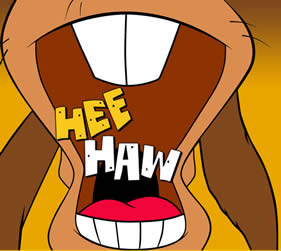
Episode 7 – The donkey that wouldn't die
 Direct link to mp3.
Subscribe to Dreamtime
[Dylan Intro – "Mothers" episode]
[HEE HAW Theme]
"The critics are unanimous...but watch it anyway!"
This is the Dreamtime podcast - occasional commentary on Bob Dylan's Theme Time Radio Hour weekly show.
Episode 7 – The donkey that wouldn't die
Who knew Dylan loves corny old jokes? Who knew that he liked HEE HAW? Well, maybe the second is easier to understand than the first.
HEE HAW was launched in 1969 by two Canadian TV producers as a country music version of NBC’s popular Laugh-In. If you had seen Laugh-In, you immediately recognized the model: quick cuts; pretty girls wearing the minimum possible for network TV, catch phrases, stupid jokes. HEE HAW just substituted corn-pone for Laugh-In's pop references. But HEE HAW had one thing that Laugh In didn't… country music, often very good country music,
Buck Owens, with twenty Number 1 hits already under his belt, taped the pilot of HEE HAW in 1968. CBS picked it up as a summer replacement for The Smothers Brothers Comedy Hour, canceled because of Tommy Smothers ongoing war with network censors over the shows pro-drug and anti-war humor. CBS picked up a 13 -show option for Hee Haw, and at Buck’s recommendation the producers hired singer Roy Clark as co-host. The show premiered Sunday, June 15, 1969.
Country music was enormously popular on the radio in the 60s, but had never cracked national television. Like the Smothers Brothers show, whose musical guests had included everyone from the Doors to the Beatles, HEE HAW's secret weapon, and what made it more than a hillbilly Laugh-In, was its music.
Its regulars included Buck Owens, Roy Clark, and Grandpa Jones of course, so it had Grand Ole Opry street cred right from the git-go, and it brought in a couple of big guest stars every week. Guests like Alabama, Roy Acuff, Garth Brooks, Johnny Cash, Crystal Gayle, Merle Haggard, Janis Ian, Waylon Jennings, George Jones, Lyle Lovett, Loretta Lynn, Barbara Mandrell, Roger Miller, Willie Nelson, Dolly Parton, Ray Price, Charley Pride, Charlie Rich, Linda Ronstadt, Kenny Rogers, Roy Rogers, George Strait, The Nitty Gritty Dirt Band, B.J. Thomas, Mel Tillis, Randy Travis, Travis Tritt, Ernest Tubb, Conway Twitty, Boxcar Willie, Tammy Wynette, Hank Williams Jr., and Faron Young, just to name a few.
HEE HAW was so successful during its initial summer run that CBS slotted it into the fall schedule, but it would only last on the network for two years, being killed off in the Great CBS Hillbilly Purge of 19 and 71, which also claimed The Beverly Hillbillies and Green Acres. CBS network suits had decided all three shows had the wrong viewer demographics – that is rural, older and with less disposable income than hipper, younger audiences.
However HEE HAW would really hit its stride in syndication, where niche programming thrives. From 1971 thorough 1997, HEE HAW was playing on some station in America every week.
A total of 585 one-hour HEE HAWs were taped in Nashville, Tennessee. The cast would tape an entire season in June and October each year, freeing them for other pursuits the other 10 months. But Buck Owens had little left to pursue after HEE HAW's success.
"Anybody that’s been on television… when you become a household name, when they can see you once a week, it reduces and diminishes your value." Owens noted in an interview on his web site. "In 1969 I was still havin’'#1 records. As I went along it degenerated into more comedy and a lot less singin’, or doin' those silly little cast songs.
"I enjoyed the Hee Haw people, but from 1980 on I didn’t enjoy it and thought about leavin’, and thought, hell, it’s an easy job and pays wonderful. I kinda just prostituted myself for their money. My music, which I loved, had suffered badly and I knew what it was from: too much ‘Phifft! You Were Gone.' I thought: ‘One more year, I’ll do one more year...'"
Owens finally left HEE HAW in 1986, stating in several other interviews before his death in 2006 that the show had effectively ruined his musical career.
In 1991, HEE HAW tried a new format with a more urban feel and pop-oriented country sound, which succeeded only in alienating its core audience. In its final 1992 season, and renamed Hee Haw Silver, the show featured Roy Clark, who remained with HEE HAW till the bitter end, hosting a mixture of classic clips and new footage.
After the show's syndication run ended, reruns aired on The Nashville Network until 1997. Its 22 years in TV syndication was the record for a U.S. program, until "Wheel of Fortune" surpassed it in 2005.
And the donkey still refuses to die. On July 17, Country Music Television, a cable channel announced that it will begin rerunning the series, starting July 29. In fact, I taped the HEE HAW segments from a CMT HEE HAW marathon last weekend. The show was just as corny as I remember… and the music just as good.
This has been Fred Bals with the Dreamtime podcast - occasional commentary on Bob Dylan's Theme Time Radio Hour.
The only association Dreamtime has is free association. Keep pickin' and a-grinnin' and keep dreaming.
Sources: "A Country Music Laugh-in"; Twangs of nostalgia; The official HEE HAW site
Wednesday, July 19, 2006
Episode 4 - Tiny, I never saw a Toronto Maple Leaf hockey game.

"I tell you, no one knew more about old music than Tiny Tim did." - Bob Dylan
Direct link to mp3
The Bob Dylan/Tiny Tim connection has a long, rich history, which Dylan alludes to in the "Flowers" episode of Theme Time as he introduces "Tip-toe through the Tulips." In Chronicles, Volume I, Dylan writes about their first meeting,
"One of the guys who played in the afternoons was the falsetto-speaking Tiny Tim. He played ukulele and sang like a girl -- old standard songs from the '20s…"
["On the Old Front Porch" excerpt]
Tiny Tim was born Herbert Buckingham Khaury, on April 12, probably in 1932, although in various interviews he gave his birth year as anytime between 1922 and 1932. His first performances -- under the name Larry Love -- took place in 1954, where he won several amateur contests. His professional career began in 1963 or '64 at a lesbian cabaret in Greenwich Village called the Page 3. In a short time, Tiny Tim was well-known in the Greenwich Village music scene, although more as a novelty act than for his deep knowledge of American music.
In Chronicles, Dylan goes on to tell about sharing lunch with Tim, "The best part of working with [Fred Neil ,
In 1967, Dylan and Tiny Tim would meet again, when Tim recorded several songs with The Band – yes The Band – for Peter Yarrow’s seldom-seen rockumentary, "You Are What You Eat." The Band/Tiny Tim collaboration included Memphis, Tennessee, The Sonny and Cher classic, I Got You Babe, and this Al Jolson standard, Sonny Boy.
[Sonny Boy]
According to Tim, Dylan renewed their friendship after hearing he was recording with The Band, and invited him to his Woodstock home. Greeting Tim at at 12 o’clock in the morning. Dylan said, "Tiny, I never saw a Toronto Maple Leaf hockey game."
In the course of conversation, Tim serenaded Dylan with Rudy Vallee’s "Maine Stein Song" and "My Time is Your Time" and played Dylan's own "Like A Rolling Stone" - comparing Dylan's popularity to Valle's. According to Tiny Tim, "After he [heard] the comparison to [Rudy] Vallee and what he meant to me Dylan said, 'Look, do you want a banana before you go to bed?' I said, 'No, I have my own fruit with me.'"
[Maine Stein Song excerpt]
Before retiring for the night, Tim sang an Irving Kaufman song from 1923 called "What's Today Got To Do With Tomorrow (when tomorrow's so far away)", and Dylan in turn played "Cool Water” for him. Dylan also offered Tim a minor part in "Eat the Document," for which he was paid $22.00.
Tim's performance in You Are What You Eat led to his first TV appearance on the popular Rowan and Martin's Laugh-In, where he was an instant sensation, although perhaps not in the way he would have wanted. Perhaps. Tiny Tim seemed to exist in his own space; oblivious to snickers, laughter, and ridicule. In any case, he became a hot TV property, appearing on Laugh-In several more times, as well as on The Ed Sullivan Show, The Jackie Gleason Show, and, of course the Tonight Show. In 1969 in front of an estimated 40 million viewers, he would marry Victoria May Budinger, better known as "Miss Vicki," on The Tonight Show. The couple later had a daughter, Tulip, as Dylan mentions on Theme Time, but lived apart, and divorced after eight years of marriage.
Although the public's taste for Tim's inherent weirdness had faded away by the mid-70s, he never stopped performing wherever and whenever he could, reportedly even joining a circus for a few months in the 1980s. In September of 1996, Tiny Tim suffered a heart attack while performing at the Ukulele Hall of Fame in Duxbury, Massachusetts. Upon his release from the hospital, Tim resumed his concert schedule, but, on November 30 1996, suffered another heart attack in Minneapolis while performing his signature song. He died an hour later. His remains are in the mausoleum of Lakewood Cemetery in Minneapolis, pictured to your left.
A true eccentric who happened to be in the right place at the right time to become a media star, and a lover of the American songbook who dedicated his life to bringing back old, obscure songs, Tiny Tim never let his personal oddities or public reaction interfere with his main mission… singing the songs he loved.
This has been Fred Bals with the Dreamtime podcast - occasional commentary on Bob Dylan's Theme Time Radio Hour weekly show. Dreamtime is not associated with XM Radio, Bob Dylan, or much of anything else. Until next time… think of Tiny Tim, and follow your dreams, wherever they lead.
[Tip-toe through the Tulips excerpt]
*See comments
Sources: Remembering Tiny Tim; Tiny Tim: A Look Back; Chronicles: Volume One by Bob Dylan
Visit the Dreamtime Store
Subscribe to:
Posts (Atom)

