Google
Web Dreamtime
SiteSearch Google

Monday, January 29, 2007

Episode 28 - Psycho Killer, Qu'est que C'est?

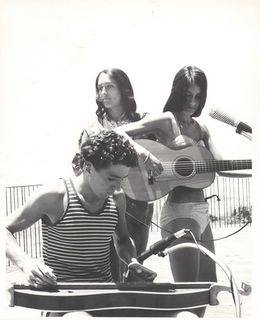
Detail from back cover of the Psychobilly compilation, God Less America.

[Intro]

Episode 28 - Psycho killer, Qu'est que C'est?

Direct link to mp3.

Subscribe to Dreamtime


Use the Dreamtime Player


"Eddie Noack, a singer and a songwriter, originally from Houston, Texas, who recorded for the Starday record label. He wanted to be a journalist. But we have enough journalists, but not enough people who could sing and write like Eddie Noack.

Eddie recorded the song called "Psycho," written by Leon Payne, a song about a serial killer and, quite understandably, it never got a lot of airplay, but has become quite a bit of a cult favorite, as is Eddie Noack himself..." - Bob Dylan on Eddie Noack, Theme Time Radio Hour, "Luck." Originally broadcast January 24, 2007
With a few sentences, Dylan would send me off on a journey that would lead me to Texas snipers, blind singers, 100 proof honky-tonkers, and a country subgenre I never knew existed - Psychobilly.

And people ask why I like Theme Time.

On August 1, 19 and 66, Charles Whitman, an architectural engineering major at the University of Texas in Austin, barricaded himself in the observation deck of the tower of the school's main building with a sniper rifle and various other weapons.

In a 96-minute shooting spree, Whitman killed 14 people and wounded over 30 more. In a note Whitman had left behind at his home, together with the bodies of his mother and wife, Whitman wrote...
"I don't quite understand what it is that compels me to type this letter. Perhaps it is to leave some vague reason for the actions I have recently performed. I don't really understand myself these days. I am supposed to be an average reasonable and intelligent young man. However, lately (I can't recall when it started) I have been a victim of many unusual and irrational thoughts."
Although he made no mention of what was coming next, Whitman apparently knew he wouldn't survive it, asking in the note that his body be autopsied for evidence that there had a physical reason behind his madness. He also left instructions for the care of his puppy.

The first shot came from the Tower at 11:48 the next morning.

Doctors discovered a tumor in Whitman's brain during the autopsy.

Leon Payne was a blind songwriter and singer based in San Antonio. Among old-time country fans, Payne is probably best remembered for the classics "I Love You Because" and "You've Still Got A Place In My Heart," as well as two songs recorded by Hank Williams Sr., "They'll Never Take Her Love From Me" and "Lost Highway."

Payne wrote hundreds of other songs too during his 30-odd year career, which included a stint with Bob Wills & His Texas Playboys in 19 and 38. But he never wrote anything else like "Psycho." Apparently deeply affected by the shootings*, Payne penned a four-minute song with the refrain...
"You think I'm psycho don't you mama?
You better let 'em lock me up."

... until the final, chilling, slightly changed, last line.
* Note - As mentioned in the comments below, Leon Payne's daughter has corrected the story that Psycho was inspired by the Whitman killings. Instead the song sprung from the movie of the same name... which, when you think about it and read the lyrics, makes better sense. Myrtie Le Payne has finished a book on her father which she notes will be published soon. It should be of interest to any Leon Payne fan and, as one, I look forward to reading it - fhb 3/30/08
There's no evidence that Payne ever recorded "Psycho." Maybe just writing the song got whatever demons the Whitman killings had stirred up out of his head. In three years time, Leon Payne would be dead of a heart attack, and "Psycho" would first be recorded by Eddie Noack in 19 and 68.

["Psycho" - Eddie Noack]

Eddie Noack (pictured to your left) was a Houston-born musician who was once described as being "100-proof Texas honky-tonk." Born Armond A. Noack Jr. in 19 and 30 in Houston, Texas, Noack would drink himself to his death 47 years later.

Though he originally set out to be a reporter, graduating from Baylor University with a B.A. in journalism, Eddie Noack became a country singer after he won a talent contest in 1947.

Better known as a radio performer and songwriter than as a recording artist during the first years of his career, Noack finally had a minor hit in 1949 with a cover of "Gentlemen Prefer Blondes," which, as Theme Time Constant Listeners will remember, was played on the "Hair" episode.

But always a second-tier performer and tiring of the business and his lack of success, Noack retired in the late ‘50s to concentrate on songwriting.

Noack attempted a comeback - in fact, several comebacks - during the `60s and `70s, but except for a small, devoted following of rockabilly fans, Bob Dylan numbered among them, he remained largely unknown.

Noack and Payne both recorded for the Starday label at one time and may have known each other through that connection. One way or the other, "Psycho" came into Noack's hands, and he recorded the song on the K-ARK label in 1968.

As well as "Psycho," some other bizarre songs recorded by Noack during that late `60s comeback included "Dolores," and "Beer Drinking Blues," making a virtual Psychobilly trilogy for fans of the genre.

And Psychobilly is a genre, with devoted fans discussing the merits of such songs as Porter Wagoner's "Rubberroom," or his "The Cold Hard Facts of Life" (where a husband exacts revenge on a wife's cheatin' heart with a large knife) or Spade Cooley's "You Clobbered Me." Cooley, as you may remember Dylan mentioning in an aside, beat his wife to death as their 14-year-old daughter looked on.

Some Psychobilly collections - all apparently going out-of-print right after release - include the commercial Rebels & Outlaws: Music from the Wild Side of Life, the appropriately-titled bootleg Death Dealers, and what is generally considered to be the definitive catalog of the genre, God Less America: Country & Western fer All Ye Sinners 'n' Sufferers, featuring as one reviewer put it, "people you've never heard of singing songs you'll never forget."

"Psycho" has been recorded several more times by several more artists, most notably by Theme Time favorite Elvis Costello, who performed it live at Hollywood's Palomino Club and released it as the B-side of "Sweet Dreams" on a UK-release single, as well as on his album Almost Blue. You can also find the song on the 1998 soundtrack for Gus Van Sant's strange shot-for-shot remake of the Hitchcock classic movie, Psycho. If you go to the Amazon page, you'll see as one of the reviewers' comments a posting from Leon Payne's daughter:
"I am of course prejudice[d] to "Psycho" written by Leon Payne, because I am his daughter. But I think Teddy Thompson did a wonderful job on the song and I am sure Daddy would have been proud of his version."
Sources: Starting points for information on Charles Whitman and Leon Payne were their respective Wikipedia entries, both of which have links to additional information. Readers interested in learning more about the Texas Tower shootings while find this "Crime Library" article useful. More about Leon Payne can be found here, as well as a wonderful picture of Payne with his band, The Lone Star Buddies.

There's a paucity of information about Eddie Noack on the Web. But I did find this Answers.com article, which I suspect was also the foundation for Bob Dylan's Theme Time commentary.

If you want to read more about psychobilly, a term that I coined, and which is usually termed "country-psycho" or "psycho-country," a good article to start your journey is Early Rumblings by Peter Orlov. As always, Chet Flippo's Nashville Skyline column was informative.

From a listening standpoint, good luck in finding any of the albums/CDs I cited. God Less America was apparently released on both vinyl and CD, but both versions are long out-of-print. You'll occasionally find one or the other listed on eBay. I would ah, kill, for a copy, if any of my listeners owns it. Ditto with the bootleg Death Dealers. Rebels & Outlaws: Music from the Wild Side of Life is also out-of-print, but much easier for the dedicated collector to find.

***

You've been listening to the Dreamtime podcast – occasional commentary on Bob Dylan's Theme Time Radio Hour.

Dreamtime is researched and written by Fred Bals, and is a Not Associated With production. As the name says, we're not associated with XM Radio, Bob Dylan, or much of anything else.

Some of the music on Dreamtime is provided via the Podsafe Music Network. Check it out at music.podshow.dot com. Our closing theme is performed by Lounge Affaire, courtesy of Christopher Murphy Studio.

We love your email and you can write us at dreamtimepodcast@gmail.com

The Dreamtime top cats are Curly Lasagna and Shaggy Bear. Our announcer is the lovely Jailbait Jones.

Until next time, dream well.

Bill Monroe - Uncle Pen

The Monday morning Dreamtime video - from 1956, Bill Monroe playing "Uncle Pen."


Saturday, January 27, 2007

Nancy Sinatra - Scopitone: These Boots are Made for Walkin'

As mentioned in the earlier Kay Starr post, here's the Scopitone of Nancy Sinatra doing a fab, gear "These Boots are Made for Walkin'" Link courtesy of MudCakeCreature over at the Expecting Rain Theme Time Forums.


Friday, January 26, 2007

Kay Starr - Wheel of Fortune Scopitone


In the "Luck" episode Our Host recommended that his listeners "go Google" Kay, and check out the Scopitone of her singing "Wheel of Fortune" on YouTube.

And here's the link (the poster, for whatever reasons, disabled embedding).

UPDATE: Some kind soul (who is selling Scopitones on DVD) posted a better-quality version that can be embedded.

What's a Scopitone? The word can mean either the ""Film Jukebox" invented in France in the early 1960's (from surplus World War II airplane parts!) and/or the films themselves.

You can learn more about them and watch some samples here.

One of my favorite Scopitones is one of Nancy Sinatra doing "These Boots..." which I've also posted. If you can't find it, use the Video label to your left.

Monday, January 22, 2007

Episode 27 - Hey, Hey, I'm a Monkee


[Intro]

Direct link to mp3.

Subscribe to Dreamtime


Use the Dreamtime Player


[Dylan – "Different Drum" – from "Musical Instruments"]

Besides "Different Drum," some other songs written by Mike Nesmith around the same period included "Pretty Little Princess," recorded by Frankie Laine in 1968, the Monkee's minor hit, "Playing in the Band," and their better-known "Mary, Mary."

"Mary, Mary" was originally recorded by The Paul Butterfield Blues Band in 1966 for their East-West album, and appeared a year later on The Monkees 1967 More of the Monkees.

[Excerpt- Paul Butterfield Blues Band, "Mary, Mary"]

On September 8th 19 and 65, an advertisement appeared in Daily Variety seeking...


Madness!
Auditions
Folk and Rock Musicians-Singers
For Acting Roles in New TV Series
Running Parts for 4 Insane Boys Age 17-21
Want Spirited Ben Frank's Types
Have Courage to Work
Must Come Down for Interview.

Four hundred and thirty-seven Ben Franks auditioned, some of them probably even wearing Franklin-type granny glasses. Among them - a candidate who ended up on the short list - was Steve Stills - who was eventually passed over because he looked "too old." Harry Nilsson and Paul Williams were also on hand.

Contrary to the urban legend,which was probably started by an LA DJ who doubled for Davy Jones, Charles Manson did not audition for The Monkees, unless he somehow conned his way out of Terminal Island Prison for the afternoon.

According to several stories, one of the reasons that Nesmith won his role as Monkee was because he was wearing a wool hat, which he had donned to keep his hair out of his eyes while driving to the audition on his motorcycle. The producers remembered "Wool Hat," although they couldn't remember his name, and called Nesmith back. Nesmith may later have regretted using the prop since it stuck with him through most of the show's run, and for a time The Monkees' publicity referred to Nesmith as "Wool Hat," rather than by name.

As with the Charlie Manson myth, there's a lot of interesting stories about both The Monkees and Nesmith, some of them true, some of them with some basis in fact, and a few spun out of whole cloth.

If you were a Monkees' fan, and of the right age and inclination to read teen fan mags like Tiger Beat, you probably saw the story that Nesmith started playing guitar to gain dexterity back in his hand after a losing encounter with a firecracker.

It made a nice little sidebar to whatever teenybopper story was the lead - which all had titles like "Mike! What's Under That Wool Hat?" - and even got out the subtle message that yes, at least one of The Monkees really could play an instrument.

However, the story was wrong. While Nesmith did injure his hand as a child, accidentally getting it between a sledgehammer and a rock, the result was a paralyzed finger on his right hand that had no effect on his guitar playing when he eventually took it up years later, after being impressed by a Hoyt Axton performance.

Another story you've probably heard is the one about Nesmith's mother inventing Liquid Paper and making herself - and later Mike - millionaires in the process. That one is true. After divorcing Nesmith's father in 1946, Bette Nesmith Graham supported herself and Mike through secretarial work.

In this digital age, probably more than one of my listeners has never touched a typewriter. But I spent the first ten years of my writing career working at one.

In the Typewriter Age - O Youthful Audience - it wasn't a simple matter to correct a mistake. You had to walk through 10 feet of snow... No, wait, that's another story. Anyway, there wasn't a Backspace key or a Select and Delete to get rid of a mistake. What you had instead was a variety of messy correction solutions, Liquid Paper among them. Back in the `40s, Bette Graham realized that,
"...an artist never corrects by erasing, but always paints over the error. So I decided to use what artists use. I put some tempera water-base paint in a bottle and took my watercolor brush to the office. And I used that to correct my mistakes."
Ironically, her bosses gave her grief about using it, but her co-workers started coming to her for the magic paint. In 1956, Bette began marketing her typewriter correction fluid as "Mistake Out," and 23 years later would sell the product to Gillette for $47 million. Nesmith inherited Bette's estate, by then valued over$50 million, upon her death in 1980.

Even Jimi Hendrix figures in a Monkees story. It's pretty well-known that Hendrix opened for The Monkees during their 1967 tour. And, if you're a Hendrix fan, you've probably heard the story that the Daughters of the American Revolution had him kicked off the tour for being "too erotic."

Although Hendrix was "too erotic," God knows, the ladies of the D.A.R. had nothing to do with him leaving the tour. Already familiar with Hendrix, Peter Tork had caught his act at the Monterey Pop Festival and promoted the idea of the Experience joining the Monkees Tour to Dick Clark, yep, the Dick Clark, who had already booked such forgettable acts as The Sundowners and Aussie songbird, Lynn Rendell.

Clark bought into the idea for whatever reasons, Hendrix needed the money and the exposure, and The Monkees got a legit rock-and-roll act fronting for them. Unfortunately, The Monkees barely-pubescent fan base was ah, less than appreciative of Hendrix, and spent most of his act chanting, "We want Davy," as the Experience feedback-wailed through "Purple Haze."

Y'know, it was probably one of those scenes that L.S.D. was invented for.

In any case, with "Purple Haze" on its way up the American charts, Hendrix decided to leave for better audiences than gum-snappin' microboppers who were not creaming in their jeans for -"Eww, an old, he's got to be at least 24! weird black, Oh, Double-Eww! guy" - but instead, God help us all, wanted white bread Davy Jones to get out on stage already and get on with that tambourine and booty-shakin'. Jimi blew the tour after a few gigs that must have been awesome to witness in their weirdness.

As a giggle, music critic Lillian Roxon, who was the official tour reporter, wrote up an article explaining that Hendrix was given the boot after the D.A.R. complained that he was "corrupting the morals of American youth." The article was printed as straight fact, and the legend was born.

One last Nesmith story, this one with a Dylan connection: Nesmith would have a minor hit with the song "Rio" in 1977. Nesmith created a video clip for "Rio," and that video can be traced as the impetus behind the creation of MTV.

Back in 2002, a "Don Wedge" posted a message at a Dylan-related internet group. Wedge claimed to be, "...editing a book of recollections and anecdotes about The Monkees," and further claimed to have the following transcription of a mid-80s Nesmith radio interview...
Interviewer:...Rio's my favourite record of yours actually. It's from the photon wing [sic] album isn't it? You mentioned that Bob Dylan had a connection with that?

Nesmith: You like it huh..it's a funny story in that we met around that time and vaguely discussed me producing him but that didn't work out. I had Rio as an idea but kept getting sidetracked with it and I showed him the chorus and he wrote most of the verses with me just straightening it out later on.

Interviewer: so a collaboration with Bob Dylan!

Nesmith: I wouldn't call it that Bob will put his pen onto something I think but I think most people would be too scared to mention something like that..you know like writer's block.
Hey, hey, Bob collaborated - or at least put put his pen on, whatever the hell that means - something written by a Monkee?

That would be a Big "No". After writing that email posting, "Wedge" disappeared back into the aether, never to post on the subject again. The book never appeared. These here internets being what they are, the story has persisted and is quoted on various sites as fact. But Nesmith states flatly in the FAQ on his home site...
Q. Has Nez ever worked with Bob Dylan?

A. No. Nez has never met or talked to him, although Nez has great respect for his work. The reports about any collaboration between him and Dylan are completely false.
Too bad. It would have been kinda cool.

Sources: Wikipedia articles on Michael Nesmith and Bette Nesmith Graham; Nesmith's official site, Videoranch; Snopes page on Jimi Hendrix and The Monkees Tour; Snopes page on Monkees/Manson non-connection. rec.arts.dylan posting by "Don Wedge" claiming Dylan co-wrote "Rio" (categorically denied by Michael Nesmith); "Rio", by Mike Nesmith (YouTube video).

***

You've been listening to the Dreamtime podcast – occasional commentary on Bob Dylan's Theme Time Radio Hour.

Dreamtime is researched and written by Fred Bals, and is a Not Associated With production. As the name says, we're not associated with XM Radio, Bob Dylan, or much of anything else.

Some of the music on Dreamtime is provided via the Podsafe Music Network. Check it out at music.podshow.dot com. Our closing theme is performed by Lounge Affaire, courtesy of Christopher Murphy Studio.

We love your email and you can write us at dreamtimepodcast@gmail.com

The Dreamtime top cats are Curly Lasagna and Shaggy Bear. Our announcer is the lovely Jailbait Jones.

Until next time, dream well.

Rockin' with Wanda

In this week's video, Wanda Jackson, featured in the "Guns" episode of Theme Time with "This Gun Don't Care Who It Shoots," rips through the rockabilly number, "Hard Headed Woman." From 1958.


Thursday, January 18, 2007

New Dreamtime "off-week" segment - Theme Time Videos

I'm adding a new segment to Dreamtime that I plan on offering on an "off-week" (that is, when I don't have the next podcast in the works) basis... always keeping in mind that consistency is the hobgoblin of little minds and sometimes I'll be posting a podcast that week, sometimes a YouTube video, maybe sometimes I'll post both.

One of the things I miss from the closed White Man Stew Theme Time Forums was someone posting "Theme Time" artist videos found on YouTube. Here's one of my favorites, from 1989 Van Morrison reading the Slim Gaillard passage from "On the Road," as Gaillard himself recreates the scene as described by Kerouac. Dylan read the same passage in the "Moon" episode of Theme Time.


Saturday, January 13, 2007

Episode 26 - Bessie with the Laughing Face?

There are eight million stories I've never heard before in the Big City. Here's another one of them....

Direct link to mp3.

Subscribe to Dreamtime


Use the Dreamtime Player


[Dylan on "Nancy (with the Laughing Face)"]

Sgt. - Phil Silvers - Bilko? He wrote the lyrics to Nancy? Wow.

Now, this is one of the reasons I love "Theme Time." I get to hear artists I've never heard of before - people like Wanda Jackson and JB Lenoir - and I get to hear stories I've never heard before.

Dylan pretty much covers the official story of Nancy. Silvers tells it a bit differently in his 1973 biography, This Laugh is On Me,

"Frank and I were very close. Like Gene Kelly, he ran an open house of good fellowship. Just before my marriage, he celebrated his baby Nancy's birthday party. My present was "Nancy with the Laughing Face."

A few weeks before, I'd been sitting around the pool at Johnny Burke's house with Jimmy Van Heusen. Bessie, Johnny's wife, laughed at one of my jokes, and I remarked, 'Oh, Bessie with the laughing face.'

'Good title for a song,' Van Heusen said.

Burke, who'd won Oscars for his lyrics answered, 'It's my day off. You two guys do it." I did the lyrics in about twenty minutes.

For the birthday party, I changed the words to fit Nancy. Frank liked the song and presented it on his Old Gold radio show."
So, we almost had "Bessie with the Laughing Face," which I suspect wouldn't have been quite as big a hit.

I think Silvers had the radio show and sponsor wrong. All the stories consistently report that Silvers presented the song for Nancy Sinatra's 4th birthday, which would have been June 8th 19 and 44. Through most of `44, Sinatra was doing The Frank Sinatra Program, on CBS Radio on Wednesday evenings from 9-9:30, and the sponsor was Vimms Vitamins.

[Frank Sinatra Program clip]

My research indicates that Sinatra probably sang Nancy to his radio audience for the first time just six days after Nancy's birthday, on June 14th, 1944.

Lana Turner was the guest star, and Frank also sang Dancing in the Dark, and for reasons now lost to history, a song Glinda the Good Witch first sang to the Munchkins in 19 and 38, Come Out, Come Out, Wherever You Are.

According to a June `46 Modern Screen magazine story,
"... No one expected the song to be commercial. The boys had written it for their buddy, Frank had put it on the air for Nancy, and now it could be retired to private life.

So they go overseas and the song’s forgotten and comes time for Frank to do his request numbers. 'What’ll it be, fellas?'

Twenty thousand guys yell: 'Nancy with the Laughing Face—'

Frank looks at Phil and Phil looks at Frank and they’re both thinking: 'Wise guy! You put ’em up to this—'

But it wasn’t a rib. The Armed Forces Radio Service had taken the song off the air and recorded it on V-discs. It was No. 1 in the Stars and Stripes Hit Parade.

Those guys are America, Frank figured. If they like it, so will the folks back home. That’s why he took it out of retirement, plugged it, recorded it, had it published."


There's one more story I found about Silvers, Sinatra, and Nancy, this one about Silvers playing matchmaker between Sinatra and his estranged wife, also named Nancy. This one appeared in the December, 1948 issue of Modern Television & Radio, and should probably be taken with a few of grains of salt, if not the full shaker.

1947 was a tough year for Sinatra. The rumors were going around that his voice was shot, that he was a Red, that he was too friendly with the Mob. On top of that, Frank was having a very public affair with Lana Turner, and ended up getting thrown up out of the house by Nancy.

One night the Sinatras ended up at the same Hollywood watering hole, sitting at separate tables. Silvers talked - and walked - Frank over to Nancy's table, and he ended up singing Nancy to her... and they made up right then and there. A little too pat, but it's still a nice story.

I'm closing out today's show with another version of Nancy, this one recorded at the Villa Venice nightclub in Chicago sometime between November 26 and December 2, 19 and 62.

As I mentioned in Episode 11 of Dreamtime, the Villa Venice was owned by mobster Sam "Momo" Giancana, and the Rat Pack shows put on at his club were rumored to be payment for Giacana fixing the West Virginia primary for JFK. The story goes that the Rat Pack weren't paid for the shows, but that Sinatra did record them for eventual release, and today you can find them on both bootlegs and "official" versions.

If you've heard any Rat Pack show - or seen the DVD of their only known filmed performance - you know it can be a frustrating experience, especially if you're fan of the boys' music.

Why? "If you wanna hear the song, go buy the album," Dean Martin used to say during the Rat Pack shows, because you're not going hear very many complete songs, or even very many songs done very well. It's not what the Rat Pack Summits were about, and it's not what their 1960s audiences wanted.

But, towards this end of this show, when Martin and Davis and Frank had come back for the first encore, some woman in the crowd - with a perfect Laverne and Shirley accent - shouts out to Sinatra, "We drove all the way from Milwaukee!" and asks Frank to sing Nancy.

And, sounding both amused and touched, he does. And after all the bad jokes, parody songs, and interruptions, Sinatra just nails this song to the wall... reminding everyone in the crowd, and his friends, just who he is - The Chairman of the Board.

Here's Ol' Blue Eyes with Nancy...

[Nancy (with the Laughing Face)]

Sources: This Laugh is On Me: The Phil Silvers Story; Is Sinatra Finished?; nancy with the laughing face; The Frank Sinatra Program.

***

You've been listening to the Dreamtime podcast – occasional commentary on Bob Dylan's Theme Time Radio Hour.

Dreamtime is researched and written by Fred Bals, and is a Not Associated With production. As the name says, we're not associated with XM Radio, Bob Dylan, or much of anything else.

Some of the music on Dreamtime is provided via the Podsafe Music Network. Check it out at music.podshow.dot com. Our closing theme is performed by Lounge Affaire, courtesy of Christopher Murphy Studio.

We love your email and you can write us at dreamtimepodcast@gmail.com

The Dreamtime top cats are Curly Lasagna and Shaggy Bear. Our announcer is the lovely Jailbait Jones.

Until next time, dream well.

Sunday, January 07, 2007

Episode 25 – The Name Game


Episode 25 – The Name Game

Direct link to mp3.

Subscribe to Dreamtime


Use the Dreamtime Player


[The Name Game Excerpt]

As usual, a Dylanesque statement - this time from Episode 35, the "Women's Names" episode - got me to thinking.

Our Host states a couple of times in that show that they could have done an alphabetical 26-song Theme Time using women's names and, mid-way through the show says, "Don't believe me...?" and precedes to list 26 names, some of them fairly unusual.

So, with a little research, I came up with a list using those names... well, kinda.

Rules were that I had to semi-program it as an episode of Theme Time. I had moderate success with that. I'm not sure Mr. D. would let some of my picks on the show , and there's not enough country or R&B).

Plus I'm stuck on three. I think Dylan says "Kathryn" but I'm not a 100 percent sure, and if it is Kathryn, damned if I can find a song about her. K-K-K-Katie, yes, Kathryn, no.

I have no clue on the spelling of the "O" name, and haven't made up my mind whether it's Irish, Welsh, or African. Whatever it is, me I'd go with Hamlet's drowned sweetheart instead, who has had dozens of songs written about her. I think she's even made a couple of appearances in Dylan tunes. (Note: I've decided he's saying, "Olivia." See the full list below.)

And I've come up with zip for "Quincy," at least as it concerns women. I could program the theme music from the old TV show, of course [Theme from "Quincy"]

If any of my listeners wants to take on "K" "O" and "Q" feel free to leave a comment on the Dreamtime blog. Or if you want to offer alternate picks – especially country and R&B – that fit better in the Theme Time Schemes and Dreams, go right ahead.

Here's a few highlights from my Women's Names countdown, inspired by Mr. D's recital. The full list is on the Dreamtime blog. Just put Dreamtime podcast in your favorite search engine and we'll be #1 on your hit parade. Let's start our countdown...

1. Abigail – Abigail Beecher, Freddy Cannon

She knows her history from A to Z
She digs the Monkey and the Watusi
It's Abigail Beecher, our history teacher.

An easy one, by Freddy "Boom Boom" Cannon. Abigail Beecher, that sexy teacher, would peak at #16 on the 19 and 64 charts. Freddy's earlier hit was Palisades Park, written by Chuck Barris of "The Gong Show" fame.

4. Diane – Diane, R Crumb and his Cheap Suit Serenaders

There's lots of Diane's you could pick for "Theme Time," including versions by Charles Mingus and Chet Baker, or "My Diane" performed by The Beach Boys. I went for something a little more eclectic – "Diane" performed by R. Crumb and his Cheap Suit Serenaders.

R. Crumb is better known as a cartoonist, and the creator of such `60s icons as Mr. Natural and Fritz the Cat, as well as the being the artist for Janis Joplin's Cheap Thrills album. Although he isn't active with the band anymore, Crumb recorded three albums with the Cheap Suit Serenaders, all songs either from the early 1900s or in that style.

We're skipping down to the Fs now and "Francine." You can take your pick with this one. A natural "Theme Time" play would be Francine, by ZZ Top…

but I decided to go with another Francine, performed by Louis Bellson & His Orchestra.

Francine was named after Bellson's current wife. His first wife was the singer-actress Pearl Bailey. After Bob Hope, Bellson and Bailey hold the second highest number of White House appearances.

The letter "J" is for "Judy" and you could get all mellow and `60s with Crosby, Stills, and Nash's classic Suite: Judy Blue Eyes, a song supposedly written for Judy Collins, but I decided to get all sedated and `80s instead with Judy is a Punk, by the Ramones.

Judy is a Punk was on the Ramones first album – the one that cost $6,200 to make and, as the joke goes, "you wonder where the money went." The song is supposedly about an over-zealous Ramones fan who may, or may not, have later died in a plane crash.

Now, I gotta tell you about this one, I had no idea who "Stacey Adams," was when I picked this for the letter "S". I just liked the idea of Snoop Dog on "Theme Time."

19. Stacy/Staci – Stacey Adams, Snoop Dog and Kokane

Turns out that "Stacy Adams" is neither a girl nor boy, but a shoe company

FROM HEAD TO TOE: WE COVER YOUR STYLE FROM HIP-HOP TO SILKY SOUL.

STACY ADAMS IS ON THE SCENE…

Apparently Snoop added the "e" to avoid the lawyers. But you know what? I think I'll keep it in anyway. You purists can go find your own Stacy.

Sometimes I think I hear Dylan is saying "Wendy," other times "Windy." If it's the first I'd go for Wendy, performed by the Beach Boys.

And, if the second, it'd have to The Association's 1967 # 1 hit.

"Windy" was The Association's second U.S. number-one, following "Cherish" in 1966.

Did you know that the name "Wendy" wasn't in popular use until 1904, when the character "Wendy Darling" was created by J.M. Barrie for his children's book, Peter Pan. A lot of people think Barrie invented the name, but it was in use as far back as 1840, and was once a boy's name.

Speaking of boys, one famous "Wendy" is composer Wendy Carlos, who did the music for "A Clockwork Orange" and was known as "Walter" until her gender switch in 1972.

We're winding up with #26 – that letter "Z." Theme Time probably would have done Zelda, by Pete Townsend, but I'd like to think that they'd consider My Zelda, Allan Sherman's parody of Harry Belafonte's Matilda.

If you're old enough, you'll remember Sherman – one-time comedy writer for Jackie Gleason and Steve Allen – as the "Weird Al" Yankovic of the `60s. There was a time when you couldn't get away from his song about a letter from summer camp, "Hello Mudda, Hello Faddah,"" At least I couldn't get away from it. My father was a giant Allan Sherman fan, had all of his albums, and played them constantly…

… which may be why I know Yiddish as well as I do.

Well. we're at the end of the alphabet and at the end of our show. Go to work on the letters "K" O" and "Q" for me, will you. I hate loose threads.

Sources:

Now largely forgotten, by the time of "The Name Game" Shirley Ellis had been an accomplished songwriter for more than a decade. From December 12, 1964 through June 26, 1965, she dominated Billboard's charts with "The Name Game" (#3), "The Clapping Song" (#8) and the "Puzzle Song" (#78). You can learn more about her and her recordings here.

Info on Allan Sherman, Freddy Cannon, R. Crumb and his Cheap Suit Serenaders, the Ramones, and The Association are from their respective Wikipedia pages.

Wendy Carlos has lived a fascinating life. You can learn more about her here.

There's a lot of conflicting opinions about the origin of the name "Wendy," although the popular conception that that the name was invented by J.M. Barrie seems to be an urban myth. If you're interested, you can follow many links on the subject here.

***

You've been listening to the Dreamtime podcast – occasional commentary on Bob Dylan's Theme Time Radio Hour.

Dreamtime is researched and written by Fred Bals, and is a Not Associated With production. As the name says, we're not associated with XM Radio, Bob Dylan, or much of anything else.

Some of the music on Dreamtime is provided via the Podsafe Music Network. Check it out at music.podshow.dot com. Our closing theme is performed by Lounge Affaire, courtesy of Christopher Murphy Studio.

We love your email and you can write us at dreamtimepodcast@gmail.com

The Dreamtime top cats are Curly Lasagna and Shaggy Bear. Our announcer is the lovely Jailbait Jones.

Until next time, dream well.

The list

1. Abigail – Abigail Beecher, Freddy Cannon

2. Beth – My Beth, Link Wray

3. Carly – Carly Simon, The Groovie Ghoulies

4. Diane – Diane, R Crumb and his Cheap Suit Seranaders

5. Eve – Eve, The Carpenters

6. Francine – Francine, ZZ Top (alt. Francine, Louis Belson & His Orchestra)

7. Gloria – Gloria, Jimi Hendrix (cover of the classic)

8. Hilary – Hotel Hilary, Poutnici (a Czech Bluegrass group)

9. Isabelle (Isabel) – Isabelle Blues. Hot Quartet de France

10. Judy – Judy is a Punk, Ramones (alt: Suite: Judy Blue Eyes, CSNY)

11. Kathryn? (I'd go for Katie Cruel, Karen Dalton)

12. Laura- Dexter Gordon, (alt. Ella Fitzgerald version or just the movie theme)

13. Melissa – Melissa, The Allman Brothers

14. Natalie – Natalie, David Crosby

15. O? (I'd go for Ophelia, The Band): UPDATE: After repeated listenings, I've decided Mr. D. is saying "Olivia," neither African, Irish, nor Welsh. So, our pick here would be Olivia, by The Whispers)

16. Penelope – Penelope, Wayne Shorter

17. Quincy? (Not a clue with this one)

18. Rachel – Little Rachel, Eric Clapton

19. Stacy/Staci – Stacey Adams, Snoop Dog and Kokane

20. Tracey/Traci – Dear Tracey, Sara Hickman

21. Ursula – Ursula, Miles Davis

22. Vivian – Vivian, Nerf Herder

23. Wendy (Windy?) – Wendy, the Beach Boys (Windy, The Association)

24. Xenia – Xenia, Stephen Bennett

25. Yvonne – Yvonne, Marshall Crenshaw

26. Zelda – My Zelda, Alan Sherman (alt: Zelda, Pete Townsend)


Saturday, December 30, 2006

Best wishes for the New Year from Your Station Manager

One of the (many) joys of doing Dreamtime is the feedback from listeners/readers. I'd do it anyway :-), but hearing that people really enjoy the podcast is an added benefit. And sometimes you even hear from one of your heroes...

Dickie "Be-Bop" Harrell - the original drummer for Gene Vincent's Blue Caps - recently dropped me a line, complimenting me on my story about Tommy Facenda (Episode 16 – "Gene Vincent said, 'Bubba, let's go on tour'") and passed on a reunion photo of the Blue Caps. Click on the photo for a larger version.

From Left to Right: Johnny Meeks, guitar; Tommy "Bubba" Facenda, vocals, clapper; and Dickie "Be-Bop" Harrell, drums.

We used to play these shows in the beginning; we had George Jones and Carl Perkins and Roy Orbison and different ones and this and that. We played shows with Johnny Burnette. And at that time, when we were doing all this stuff for them, the big thing for them was just to go out there and do their thing. But hell, we'd go out there and act stupid and fall all over the damn place and jump in the audience and run up and down the aisles and all that. They'd just sit around and look and just think you lost your damn mind! - Be-Bop Harrell
Rockabilly gods. Thanks for writing, Be-Bop! And thanks to all my listeners and to everyone who has written in. The staff of Dreamtime - Jailbait, Curly, Bear, and Your Host wish you a happy and safe New Year. More Dreamtime coming in 2007!

Visit the Dreamtime Store

Friday, December 29, 2006

Episode 24: 1953 and Changes in the Wind

[Intro]

Direct link to mp3.

Subscribe to Dreamtime


Episode 24 - 1953 and Changes in the Wind


Dreamtime closes out 2006 with a turn around the radio dial and a look back at a year when music was about to change forever... 1953.

Harry S. Truman hands over the reins of power to Eisenhower. Peter Pan and the first 3D movie, Bwana Devil, premieres. Ian Fleming publishes the first James Bond novel, Casino Royale. Both the U.S. and Soviet Union announce the development of a hydrogen bomb.

The Korean War ends and the Kinsey Report issues Sexual Behavior in the Human Female. Pat Benatar, Desi Arnaz, Jr., Cyndi Lauper, Alan Moore, and Kim Basinger are all born in 1953.

On January 1, 1953, Hank Williams hired a chauffeur to drive him to his next gig in Canton, Ohio from Knoxville, Tennessee. Williams left in a Cadillac, carrying a bottle of whiskey with him. When his driver pulled over at an all-night service station in Oak Hill, West Virginia, he discovered Williams dead in the back seat. Hank Williams was 29.

Williams' single, the eerily-titled I'll Never Get Out of This World Alive would hit #1 on the Billboard Country Charts on January 24, 1953, and is our first stop in our spin around the 1953 airwaves.

As Dylan says in the Dogs episode of Theme Time, Patti Page's (How Much Is) That Doggie in the Window? - which she recorded on a Thursday, the week before Christmas, a date which also happens to be the date of my birth, December 18, 1952 - would hit the top of the single charts on January 10th, 1953, and remain there until finally booted off by Percy Faith and his Orchestra's Song From Moulin Rouge, also known as Where is Your Heart?

In turn that single would lose the #1 slot to I'm Walking Behind You, sung by Eddie Fisher. Turn on your Dreamtime radio and listen in as we broadcast a collage of popular music from January through June of 1953, including all three, as well as Perry Como's Don't Let the Stars Get in Your Eyes, the first #1 pop single of 1953.

But change, as the man says, was in the wind.

Crazy Man, Crazy, recorded by Bill Haley & His Comets in April 1953, would be the first rock and roll single to make it on the American musical charts, where it peaked at #12. Crazy Man, Crazy may also have been the first rock and roll recording to be played on national television in the U.S. when it was used in the soundtrack of Glory in the Flower, an episode of the CBS anthology series, Omnibus. Interestingly. Glory in the Flower starred James Dean, soon to become iconic in Rebel Without a Cause.

On August 1, 1953, The Orioles' biggest hit, Crying in the Chapel, enters the R&B charts, and will go on to top the charts for the next eight weeks. A decade later, Elvis Presley would cover Crying in the Chapel for his gospel album How Great Thou Art. And Elvis, as Dylan says, would begin his Sun recording career in the summer of 1953, most likely prompted by an article in the local paper on Sam Phillips's recording of the Prisonaires, a group of prisoners from the state penitentiary, as faithful Theme Time listeners already know.

Elvis walked into into 706 Union Avenue and asked to record for the very first time. The two songs he cut were My Happiness, originally written in 1933 by Betty Peterson and Borney Bergantine and That's When Your Heartaches Begin, written in 1940 by William J. Raskin, Billy Hill and Fred Fisher. Elvis later re-recorded that one for RCA as the B side to the single All Shook Up and it peaked at #58 on the Hot 100 Chart...

...and meantime, back in 1953 the doggie was growing up to be a hound dog. We wind up our Dreamtime radio tour with Big Mama Thornton's original 1953 version of Hound Dog, written Jerry Leiber and Mike Stoller. Big Mama Thornton is backed on this cut by by Theme Time favorite Johnny Otis, who also got author credit on the original pressings.

You've been listening to the Dreamtime podcast – occasional commentary on Bob Dylan's Theme Time Radio Hour.

Dreamtime is researched and written by Fred Bals, and is a Not Associated With production.

Some of the music on Dreamtime is provided via the Podsafe Music Network. Check it out at music.podshow.dot com. Our closing theme is performed by Lounge Affaire, courtesy of Christopher Murphy Studio.

We love your email and you can write us at dreamtimepodcast@gmail.com

The Dreamtime top cats are Curly Lasagna and Shaggy Bear. Our announcer is the lovely Jailbait Jones.

Until next time, dream well.

Saturday, December 09, 2006

Episode 23 - In Search of Eddie G.


[Intro]

Direct link to mp3.

Subscribe to Dreamtime


Episode 23 - In Search of Eddie G.

["Here Comes Eddie" - The Eddie G. Singers]

With the Christmas season coming up, it seemed like the right time to take another* look at the producer of "Theme Time," Mr. Eddie Gorodetsky, better known to his fans as "Eddie G."

"Eddie G. has fans?" you say. "And what does he have to do with Christmas?"

Glad you asked.

I mentioned in that earlier show that Eddie was a writer for TV shows such as "Dharma & Greg," "Saturday Day Night Live," the animated Batman series, and various Penn & Teller specials. He also writes liner notes for CDs - which almost appears to be a second career for the man. But Eddie G. may be best known among a small, select circle for his annual holiday mix tapes.

Starting sometime in the early 1980s, Eddie G. began circulating Christmas mix tapes on cassette to family and friends. The tapes were a compilation of weird, strange, forgotten, and sometimes very cool Yule tunes, culled from 45s, albums, and promotional tapes from Gorodetsky's collection; reportedly one of the largest privately-owned Holiday Music collections in the world. By 1999, he was sending out over 1500 copies of his Christmas mix tapes.

In 1990, Columbia released a commercial CD version of Eddie's annual tape mix titled, "Christmas Party with Eddie G." Now out-of-print, but regularly available on eBay. "Christmas Party with Eddie G." could almost be an episode of "Theme Time" with tracks featuring The Skeltons, Louis Prima, Huey "Piano Smith" and the Clowns, Rufus Thomas, and George Jones and Tammy Wynette among others.

One of the very interesting things about "Christmas Party with Eddie G." isn't the music, but the label. I mentioned that Columbia issued it. Actually that isn't quite right. The disc is a "Columbia publication," under the "Strikin' It Rich" label. Strikin' It Rich was created in October of 19 and 90 with the reported goal of "releasing rare and interesting rhythm and blues material."

And who was behind "Strikin' It Rich"? Our Host, Bob Dylan.

"Christmas Party with Eddie G." was apparently the only disc ever released under the Strikin' It Rich imprint. When the disc was re-released in 1998, it came out under the Columbia/Legacy brand.

Not to re-open the debate which broke out about how much involvement Dylan actually has with "Theme Time," but my research makes me increasingly of the opinion that Gorodetsky plays a major role in the creation of "Theme Time," which would make sense, since that's what a "producer" does after all.

I think Dylan is much more than just a voice talent or the name they needed to make "Theme Time" work, although "Theme Time Radio Hour with Your Host, Eddie G." would have had a much smaller audience. A read through Chronicles is pretty clear evidence that many of the "Theme Time" selections are coming directly from Dylan's input. But the man also released a record album in 2006, just finished a major U.S. tour and is now blasting his way through Europe and (I hope) is working on the second volume of Chronicles and God knows what all. It's hard to think he's hauling his record collection along on the bus, or calling home and saying "Will you FedEx out that 78 of 'I Heard The Voice Of A Pork Chop'" for me? I think the last time I saw it was on the kitchen shelf."

I wonder if the scenario at the Abernathy Building when Lee Abrams was finally able to set up a meet with Dylan and "his people" went something like someone on Dylan's side saying, "Y'know, we should get Eddie G. in on this. This is like what we were trying to set up with Strikin' It Rich, but even better, 'cause it's radio! Eddie knows as much about Ol' Weird America music as Bob does, and their tastes run the same."

And now there's some brainstorming every couple of weeks when the next Themes get picked and Eddie and Bob swap playlists and take stuff off and put stuff on until they get something down they like, and the licensing and permission teams of Diane and Debbie go to work and the research team hits Wikipedia for some color and Bob does his commentary and Eddie keeps all the other plates spinning and the balls in the air in order to produce a weekly hour-long radio show.

Who knows? But it's fun to speculate. And I sure wish I had been a fly on the wall when they were setting this up.

So, who is this man, Eddie G. What more do we know about him?

"I started collecting records in high school, in the early 1970's," said Gorodetsky in an interview for CollectorMania!. "I grew up in Providence, Rhode Island, and I remember hearing legends about record stores in Boston that have bins full of these records that you couldn’t find anywhere, and I remember hitchhiking with a couple of friends of mine up to Boston more than once to go to stores in Roxbury and Boston. I ended up living in Boston and working in a half-dozen record stores there."

In the late `70s, Eddie also worked as a columnist for the Boston Rocks music fanzine, and occasionally as DJ for WERS-FM , doing a rhythm and blues show called, "Real Oldies."

A bogus posting, maybe from Eddie G. himself, on a J. Geils Band message board claims that he was also an M.I.T. post-grad, working on a study of earthworms and their reaction to rock and roll, particularly of the J. Geils Band's music. Earthworms aside, Eddie G. was tight with several of the band members, especially Peter Wolf, and would appear on Wolf's solo album "Light's Out" after the breakup of The J. Geils Band. Here's Eddie G. as the radio announcer from Peter Wolf's "Mars Needs Women."

[Mars Needs Women excerpt]

As I noted in my opening, Eddie G. has also worked on several Penn & Teller specials. Penn Jillette calls Eddie, "one of the funniest guys in the world." coming up with up with the idea for a proposed Penn & Teller videogame for people who didn't like violence, "Desert Bus."

The goal of Desert Bus was to drive a bus from Tucson, Arizona to Las Vegas, Nevada, a very long, boring drive, since your bus could not go over 45 miles per hour, and nothing happened. You simply saw desert scenery.


The bus' steering was also slightly out of alignment, meaning the player had to be on the controller at all times. And, the game happened in real time, and couldn't be saved. The only way a player could win was to drive the whole trip in one session. One eight hour plus session.

Rumor had it that if you accomplished the eight-hour trip and made it to Vegas you scored... one point.

"Desert Bus" was never officially released but bootleg copies of the game can still be found on the Web. Another legacy from Mr. G.

If you do a deep enough search, you'll eventually find references to the ubiquitous Eddie everywhere, including cartoonist's Paul Dini's site detailing the adventures of Santa Claus' daughter, Jingle Belle.

"The coolest elf at the North Pole," , says Jingle in her description of Eddie the Music Elf. "[He] has the biggest record collection this side of Greenland. True, a lot of it is Xmas music, but a surprising amount of it does not suck. If you want a great ska version of "Frosty" or a hot zydeco rendition of "Sleigh Ride" Eddie’s the man to see. Each year Eddie descends into his subterranean subarctic Xmas record vault to blend the familiar, the obscure and the just plain weird into a holiday mix."

Writer, musicologist, Mix Master, cartoon character, game inventor, radio producer, Eddie G. seems to have re-invented himself as many times as Bob Dylan himself. Where he'll appear next, no one knows, but whatever he does next, you can bet it will be interesting.

["So Long Eddie" - The Eddie G. Singers]

This had been Fred Bals with the Dreamtime podcast – occasional commentary on Bob Dylan's Theme Time Radio Hour. Dreamtime is a Not Associated With production, and indeed, is not associated with much of anything. Special thanks to the contributors at the Theme Time message boards. Dreamtime's opening segment provided by Jailbait Jones. Background music for this podcast was provided by Kimo Watanabe, via the Podsafe Music Network. Our closing theme is performed by Lounge Affaire, courtesy of Christopher Murphy Studio.

Until next time, dream well.


*Dreamtime's first look at Eddie G. can be found here.

Sources: The J. Geils Band Message Board; A Christmas Yuleblog; Doo-Wop Around the Christmas Tree; Whistle Bait: 25 Rockabilliy Raveups; Interview with Paul Dini; Penn Jillette discusses unreleased game; CollectorMania! - When L.Ps.s Roamed the Earth (Acrobat document)

Monday, November 27, 2006

Episode 22 - All Along the Watchtower


Direct link to mp3.

Subscribe to Dreamtime


[Intro]

Episode 22 – All Along the Watchtower

This is another one of the shows that decided to write itself, and I'm just along for the ride. I'm a regular listener of Brian Ibbott's Coverville podcast, which I commend to your attention if you haven't heard it. As the name implies, Coverville focuses on cover music, sometimes centered around a particular artist or band, sometimes just a hodge-podge of different covers that have caught Brian's ear.

Back in October, in one of those hodge-podge shows, Coverville 'casted a stark, spooky cover of Dylan's All Along the Watchtower played on ukulele – yes, ukulele - by a musician named Kimo Watanabe. I finally got around to listening to that podcast in November and when I heard it, the music literally made me pull over to the side of the road so I could focus on listening.

It's what radio is all about, and doesn't happen often enough anymore. Thanks to the wonders of these here internets, I was able to track down Kimo – who has a Myspace page – sent off an email, and he responded with not only a new version of All Along the Watchtower, but several other pieces of music from the album he's currently working on, Backyard Music. Here's Kimo Watanabe with All Along the Watchtower.

[All Along the Watchtower]

Dylan recorded All Along the Watchtower in 1967, releasing it on John Wesley Harding, his first album after the famous motorcycle accident. At least 30-odd – and probably many, many more than that - bands and musicians have covered the song ; everyone from Elton John to the Kronos Quartet's semi-classical take on the song, to, of course, probably the most famous cover of them all, Jimi Hendrix's version. In fact, the cover may be better-known than Dylan's original. Many people on first hearing it – including my then 13-year-old self – assumed Hendrix had written it.

As the story goes, Hendrix heard the song at a party and the same night went into the studio to record it, backed by Traffic's Dave Mason. Released as a single, it was Hendrix's only U.S. Top 40 hit, making it to #20 in 1968.

I've always thought of All Along the Watchtower as an October and November song; an end of days song, characters trying to stay warn on a bleak wind-whipped tower, snow falling around them, the watchfire embering, and in the distance two figures on horseback approaching, their purpose unknown. Friends? Heralds of an approaching disaster?

These days All Along the Watchtower is a regular war horse in Dylan's encore stable; at my rough count he played it over 60 times during his 2006 tours, thundering it out at the encore close of his shows, the reverse side of the cynical optimism of his other regular encore song, Like A Rolling Stone. If Like a Rolling Stone has become something of the anthem for `60s survivors, All Along the Watchtower may be their elegy. No one is being asked how they feel at world's end.

This is Fred Bals with the Dreamtime podcast, occasional commentary on Bob Dylan's Theme Time Radio Hour, occasional commentary on other things Dylan-related. If you're listening to Dreamtime through iTunes or an RSS Reader, please come by and visit our home page Just put Dreamtime podcast in Google, Yahoo, or whatever your favorite search engine, and we'll be number one on your hit parade.

And if you can't get enough of that good old Theme Time music, take a look at the left-hand column for the Dreamtime Store, where you'll find Amazon links to the music and artists featured on "Theme Time." I have three sections up – Flowers, Mothers, and Weather – and will be creating more as soon as I can.

Closing us out is another cover from Kimo Watanabe, his take on that jazz classic, "The Way You Look Tonight."

[The Way You Look Tonight]

Podcaster or listener, you can find even more of Kimo's music for your pleasure at the Podsafe Music Network.


Visit the Dreamtime Store

Thursday, November 16, 2006

Episode 21 – Def Poets Society


Direct link to mp3.

Subscribe to Dreamtime


[Intro]

Be quiet now and still. Be unafraid:
That hiss and garden tinkle is the rain,
That face you saw breathe on the windowpane
Was just a startled cat with eyes of jade –
Cats worry in the rain, you know, and are afraid.
The nervous laugh that creeps into our room
Is throated in a voice beyond the door.
We hear it once and then no more,
A distant echo tumbling from its loom.
Our time is measured in another room.

We know days pass away because we’re told.
We lie alone and sense the reeling earth.
(You whisper in my ear it has some worth)
And I lean near to keep you from the cold.
There are so many things that must be told.
I speak of lost regimes and distant times,
And afternoons of rain spun into rhyme.
(The patter of the rainfall marks our time.)

As does the waning moon. Or muted sun.
As do the nodding gods who ride the sea.
For even now, alone and still with me,
You sense the bonds that cannot be undone:
Our pulse is in the rain and moon and sun,
We take our breaths together and are one.

Celebration for a Gray Day - Richard Fariña


Put away your themes and schemes, because it's time for the Dreamtime podcast, occasional commentary on Bob Dylan's Theme Time Radio Hour. In the background is Tommy Flanagan's, "Peace," and today we're taking about poetry…

I have to admit that when I first heard Dylan refer to Henry Ward Beecher as a "def poet," in the "Coffee" episode, my initial reaction was, "Huh, I never knew that Beecher couldn't hear." However, when he called Robert Louis Stevenson "slightly def," I realized that there was a joke going on that I wasn't getting. Happily, Google is the balm that cures almost all woes – even those of the slightly thick, and, after trying out variant spellings of "deaf," Google informed my white bread self that Dylan hadn't fixated on poets with hearing problems, but instead was using the hip-hop slang term "def," as in "great," or "definitive."

Who knew?

According to Wikipedia, not necessarily a final authority on any subject, "Def" originated in New York City in the 1980s, made it into the big time and the Oxford English Dictionary in 1993, and subsequently was declared dead by the NYC rap community, and even had a mock eulogy delivered by the Reverend Al Sharpton. Dylan apparently got the idea for the def poetry tag from Russell Simmons, who, in 2002 produced an HBO series called Def Poetry Jam, now in its 5th season, with poets performing their work on stage in front of a live audience. Celebrity guests make frequent appearances on Def Poetry Jam, guests that have included Smoky Robinson, Lou Reed, Jamie Foxx, and the woman about who there is nuthin' not to like, according to Bob Dylan, Alicia Keyes herself.

I bet he taped that show.

Def poets on Theme Time have included: Lawrence Ferlinghetti; one of the last surviving Beat poets who Dylan seems to like a lot, Henry Ward Beecher; the Bard of Avalon, William Shakespeare who has had more Theme Time readings than any other poet; Charles Bukowski; Gregory Corso; Emily Dickinson (Def Poetess); Robert Louis Stevenson (Slightly Def Poet); T.S. Eliot; John Donne; Bertolt Brecht; Gwendolyn Brooks; Samuel Coleridge; Edgar Allan Poe; Lord Buckley; Alexander Pope; the Def Bostonian, Anne Sexton; James Joyce, Rainer Maria Rilke; Christopher Marlowe; Percy Bysse Shelley, and Frosty Poet, Robert Frost.

On "Theme Time," Dylan returns to a time of free-form radio when a DJ – especially those on the graveyard shifts – was as likely to read a poem to his or her audience as to spin a platter. Free verse, the ode, the ballad, the haiku, the limerick, palindrome, villanelle, quatrain, sonnet, sestina, and my personal favorite, the clerihew. By any name, if it uses some form of meter, metaphor and rhyme, as far as I'm concerned, it's poetry. To reverse Mata Hari's quote in the "Dance" episode, "The poem is a dance in which each word is a movement."

Richard Fariña was many things, musician, author, poet; contemporary of Thomas Pynchon and Dylan, a charming rogue from all reports, his charm dependent on your tolerance for rogues. Dylan gives Fariña only a passing mention in Chronicles, dismissing him in a line as just someone else who was in on the Village music scene. That's a little surprising, if you've read David Hajdu's Positively 4th Street, but, on the other hand that gossipy book may be one of the reasons Fariña isn't mentioned more in Chronicles.

By the end of Positively Fourth Street, the only person who doesn't appear to be a calculating hustler is Joan Baez's younger sister, Fariña's wife, Mimi. Or maybe some bad feelings still remain. It's been claimed more than once that Dylan's song "Positively 4th Street" was directed at Fariña, who was nakedly jealous of Dylan's success.

"It got to Dick," Mimi said in an interview. "That this younger person (Dylan was six years younger) was able to do it a bigger way." Things went bad between Dylan and the Fariñas both because of that jealousy and Dylan's treatment of Joan. Perhaps in counter to Dylan's "Positively 4th Street," Fariña replied with "Morgan the Pirate," a song ending whatever friendship was left, with the refrain, "one or two hard feelings left behind."

Between Positively 4th Street and Michael Gray's ugly portrayal in his so-called Bob Dylan Encyclopedia, Fariña's reputation has taken something of a beating in the past few years. But the bottom line is that he was a talented artist who, at age 29, died much too early to fulfill that talent. Two full albums, one other pieced together after his death, one novel, one collection of short stories. That's all that we have. Dick Fariña would have been 69 this April. It would have been wonderful to have his version of Chronicles. And maybe by now the hard feelings would have been fully left behind.

This is Fred Bals with the Dreamtime podcast, occasional commentary on Bob Dylan's Theme Time Radio Hour. If you haven't been to our home page, come by and visit. Just put Dreamtime podcast in Google, Yahoo, or whatever your favorite search engine, and we'll be number one on your hit parade.
After the poem Celebration for a Gray Day there was the song, which was also the title track of the Fariñas first album. A song without words, here's "Celebration for a Gray Day."